
By EIV Diagnostics · November 29, 2026
Choosing a Pathology Lab: What to Check Before You Send or Book
How to choose a pathology lab: accreditation, pathologist training, turnaround, pricing and specimen collection, with the checks patients and physicians should run.
The right pathology lab is one that is accredited and CLIA-certified, staffed by board-certified pathologists with training in the specialty your sample needs, clear about turnaround and price, and easy to reach for collection. At EIV Diagnostics, an independent laboratory in Fresno, California, we built our service around those points: board-certified pathologists, CAP-accredited quality standards, molecular, dermatopathology and digital pathology capability, and mobile phlebotomy that brings the blood draw to your home or office.
This guide is for patients who want reliable tests, physicians who send specimens, and anyone who needs a skin biopsy read well. It covers what to verify, how to verify it, and what to ask before you commit.
TL;DR
- Choose on quality first. The CLSI guideline on referral laboratories says selection should rest primarily on quality of service, not on cost, proximity or a salesperson’s claims.
- Verify two things yourself: the lab’s CLIA certification and its accreditation, for example from the College of American Pathologists (CAP).
- For skin biopsies, look for a pathologist with dermatopathology board certification or fellowship training. A 2018 study linked that training to higher diagnostic accuracy.
- Ask about turnaround, how results are delivered, and the price in writing before the sample is collected.
- If getting to a draw site is the obstacle, mobile phlebotomy removes it. EIV Diagnostics offers it from $65 per visit.
Table of Contents
- What a good pathology lab does
- Check certification and accreditation first
- Look at who reads the slides
- Match the lab’s technology to your test
- Ask about turnaround and how results reach you
- Understand price before you collect
- Collection: where mobile phlebotomy changes the choice
- A checklist you can use today
- Our perspective
- Book with EIV Diagnostics
- FAQ
- Sources
What a good pathology lab does
A pathology lab examines blood, tissue and cells to help diagnose disease. Clinical pathology covers blood and body-fluid tests. Anatomic pathology covers tissue and cell samples, such as a skin biopsy read under the microscope. Molecular pathology looks at DNA, RNA and other markers, often with PCR (a method that copies tiny amounts of genetic material so it can be detected).
The CLSI guideline for selecting a referral laboratory (CLSI GP9-A) groups what to evaluate into three areas:
- Quality of service: facilities, equipment, personnel, quality control, quality assurance and instrument maintenance.
- Cost effectiveness.
- Efficiency of service: scope of testing, specimen collection, test ordering, transportation, turnaround time and result reporting.
The guideline’s authors say the decision should rest mainly on the first. That ordering is a useful discipline: a cheap result you cannot trust costs more in the end.
Check certification and accreditation first
Two credentials matter, and they are different.
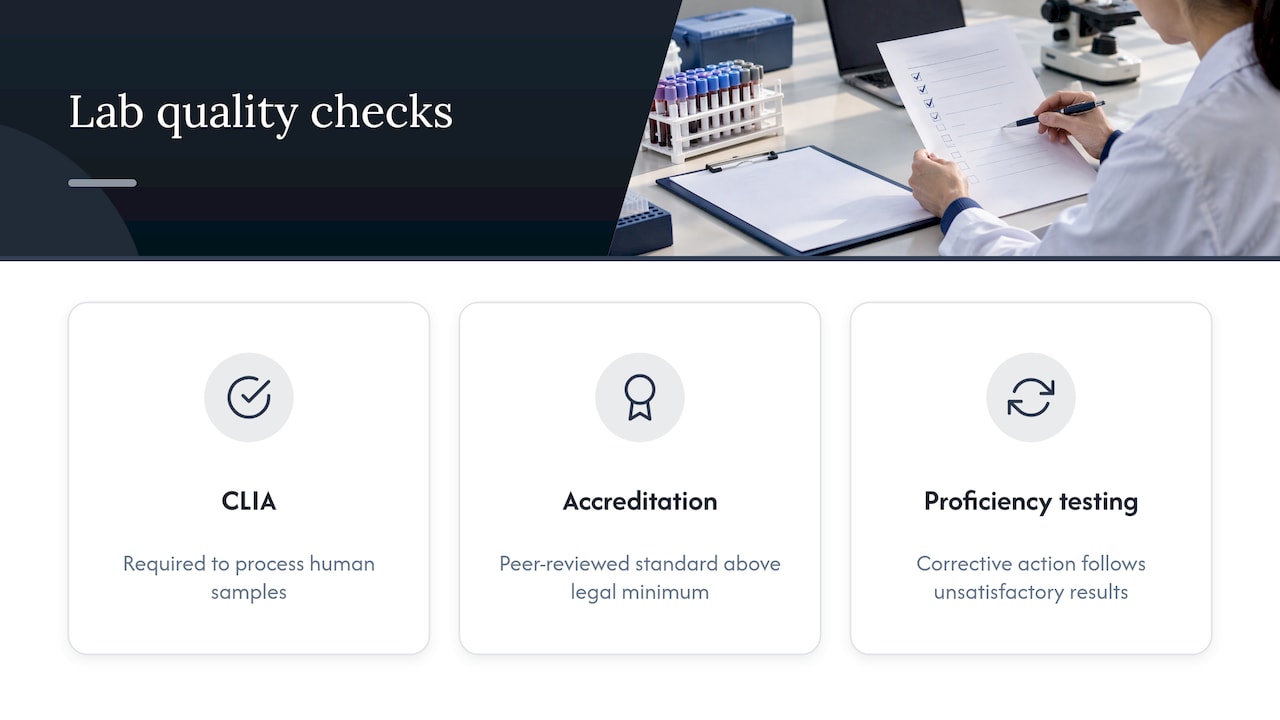
CLIA certification. Under the Clinical Laboratory Improvement Amendments of 1988, a laboratory must be certified to process human samples. The American Medical Association’s patient guide to reliable labs points to the CMS CLIA Laboratory Lookup at qcor.cms.gov, where you can search by name, city or zip code.
Accreditation. This is a peer-reviewed standard above the legal minimum. The Agency for Healthcare Research and Quality (AHRQ) advises patients to ask which lab their doctor uses and why, and to confirm it is accredited by a group such as the College of American Pathologists or The Joint Commission. CAP keeps a searchable accredited laboratory directory. It does not list which tests each lab performs, so you still need to ask about your specific test.
According to CAP’s accreditation program page, CMS has granted CAP deeming authority, so a CAP inspection can stand in for a CMS inspection, and on-site inspections happen every two years. EIV Diagnostics works to CAP-accredited quality standards.
What the regulations demand behind the scenes is also worth knowing. Under 42 CFR Part 493 (eCFR version of December 28, 2024), labs must enroll in an HHS-approved proficiency testing program, treat those samples like patient specimens, and follow a corrective action plan if a result is unsatisfactory. CMS also updated its CLIA survey guidance in 2025, adding 29 proficiency-testing analytes and deleting five, in memo QSO-25-10-CLIA. You do not need to audit this, but you can ask a lab whether it participates in proficiency testing for the tests you need.
Look at who reads the slides
Accreditation tells you about the system. The pathologist tells you about the diagnosis.
Under CLIA rules, a moderate-complexity laboratory director must be an MD or DO certified in anatomic or clinical pathology by the American Board of Pathology or the American Osteopathic Board of Pathology, or meet alternative training and experience criteria (42 CFR Part 493). Board certification is the baseline to look for. To confirm it, see our guide on how to verify a board-certified pathologist.
Subspecialty training matters most for hard-to-read tissue. A 2018 study in the Journal of the American Academy of Dermatology examined how accurately pathologists interpret melanocytic skin lesions (moles and melanoma look-alikes). Accuracy was highest among pathologists with dermatopathology board certification or fellowship training and at least five years of experience. Dermatopathology certification was associated with higher odds of an accurate read (odds ratio 1.41), and so were reading 60 or more such lesions a month and having five or more years of experience.
For a skin biopsy, ask three questions:
- Is the reading pathologist board-certified, and in dermatopathology specifically?
- Does the lab handle a high volume of skin specimens?
- Can the pathologist consult with you or your physician about a difficult case?
Our dermatopathology service is read by board-certified pathologists with subspecialty expertise, and our patient’s guide to dermatopathology consultations explains what to expect.
Match the lab’s technology to your test
A lab should be able to say plainly which methods it uses for your test. At EIV Diagnostics the menu includes:
| Need | Service |
|---|---|
| Routine blood and body-fluid testing | Clinical pathology |
| Skin biopsies and rashes | Dermatopathology, with confocal microscopy available |
| Genetic and infectious-disease markers | Molecular pathology, including PCR |
| Remote review of slides as digital images | Digital pathology |
| Medication-response genetics | Pharmacogenomic testing |
| Tissue, cells, drug testing | Histopathology, cytology and toxicology, listed on our services page |
For molecular work in particular, external quality assessment matters. The international IQNPath guideline says external quality programs should cover pathology review, the molecular test and the report, and that reference labs should be accredited to a recognized standard such as ISO 15189.
If you are comparing providers of dermatology equipment or services more broadly, this dermatology device evaluation checklist shows how a structured set of criteria keeps a decision objective, the same habit that helps when you evaluate a referral lab.
Ask about turnaround and how results reach you
Turnaround depends on the test. The American Cancer Society says routine biopsy and cytology results may be ready in a day or two, while extra stains, additional sections or second opinions add time, and some molecular tests sent to central labs can take two to three weeks. It also notes that many labs send results to portals, but not all do.
Before you choose, ask:
- What is the typical turnaround for this exact test?
- How are results delivered: to the ordering physician, a portal, or directly to you?
- What happens if a case needs a second opinion?
For patients, federal guidance gives you a right here too. CMS’s Appendix C guidance says that on request a CLIA laboratory may give a patient or personal representative access to their completed test reports, and must have a written policy for handling such requests.
Rapid turnaround is one of the things we focus on at EIV Diagnostics, and our local, independent setup in Fresno keeps the lab close to the physicians and patients it serves across Fresno, Clovis, Madera, Visalia and the surrounding Central Valley.
Understand price before you collect
Patients buying tests without insurance should get the price in writing. Under the No Surprises Act, which took effect January 1, 2022, uninsured and self-pay patients are entitled to a written good faith estimate when they schedule a service three or more business days ahead or ask about its cost. If the final bill is at least $400 above the estimate, a dispute process may be available. CMS’s FAQ on good faith estimates adds that same-day or walk-in scheduling fewer than three business days ahead does not trigger the requirement.
If you have Medicare, Medicare.gov explains that Part B covers medically necessary diagnostic lab tests ordered by a health care provider, usually at no cost to you, and that tests Medicare does not consider necessary may not be covered. Ask your doctor what Medicare will cover for your test.
EIV Diagnostics works with providers, with patients who have prescriptions, and with direct-to-consumer customers who want to self-pay for tests. Our self-pay testing page is the place to start if you want lab work without a doctor’s visit.
Collection: where mobile phlebotomy changes the choice
A good lab is not much use if getting the sample to it is hard. Specimen collection is one of the efficiency criteria in the CLSI guideline, and it is where many patients drop out: a long drive, a work schedule, limited mobility.
Mobile phlebotomy brings a trained blood draw to your home or office. EIV Diagnostics offers it from $65 per visit, charged per visit, across our Central Valley service area. For homebound patients, Medicare has a separate rule: CMS Transmittal R3071 allows a specimen collection fee when it is medically necessary for a technician to draw from a nursing home or homebound patient, with a travel allowance, and the claim must be annotated, for example, that the patient is confined to home.
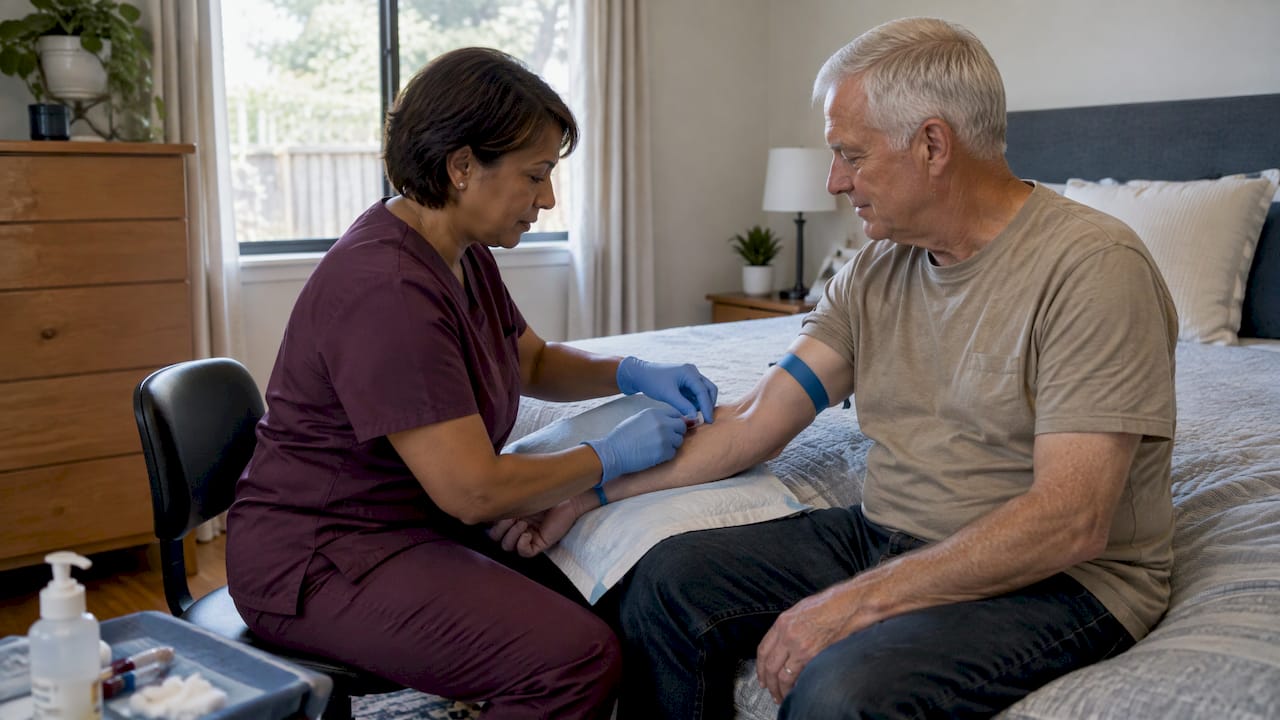
For physicians, mobile draws mean fewer missed appointments and fewer unfulfilled orders. For patients, it means the test actually gets done.
A checklist you can use today
- Confirm CLIA certification in the CMS lookup.
- Confirm CAP or Joint Commission accreditation.
- Ask who reads the slides and whether they are board-certified in the relevant specialty.
- Ask for turnaround on your specific test and how results are delivered.
- Get the price, or a good faith estimate, in writing.
- Ask how the sample will be collected and transported.
- If a result seems wrong, ask for a repeat: AHRQ’s patient guidance says to do so when results do not seem right.
For a fuller look at what a clinical lab does for patients, see our guide to clinical pathology labs. Lab managers who want the regulatory detail can read our explainers on CLIA certification and pathology lab accreditation.
Our perspective
Most people choose a lab by default: it is whoever their clinic or insurer points to. We think the choice deserves the same care as choosing the physician, because the report is what the physician acts on.
That is why we run EIV Diagnostics as an independent lab with board-certified pathologists, CAP-accredited quality standards, and subspecialty expertise in dermatopathology and molecular pathology. Digital pathology and PCR support fast, precise reporting for providers who need to act on a result.
We also think access is part of quality. A test that is never drawn gives no answer, so we bring mobile phlebotomy to homes and offices, and we serve patients with prescriptions, providers, and self-pay customers who want to order tests directly.
Our advice to any reader: verify credentials, ask who reads the slides, and get the price first. We are glad to answer those questions about our own lab.
EIV Diagnostics
Book with EIV Diagnostics
If you are in Fresno, Clovis, Madera, Visalia or elsewhere in the Central Valley, EIV Diagnostics can handle the whole path: collection at your door through mobile phlebotomy, analysis by board-certified pathologists, and reporting to you or your physician. Physicians can send specimens through our services, and patients can order through self-pay testing.
FAQ
Can I order lab tests without a doctor’s visit?
Yes, in many cases. EIV Diagnostics accepts direct-to-consumer self-pay orders as well as orders from providers and patients with prescriptions. Rules on direct access testing differ by state, and insurers such as Medicare generally pay only for tests ordered by an authorized provider, so self-pay is the straightforward route when you have no order.
How do I know a lab is legitimate?
Search for it in the CMS CLIA Laboratory Lookup at qcor.cms.gov, which the AMA recommends, and in CAP’s accredited laboratory directory. Then ask which tests it performs and who signs out the reports.
How long do pathology results take?
It varies by test. The American Cancer Society says routine biopsy and cytology results may take a day or two, while special stains, second opinions or molecular testing can take longer, up to two to three weeks for some molecular tests. Ask the lab for the expected time for your specific test.
Why does the pathologist’s training matter for a skin biopsy?
A 2018 study found higher accuracy in interpreting melanocytic skin lesions among pathologists with dermatopathology certification or fellowship training and several years of experience. Our dermatopathology service is read by board-certified pathologists with subspecialty expertise.
Can someone draw my blood at home?
Yes. EIV Diagnostics provides mobile phlebotomy for homes and offices, from $65 per visit.
Sources
- CLSI GP9-A: Selecting and Evaluating a Referral Laboratory
- AMA: Finding Reliable Clinical Laboratories
- AHRQ: Quick Tips When Getting Medical Tests
- CAP Accredited Laboratory and Biorepository Directory
- CAP Laboratory Accreditation Program
- eCFR: 42 CFR Part 493 (Dec. 28, 2024)
- CMS QSO-25-10-CLIA
- Pathologist Characteristics Associated with Accuracy and Reproducibility (PMC)
- IQNPath EQA guideline
- American Cancer Society: Waiting for Your Biopsy or Cytology Test Results
- CMS State Operations Manual Appendix C
- CMS No Surprises Act Toolkit
- CMS Good Faith Estimate FAQ
- Medicare.gov: Diagnostic laboratory tests
- CMS Transmittal R3071
- Dermatology device evaluation criteria