
By EIV Diagnostics · August 29, 2026
Clinicians and Patients: 1–3 Days to 12 Weeks for Urine Drug Detection
For clinicians and patients: concise urine drug detection windows, common blind spots, and clear steps to obtain chromatography confirmation.
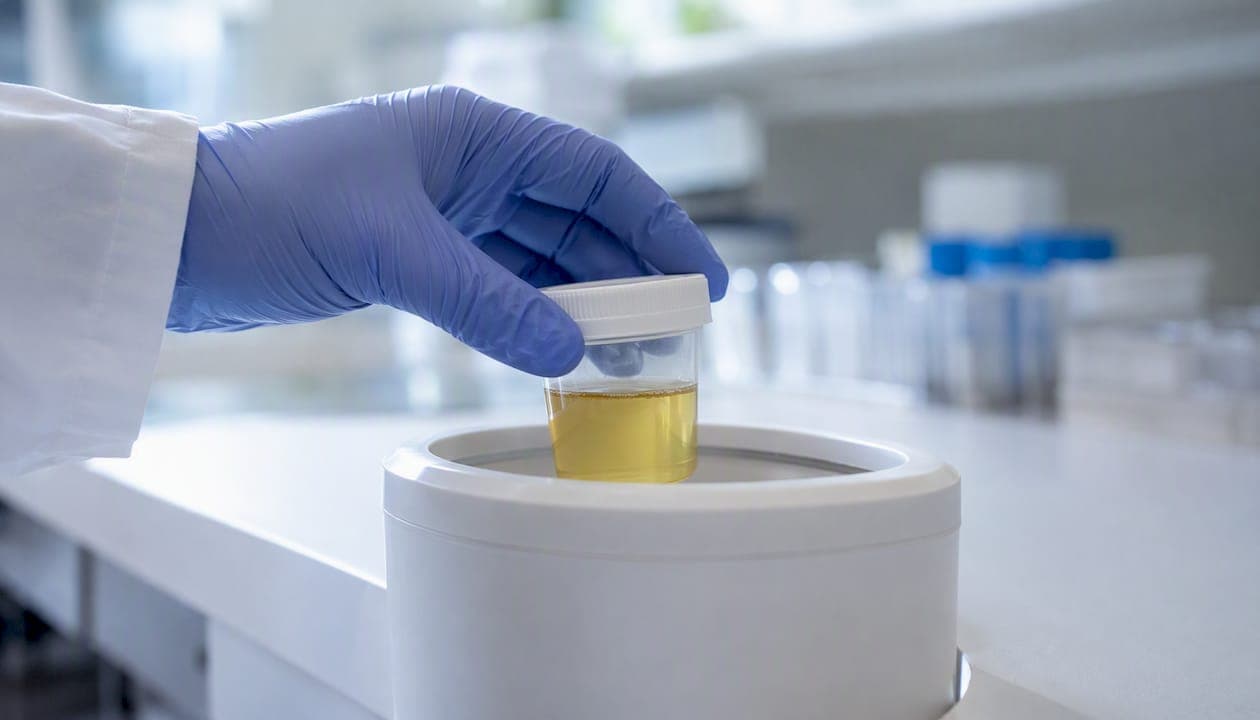
Urine drug detection identifies drugs or their metabolites for a window of hours to weeks, depending on the substance and how often someone used it, but an initial positive is only presumptive. Confirmatory chromatography, either GC‑MS or LC‑MS/MS, is what turns a screening result into a defensible answer, and it’s the step that gets skipped far too often when the stakes are highest.
TL;DR:
- Confirmatory chromatography is essential for verifying positive screening results, as immunoassays often detect drug classes rather than specific substances.
- Detection windows vary widely by drug, with heavy cannabis use potentially detectable for up to 12 weeks, while alcohol metabolites last less than a day.
- Assay cutoff levels and individual factors like hydration and metabolism significantly influence how long a drug remains detectable in urine.
- Fentanyl, many benzodiazepines, and buprenorphine require specific tests, as standard panels often miss these substances altogether.
- Always pair screening results with confirmatory testing and thorough medication history before making clinical, legal, or employment decisions.
Table of Contents
- Urine Test Detection Chart: Windows By Drug Class
- How Does a Urine Drug Test Actually Work?
- Which Drugs Have Detection Blind Spots?
- What Happens During Specimen Collection and Validity Testing?
- Why Do False Positives and False Negatives Happen?
- When Should Providers Order Urine Drug Monitoring?
- What Should You Do After an Unexpected Positive Result?
- How EIV Diagnostics Supports Accurate Urine Drug Detection
- Get Confirmatory Testing Without the Wait
- A Straight Answer on What Urine Testing Can and Can’t Tell You
- Sources
- FAQ
Urine Test Detection Chart: Windows By Drug Class
If you’re searching for a urine test detection chart, the honest answer is that no single number covers every case. Detection time depends on dose, frequency, metabolism, hydration, and which assay a lab runs. Still, published ranges give you a realistic baseline to work from.
Alcohol biomarkers behave differently than most other substances. Ethanol itself clears from urine within hours, but its metabolites EtG and EtS extend the window to roughly 6 to 24 hours after typical drinking, sometimes longer after heavy use. Opioids, stimulants, and benzodiazepines each follow their own curve, and chronic use pushes nearly every category toward the longer end of its range.
| Drug class | Single/occasional use | Frequent/chronic use | Key notes |
|---|---|---|---|
| Alcohol (EtG/EtS) | 6–24 hours | Up to several days | Detects metabolite, not ethanol itself |
| Opiates (morphine, codeine) | 2–3 days | Up to 4 days | Poppy seed ingestion can trigger low-level positives |
| Fentanyl | 1–3 days | Up to 7 days | Not detected on standard opiate immunoassay; needs a specific fentanyl panel |
| Methadone | 4–5 days | Up to 7 days | Requires a dedicated methadone assay |
| Benzodiazepines | 1–4 days | Up to 42 days | Long-acting agents like diazepam accumulate; short-acting drugs may not cross-react on standard IA |
| Cocaine (benzoylecgonine) | 2–4 days | Up to two weeks | Metabolite detected, not parent cocaine |
| Amphetamines/methamphetamine | 3–5 days | Up to 7 days | Some decongestants cause cross-reactivity |
| MDMA | 2–4 days | Up to 5 days | Shares structural similarity with amphetamines on screening assays |
| THC (marijuana) | 2–3 days after single use | Up to 12 weeks with heavy habitual use | Fat-soluble metabolite; hydration and body composition affect clearance |
| Buprenorphine | 3–4 days | Up to about a week | Requires its own immunoassay; not caught by standard opiate screens |
| Barbiturates | 2–4 days (short-acting) | Up to 3 weeks (long-acting) | Half-life varies widely by specific agent |
A few caveats matter more than the table itself:
- Renal function and hydration change clearance rates person to person, so two people using the same dose can test differently.
- Assay cutoff levels determine whether trace amounts register as positive; a lab using a lower cutoff will detect residual drug longer than one using a workplace-standard cutoff.
- Most screening tests detect metabolites, not the parent drug, which is why interpreting “how long does it stay in your system” questions requires knowing which compound is actually being measured.
- Body fat percentage plays an outsized role for THC because it’s stored in fatty tissue and released slowly over time.
None of these ranges are guarantees. They’re population-level estimates, and the only way to know what’s actually in a specific sample is to test it.
How Does a Urine Drug Test Actually Work?
Every reliable urine analysis for drugs runs on a two-step logic: screen first, confirm second. The screening step uses immunoassay technology, antibodies that bind to a target drug class and produce a color or signal change when a threshold concentration is present. It’s fast, usually returning results in minutes, and inexpensive enough to run on thousands of samples a day.
The tradeoff is specificity. Immunoassays detect a drug class, not a single compound, which means structurally similar substances can trigger a positive for something the person never took. That’s cross-reactivity, and it’s the single biggest reason immunoassay results are called presumptive rather than final.
Confirmatory testing solves that problem. GC‑MS and LC‑MS/MS separate and identify individual molecules with far greater precision, distinguishing, for example, amphetamine from a decongestant metabolite that happens to share a similar structure. LC‑MS/MS has become the preferred confirmatory method in many labs because it needs a smaller urine volume and handles complex metabolites with less interference than older GC‑MS platforms.
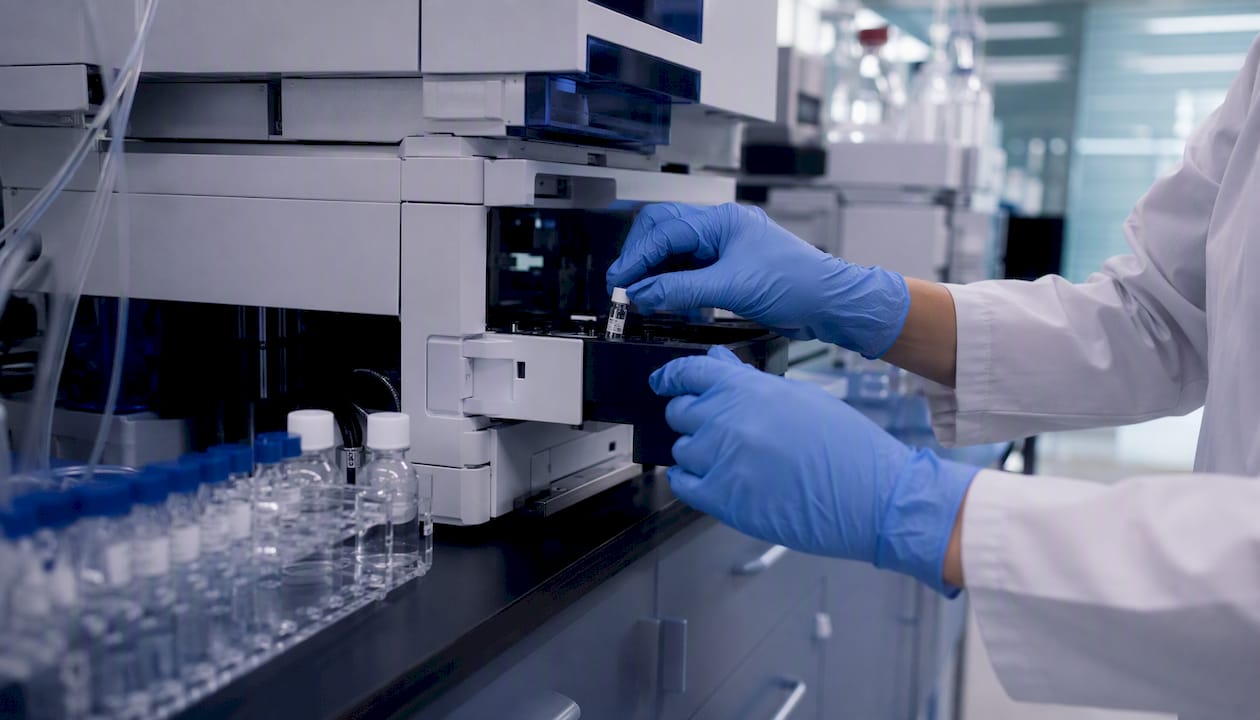
Point-of-care cups and dipstick tests, the kind used in some clinics and workplaces, are immunoassays built into a portable format. They give an answer on-site but carry the same specificity limits as any other immunoassay, and a positive from a cup test still needs lab confirmation before it should influence a real decision.
Turnaround time differs sharply between the two steps. Screening is nearly instant; confirmatory chromatography at a reference lab typically takes one to three business days because it requires specialized equipment and trained staff to run and interpret.
“Below cutoff” doesn’t mean drug-free. It means the concentration measured fell under the threshold the assay is calibrated to flag, so trace amounts can be present and still get reported as negative. Cutoffs exist specifically to reduce false positives from incidental exposure, and clinical cutoffs are often set lower than the federal workplace cutoffs built to filter out passive marijuana exposure or poppy seed consumption.
Pro Tip: If a screening result will affect a medical decision, employment status, or legal outcome, always ask specifically whether the lab ran a confirmatory chromatography test, not just an immunoassay.
Which Drugs Have Detection Blind Spots?
Some of the most consequential testing errors don’t come from lab mistakes. They come from assays that were never designed to catch the substance in question.
-
Fentanyl and standard opiate panels. A routine opiate immunoassay targets morphine-derived compounds and typically misses synthetic opioids like fentanyl entirely. Labs need a dedicated fentanyl-specific assay to catch it, which is a critical gap given how often fentanyl shows up in counterfeit pills.
-
Benzodiazepine cross-reactivity gaps. Standard benzo immunoassays are built around diazepam metabolites, and drugs like lorazepam and clonazepam often show low cross-reactivity, producing false negatives even in people taking them as prescribed.
-
Heroin’s metabolite trail. Heroin converts rapidly to 6-acetylmorphine, then to morphine. 6-AM is the only marker that proves heroin specifically rather than another opiate source, and it has a short window, often under a day, so timing the sample matters.
-
The poppy seed effect. Eating poppy seed foods can produce trace morphine and codeine levels on a urine opiate screen, which is exactly why the federal opiate cutoff was raised. It’s a real phenomenon, not an urban legend, though the levels it produces rarely approach a level consistent with actual opioid use.
-
Buprenorphine’s separate lane. Standard opiate panels do not detect buprenorphine. Any monitoring program involving this medication needs its own assay ordered specifically.
A frequently overlooked detail: urine drug monitoring reviews note measurable false-negative rates for several drug classes when immunoassay results are compared against confirmatory testing, which is exactly the gap chromatography is built to close.
What Happens During Specimen Collection and Validity Testing?
Not every urine collection looks the same, and the difference matters for how much you can trust a result. Observed or supervised collection, where staff directly witness the sample being provided, is typically reserved for situations with a documented history of tampering, legal proceedings, or specific regulatory requirements. Most clinical and diagnostic collections are unsupervised, relying instead on validity testing to catch interference after the fact.
Specimen validity testing checks several markers automatically:
- Creatinine below a certain threshold suggests the sample was diluted, either by drinking excess fluids or adding water directly.
- Specific gravity outside the normal physiological range flags a sample that’s too watered down to be reliably interpreted.
- pH far outside the normal urinary range can indicate an adulterant was added to interfere with test chemistry.
- Oxidants or nitrites at elevated levels point to specific adulterant products sold to defeat drug screens.
When a sample fails one of these checks, labs typically flag it as dilute, substituted, or invalid rather than reporting a straightforward negative, and many protocols call for a recollection under closer observation.
Pro Tip: If you’re asked to provide a specimen for a monitoring program and you’re drinking more water than usual for an unrelated health reason, mention it beforehand. A borderline creatinine result without context can trigger unnecessary retesting.
Why Do False Positives and False Negatives Happen?
The single most important interpretation rule is this: a presumptive positive is not a diagnosis, a legal fact, or grounds for a final decision. It’s a flag that says “test this further,” and treating it as anything more skips the step that actually confirms what’s in the sample.
False positives tend to cluster around a few known culprits. Certain decongestants can mimic amphetamines on screening. Poppy seeds can register trace opiates. Some antidepressants and proton pump inhibitors have been reported to cross-react with benzodiazepine or amphetamine assays in specific circumstances. False negatives happen just as often, usually because the assay wasn’t built to detect the specific compound present, dilution pushed the concentration under the cutoff, or the sample was collected outside the detection window entirely.
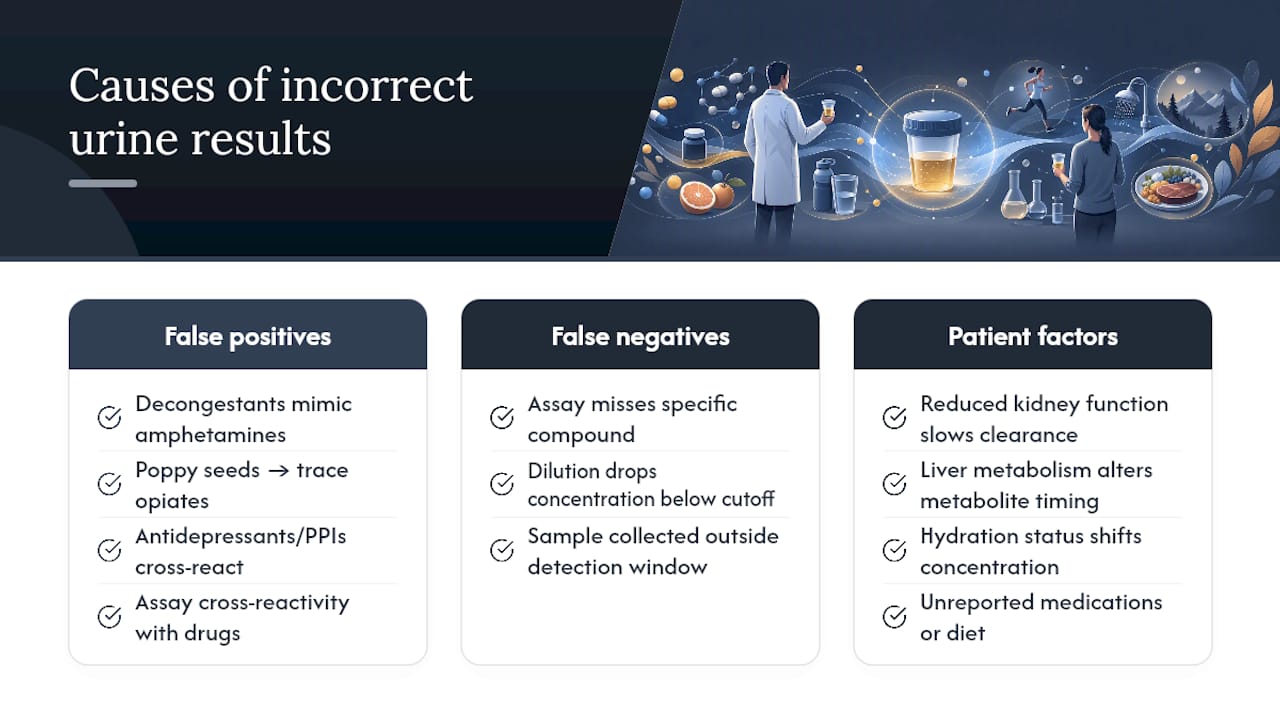
Patient-specific factors shift these outcomes further. Someone with reduced kidney function may clear a drug more slowly, extending detection time well past textbook ranges. Liver metabolism differences change how quickly a drug converts to its detectable metabolite. Hydration status alone can push a borderline result across the cutoff line in either direction.
Clinical reviews of urine drug monitoring consistently point to one fix for all of this: pair every unexpected screening result with a full medication list, recent dietary history, and confirmatory testing before drawing conclusions. A five-minute conversation about what someone has actually taken often resolves what a lab report alone cannot.
When Should Providers Order Urine Drug Monitoring?
Consensus guidance from addiction medicine specialists treats urine drug monitoring as a routine, expected part of managing patients on controlled substances, not a punitive checkpoint. The recommended cadence scales with risk.
- Baseline testing before starting long-term opioid therapy, establishing what’s actually present before treatment begins.
- Low-risk patients are typically monitored around once a year.
- Moderate-risk patients are monitored at least twice a year.
- High-risk patients, based on history or clinical judgment, are monitored three or more times annually.
Analyte selection should track what’s actually been prescribed rather than running a generic panel. A patient on buprenorphine needs a buprenorphine-specific assay; someone on long-term benzodiazepine therapy needs a panel sensitive to the specific agent prescribed, not just diazepam metabolites. Expert panel guidance also stresses that definitive, chromatography-based testing should be used whenever a result will meaningfully affect a care decision.
Just as important is what monitoring is not for. Guidance from SAMHSA on appropriate use of drug testing frames urine monitoring as most effective when it’s discussed openly with the patient and interpreted through a multidisciplinary lens rather than used as an automatic trigger for discharge or discipline. A single unexpected result should prompt a conversation and confirmatory testing, not an immediate administrative action.
What Should You Do After an Unexpected Positive Result?
An unexpected result on a screening test calls for a specific sequence, not a reaction.
- Don’t act on the presumptive result alone. No employment, legal, or major clinical decision should rest on an immunoassay screen by itself.
- Request confirmatory chromatography immediately. Ask the lab specifically for GC‑MS or LC‑MS/MS confirmation of the flagged analyte.
- Preserve the specimen and chain of custody. Labs commonly retain original urine samples for only about 5 to 7 days, so delay is the enemy of getting an answer.
- Document medication history and recent diet. Prescriptions, over-the-counter drugs, and even certain foods can explain an unexpected flag.
- Confirm what forms or consent are required. Some confirmatory requests need a signed release or a specific test order from a provider; ask before the retention window closes.
Pro Tip: Call the testing lab directly rather than the ordering party first. Labs can tell you exactly how many days remain before the specimen is discarded, and that clock is the one that actually matters.
How EIV Diagnostics Supports Accurate Urine Drug Detection
Confirmatory testing only works when the lab running it has the right equipment and the people who know how to interpret it. EIV Diagnostics is an independent pathology laboratory built around exactly that combination: board-certified pathologists, molecular platforms capable of PCR-based confirmatory workflows, and the kind of rapid turnaround that keeps a narrow retention window from becoming a problem.
For readers who received an unexpected screening result and need chromatography-based confirmation before making a decision, EIV Diagnostics offers a direct path, whether you’re a patient ordering testing on your own or a clinician who needs a fast second opinion on an ambiguous result. Mobile phlebotomy adds a practical layer most labs don’t offer: specimen collection at home or in-office, without requiring a separate trip that can eat into a limited retention window. That combination of accuracy and accessibility is what a confirmatory testing decision actually needs when time is short.
Get Confirmatory Testing Without the Wait
If a screening result left you with more questions than answers, EIV Diagnostics gives you a faster route to a real answer than waiting on a generic clinic to schedule a follow-up draw weeks out. As an independent lab with board-certified pathologists and its own molecular testing capability, EIV Diagnostics can run confirmatory chromatography directly, and its mobile phlebotomy service brings specimen collection to your home or office instead of adding another appointment to your calendar during a retention window that’s already ticking down.
Whether you’re a patient who wants a self-pay confirmatory test after an unexpected result, or a provider who needs a lab partner for routine urine drug monitoring, EIV Diagnostics supports both paths without requiring a long-term commitment to a single referral network. Explore molecular pathology testing options to see what confirmatory analytes are available, or check mobile phlebotomy availability to schedule a specimen collection near you before your current sample’s retention window closes.
A Straight Answer on What Urine Testing Can and Can’t Tell You
The biggest misconception about urine drug detection isn’t about detection windows. It’s the assumption that a positive screening result is the end of the story. It almost never is, and treating it that way is where most of the real damage happens, not in the testing itself, but in the decisions made before confirmation ever gets ordered.
What frustrates us most, watching this field from the lab side, is how often the two-step system gets treated as optional friction instead of the safeguard it actually is. Immunoassays were never designed to be the final word. They were designed to be fast and cheap so labs could triage thousands of samples and send the ones that matter to chromatography. When an employer, a court, or even a well-meaning clinician skips that second step, they’re not saving time, they’re gambling with a result that has a known, documented failure rate for cross-reactivity.
The other pattern worth naming: people fixate on detection window charts as if they’re precise countdown clocks, when the research behind them is built on population averages, not individual biology. Two people with the same dose and same drug can produce different results a day apart because of kidney function, hydration, or genetics none of the standard panels account for. That’s not a flaw in testing. It’s a reason to treat every number in a detection chart as a range to reason with, not a deadline to bet on.
If there’s one shift we’d want every reader to make, it’s this: stop asking “did I test positive” and start asking “was that result confirmed.” That single question changes how you respond to a screening result, how you advocate for yourself or your patients, and whether the next decision made is based on a real answer or a probable one.
— EIV Diagnostics
This article is general information, not a substitute for advice from a qualified doctor. Consult a qualified healthcare professional about your own circumstances before acting on anything here.
Sources
The clinical guidance in this article draws from peer-reviewed reviews and federal health resources, including a detailed overview of urine and other drug testing methods, the NCBI Bookshelf’s clinical principles reference on urine drug testing, a review of urine drug monitoring’s clinical utility and limitations, consensus recommendations on monitoring frequency for opioid therapy, and MedlinePlus’s patient-facing overview of drug testing. Readers managing multiple medications may also find value in understanding how genetic testing affects drug metabolism, since individual metabolism differences directly shape detection windows.
FAQ
How Far Back Does a Urine Test Detect Drugs?
It depends entirely on the substance. Alcohol biomarkers fade within roughly a day, while heavy, chronic THC use can remain detectable for up to 12 weeks, with most other drug classes falling somewhere between 2 days and several weeks.
What Is the Fastest Way to Clean Urine Before a Test?
There’s no reliable way to “clean” urine, and attempts to do so, like excessive water loading or adulterants, are exactly what specimen validity testing is designed to catch through creatinine, specific gravity, and pH checks. A diluted or adulterated sample typically gets flagged and often requires recollection rather than producing a clean negative.
How Much Urine Is Needed to Detect Drugs Accurately?
Standard immunoassay screening generally requires a modest sample volume, and confirmatory LC‑MS/MS testing needs even less than older GC‑MS methods, making it useful when only a small volume is available. Labs will specify minimum volume requirements, and a specimen that’s too small may be reported as insufficient rather than tested.
What Color Should Urine Be for a Drug Test to Be Valid?
Urine color itself isn’t a validity marker labs rely on; specimen validity testing instead checks creatinine, specific gravity, pH, and oxidant levels regardless of visible color. A sample that looks unusually clear or diluted visually can be a signal to check those validity markers, but color alone doesn’t determine whether a test result is trustworthy.