
By EIV Diagnostics · July 9, 2026
Fast Testing Results: What Patients in Clovis Need to Know
Discover how fast testing results in Clovis provide quick, accurate medical insights. Make informed choices for your health today!

Fast testing results are defined as accurate medical test outcomes delivered within minutes to hours, rather than the days typical of traditional laboratory processing. The industry term for measuring this speed is laboratory turnaround time, or TAT, and it is the primary benchmark labs use to evaluate diagnostic efficiency. For patients in Clovis who need answers quickly, whether for an urgent health concern or routine monitoring, understanding TAT helps you choose the right testing path. CLIA, the federal regulatory framework governing U.S. diagnostic labs, sets the quality floor every certified lab must meet before reporting any result.
How are laboratory turnaround times measured and optimized?
Laboratory turnaround time measures the total time from when a sample is collected to when a result reaches the ordering provider or patient. TAT breaks into three phases: pre-analytical (collection and transport), analytical (actual testing), and post-analytical (reporting and communication). Each phase adds time, and delays in any one of them push the final result further out.
Turnaround time benchmarks vary significantly by department and test urgency. One clinical study found average TATs of 87 minutes for emergency tests, 118 minutes for outpatient tests, and 130 minutes for inpatient tests, with 87.5% of results meeting established standards. That gap between emergency and inpatient processing reflects how workload prioritization directly shapes speed.

Operational improvements make a measurable difference. Integrated lab models that combine workload prioritization, flexible staffing, and optimized analyzer scheduling reduced median emergency TAT from 52 to 38 minutes and routine TAT from 145 to 112 minutes. That is a 27% reduction for emergency tests and a 23% reduction for routine tests. Labs that treat TAT as an operational metric, not just a clinical one, consistently outperform those that do not.
| Test Category | Baseline Median TAT | Optimized Median TAT | Improvement |
|---|---|---|---|
| Emergency (STAT) | 52 minutes | 38 minutes | 27% |
| Routine | 145 minutes | 112 minutes | 23% |
| Emergency (dept. avg.) | 87 minutes | Not listed | Benchmark reference |
| Outpatient (dept. avg.) | 118 minutes | Not listed | Benchmark reference |
| Inpatient (dept. avg.) | 130 minutes | Not listed | Benchmark reference |
Pro Tip: When scheduling a lab test, ask the facility whether it runs STAT processing for urgent samples. A lab that separates STAT from routine workflow will almost always deliver faster results for time-sensitive needs.
What types of rapid lab tests deliver fast results?
Rapid point-of-care tests like strep throat swabs, flu panels, urinalysis, and blood glucose checks deliver results within minutes to hours during the same clinical visit. These tests enable immediate diagnosis and treatment without waiting days for a result. They work because the analysis happens on-site, using compact analyzers or lateral flow technology that requires no external processing.
Not every test can be completed on-site. Complex tests like lipid panels typically take about 24 hours due to required processing steps, even with automation. Tests involving molecular analysis, tissue pathology, or specialized cultures often require send-out to a reference lab, which adds 1–3 days or more to the timeline.
The table below compares common test types by expected turnaround and typical use case.
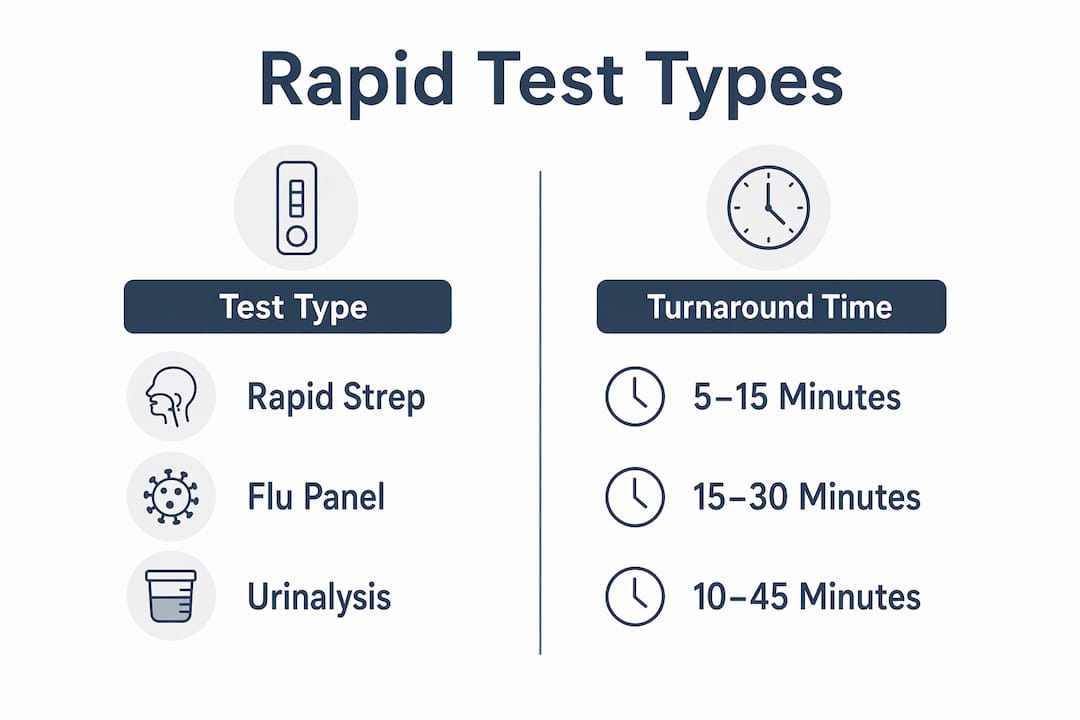
| Test Type | Expected Turnaround | Typical Use Case |
|---|---|---|
| Rapid strep test | 5–15 minutes | Sore throat, fever |
| Rapid flu panel | 15–30 minutes | Flu symptoms, urgent care visit |
| Blood glucose | Minutes | Diabetes monitoring, urgent care |
| Urinalysis | 30–60 minutes | UTI, kidney function screening |
| Complete blood count (CBC) | 1–4 hours | Infection, anemia, general health |
| Lipid panel | ~24 hours | Cardiovascular risk assessment |
| Molecular PCR test | 1–24 hours | Infectious disease, pathogen ID |
| Send-out specialty tests | 1–3 days or more | Complex diagnoses, tissue analysis |
Pro Tip: Before your appointment, call the clinic or lab and ask specifically which tests are run on-site. Many urgent care centers and independent labs in the Fresno and Clovis area offer same-visit results for common panels that hospital labs send out.
What factors influence the accuracy of fast testing results?
Speed without accuracy is worthless. CLIA certification is the federal quality standard every U.S. diagnostic lab must hold to legally report patient results. CLIA certification confirms that a lab meets federal requirements for personnel, quality control, and proficiency testing. Patients using direct-access or at-home testing should verify this credential before ordering.
Ordering tests without a clinical reason creates real risk. Testing without clinical suspicion increases false positives and can trigger unnecessary follow-up procedures. A false positive on a rapid strep test, for example, may lead to antibiotic prescriptions that are not needed. The test result is only as useful as the clinical context around it.
Direct-to-consumer (DTC) lab testing gives patients faster access and more control, but it carries a specific limitation. DTC testing is supplementary to medical care, not a replacement for it, because most patients lack the clinical context to interpret results accurately without provider involvement. A result outside the normal range does not automatically mean disease, and a normal result does not always rule one out.
Patient considerations when selecting fast testing options:
- Confirm the lab holds CLIA certification before submitting a sample.
- Ask whether results will be communicated through a portal, phone call, or provider notification.
- Know the lab’s protocol for critical or abnormal findings before you receive results.
- Avoid ordering panels without a specific clinical reason to reduce false positive risk.
- Plan for a follow-up appointment if results are complex, borderline, or unexpected.
How can individuals get fast testing results safely?
The first step is matching the test type to your actual need. On-site rapid tests work well for acute symptoms like fever, sore throat, or suspected UTI. For monitoring chronic conditions or evaluating cardiovascular risk, a direct-access lab that processes samples quickly and communicates results through a secure portal is a better fit. At-home kits are convenient but best reserved for straightforward screening, not diagnosis.
Verifying lab credentials protects you from unreliable results. Check that any lab you use holds CLIA certification. For independent labs, board-certified pathologists overseeing the process add another layer of quality assurance. Result portals are not substitutes for medical follow-up. Patients should know a lab’s protocol for communicating critical findings before they receive results, not after.
Follow these steps to get rapid lab results safely:
- Identify whether your need is urgent (same-day) or routine (24–48 hours acceptable).
- Confirm the lab or clinic runs on-site testing for your specific panel.
- Verify CLIA certification and ask about board-certified oversight.
- Ask how and when results will be delivered, and what happens if a result is flagged as critical.
- Schedule a provider consultation for any result that is abnormal, borderline, or unexpected.
- For ongoing monitoring, consider a lab that offers mobile phlebotomy to eliminate travel time and reduce pre-analytical delays.
Eivdiagnostics serves both providers and self-pay patients in the Fresno and Clovis area, offering clinical pathology services with board-certified oversight and clear result communication protocols. Labs that establish defined pathways for critical or uncertain results protect both patient safety and trust. That standard should be non-negotiable when you are choosing where to get tested.
Key Takeaways
Fast testing results require both speed and accuracy, and the best labs achieve both by optimizing every phase of the turnaround time process.
| Point | Details |
|---|---|
| TAT is the core benchmark | Laboratory turnaround time measures total time from sample collection to result delivery across three phases. |
| Operational models cut TAT significantly | Integrated lab workflows reduced emergency TAT by 27% and routine TAT by 23% in clinical studies. |
| Rapid tests have real limits | Point-of-care tests deliver results in minutes, but complex panels still require 24 hours or more. |
| CLIA certification is non-negotiable | Always confirm a lab holds CLIA certification before submitting a sample for any direct-access test. |
| Clinical context prevents errors | Ordering tests without a specific clinical reason increases false positives and unnecessary follow-up procedures. |
Speed matters, but context matters more
I have seen patients walk in with a stack of DTC lab results they ordered themselves, genuinely confused by numbers that were slightly outside the reference range. The results were fast. They arrived in a portal within 24 hours. But without clinical context, those numbers created more anxiety than clarity.
The progress in TAT optimization over the past decade is real and worth celebrating. Labs that once took three days to return a routine panel now do it in under two hours with the right operational model. That is a genuine win for patients who need answers quickly. What has not kept pace is patient education around what those results actually mean.
The most common misunderstanding I encounter is that a fast result is automatically a reliable result. Speed and accuracy are separate variables. A rapid test run on a poorly collected sample, or interpreted without clinical history, can mislead as easily as a slow one. The labs doing this right are the ones that invest equally in turnaround time and in the communication infrastructure around results.
Emerging technologies like PCR-based point-of-care platforms and digital pathology are closing the gap between speed and diagnostic depth. Molecular tests that once required a reference lab and three days can now return results in hours. That shift is changing what “fast” means in diagnostics, and it is raising the bar for what patients should expect from any lab they choose.
— Krunal
Eivdiagnostics: fast, accurate diagnostics for Clovis patients
Eivdiagnostics is an independent pathology laboratory serving patients and providers in Fresno and Clovis, with board-certified pathologists overseeing every result. The lab specializes in molecular pathology, digital pathology, and clinical pathology, and offers mobile phlebotomy that brings sample collection directly to your home or office.
Whether you are a self-pay patient, working with a prescription, or a provider seeking reliable diagnostic support, Eivdiagnostics delivers results with the speed and accuracy that clinical decisions require. Explore molecular pathology services or visit Eivdiagnostics to learn about available test packages and direct-access options for patients in the Clovis area.
FAQ
What is a normal lab turnaround time?
Emergency tests average 87 minutes, outpatient tests average 118 minutes, and inpatient tests average 130 minutes based on clinical benchmarks. Optimized labs using integrated workflows can reduce emergency TAT to under 40 minutes.
What rapid tests give same-visit results?
Rapid strep, flu panels, urinalysis, and blood glucose tests typically return results within 5–60 minutes during the same clinical visit. These tests use on-site analyzers that require no external processing.
How do I know if a lab is certified for fast testing?
Confirm the lab holds CLIA certification, which is the federal quality standard for all U.S. diagnostic laboratories. Board-certified pathologist oversight adds an additional layer of accuracy assurance.
Are direct-to-consumer lab tests as accurate as doctor-ordered tests?
DTC tests from CLIA-certified labs use the same analytical methods as provider-ordered tests, but accuracy depends on proper sample collection and clinical interpretation. Without provider involvement, results are harder to interpret correctly.
What should I do if my fast test result is abnormal?
Contact your healthcare provider before drawing conclusions from any abnormal result. Result portals are not substitutes for medical follow-up, and a single out-of-range value rarely tells the full clinical story.