
By EIV Diagnostics · November 1, 2026
PCR for UTI: What Urine PCR Tests Detect and When They Help
Urine PCR can name bacteria and resistance genes within hours, but it does not replace culture. Learn what it detects, its limits, and when a clinician uses it.
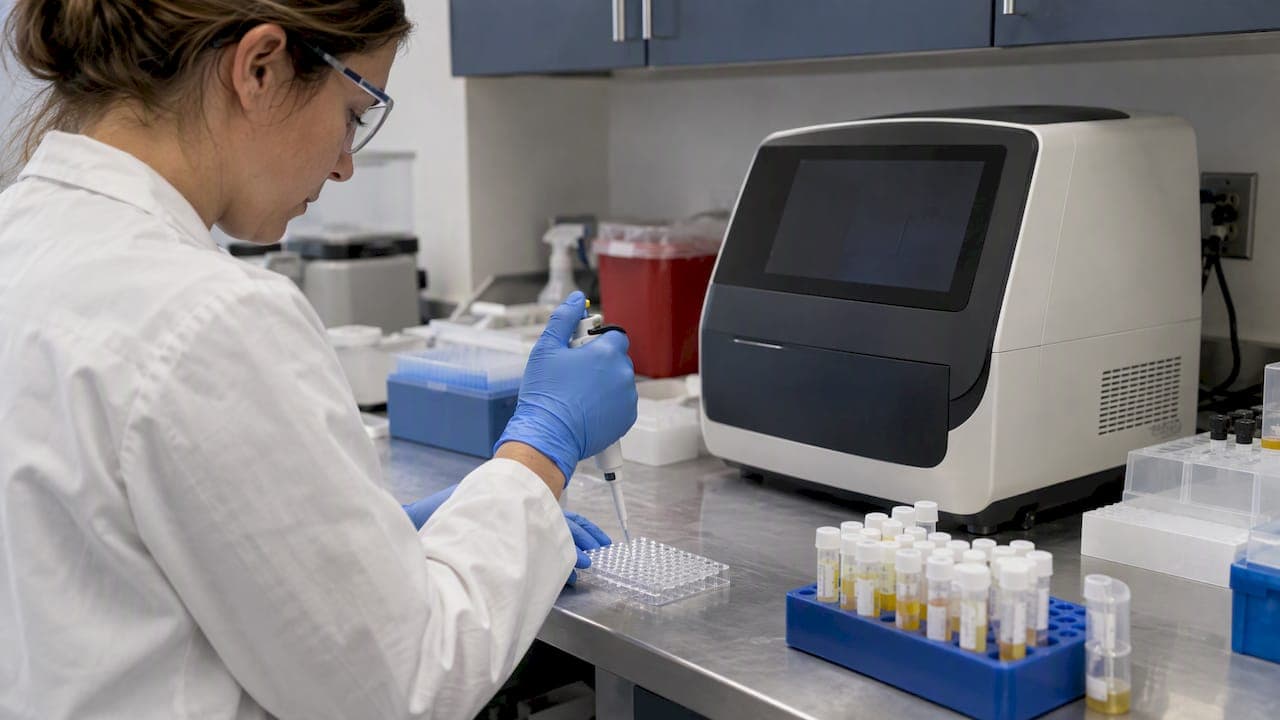
PCR can detect a urinary tract infection (UTI) by finding the DNA of bacteria and other organisms in a urine sample, and it can often return results in hours instead of days. But in the United States it does not replace urine culture. Official guidance says urine PCR is not FDA-approved for diagnosing UTIs and should not stand in for standard culture. Used by a clinician for the right patient, it is a useful second tool. Used alone, it can raise more questions than it answers.
At EIV Diagnostics, an independent pathology laboratory in Fresno, CA, we run molecular tests every day. This guide explains how urine PCR works, where it helps, where it misleads, and what to ask before you or your doctor order one.
TL;DR
- Urine PCR detects pathogen DNA and, on some panels, antibiotic resistance genes. It is not FDA-approved for UTI diagnosis and does not replace urine culture.
- Its strength is speed and the ability to find slow-growing organisms. Its weakness is that it cannot tell a harmless colonizer from an active infection, and it does not measure antibiotic susceptibility directly.
- For a simple, first-time bladder infection, guidelines do not favor routine PCR. It fits better with recurrent, complicated or unclear cases.
- Collect the sample carefully and avoid starting antibiotics before testing if your clinician advises it, because contamination and prior treatment both change results.
- PCR is also used in dermatology, for example for dermatophyte and nail fungus testing, with its own rules.
Table of Contents
- How PCR works on a urine sample
- Is PCR approved to diagnose a UTI?
- PCR vs urinalysis vs urine culture
- What PCR can do well
- Where urine PCR falls short
- When a clinician might order urine PCR
- How to collect a urine sample for PCR
- What is a normal result and what do the numbers mean?
- What does it cost?
- Beyond UTIs: PCR for skin and nail infections
- Our perspective
- Order testing with EIV Diagnostics
- Related reading on molecular testing
- FAQ
- Sources
How PCR works on a urine sample
Polymerase chain reaction (PCR) copies a short stretch of genetic material many times over until it is easy to detect. In a urine test, the lab adds primers, short DNA sequences built to match specific organisms. If the organism’s DNA is in the sample, the primers bind and the target is amplified and flagged.
That is the key difference from culture. Washington State Department of Health guidance explains that molecular UTI testing uses pathogen-specific primers to detect several pathogens, while urine culture counts cells that can actively divide under set conditions. Culture asks, “What is alive and growing?” PCR asks, “Whose DNA is here?”

Most urine PCR panels look for a defined list of bacteria, sometimes a few yeasts, and sometimes a group of resistance genes. If an organism is not on the panel, PCR will not report it. For a broader overview of how this technology works across medicine, see our guide to molecular diagnostic testing.
Is PCR approved to diagnose a UTI?
Not in the way many patients assume. The Washington State Department of Health’s 2023 guidance states that PCR-based urine testing is not FDA-approved for diagnosing UTIs. Medicare’s contractor policy points the same way: CMS notes in its MolDX molecular syndromic panel policy that no FDA-approved panels existed for UTI, so tests without FDA-cleared or approved indications need MolDX registration and a technical assessment.

This does not mean the tests are useless. Many are validated and offered by accredited laboratories as laboratory-developed tests. It does mean the result should be read as one piece of information, alongside symptoms, a urinalysis and, in most cases, a culture.
PCR vs urinalysis vs urine culture
| Feature | Urinalysis (dipstick/microscopy) | Urine culture | Urine PCR |
|---|---|---|---|
| What it shows | Signs of inflammation or infection, such as white cells and nitrites | Living bacteria that grow, with a colony count | DNA of organisms on the panel, sometimes resistance genes |
| Speed | Minutes | Typically a day or more for growth and susceptibility | Hours on many platforms, often 24 to 48 hours in practice including transport |
| Antibiotic susceptibility | No | Yes, measured directly | Inferred from resistance genes only |
| Detects slow-growing organisms | No | Often misses them | Yes, if on the panel |
| Separates infection from colonization | Partly | Partly, using counts | Poorly |
| Role in guidelines | Screening step | Clinical gold standard | Adjunct in selected cases |
The speed claim has support. CMS’s MolDX policy says molecular panel results are often available within minutes to hours, and a Urology Times report describes diagnosis, resistance information and susceptibility testing within 24 to 48 hours when PCR is paired with culture-based workflows. The turnaround you actually see depends on how far the sample travels and how the lab batches it.
What PCR can do well
Find organisms culture struggles to grow
Some organisms grow slowly or need special conditions. A routine culture can come back negative while the patient still has symptoms. PCR can pick up those organisms if they are on the panel, which is why clinicians sometimes use it when culture results do not match the clinical picture.
Return results faster
A patient with a complicated infection, such as one involving a kidney, a catheter or a weakened immune system, may be started on broad antibiotics while waiting. A faster identification can help narrow treatment sooner. CMS’s policy covers UTI panels for symptomatic patients at higher risk of complications and for those seen in urogynecology or urology settings.
Agree with culture on the main organism
In the evidence CMS reviewed, multiplex PCR panels showed at least 90% agreement with standard urine culture for identifying the organism. The same policy cautions that molecular results detect more organisms than culture and must be interpreted clinically. Agreement on the main bug is reassuring. The extra findings are where the trouble starts.
Where urine PCR falls short
It cannot tell colonization from infection
Many healthy people, especially older adults and people with catheters, carry bacteria in the urine without being sick. PCR is sensitive enough to find them. The Washington guidance lists difficulty separating colonization from active infection among the main limits, along with the risk of false positives and the reporting of non-viable DNA, meaning DNA from organisms that are no longer alive.
It does not measure susceptibility
Culture exposes live bacteria to antibiotics and sees which ones stop growth. PCR can only report whether a resistance gene is present. Molecular testing is faster than culture but lacks that phenotypic susceptibility testing, which is why culture remains the clinical standard. The IDSA 2025 complicated UTI guideline recommends choosing definitive therapy based on urine culture identification and susceptibility as soon as results are available, rather than continuing broad-spectrum treatment for the full course.
More organisms can mean more confusion
The American Urological Association’s recurrent UTI guideline says molecular detection, including PCR, is not necessarily beneficial for routine suspected bacterial cystitis, because finding extra organisms can create diagnostic confusion and antibiotic overtreatment. It also notes early evidence that rapid identification of uropathogens and susceptibility may help avoid delayed or inappropriate treatment, but says the effect on diagnostic accuracy was not documented well enough for routine use.
That is a balanced position, and we agree with it. PCR is a tool for a question, not a replacement for judgment.
When a clinician might order urine PCR
Based on the sources above, PCR makes the most sense in situations like these:
- Recurrent symptoms with repeated negative or unclear cultures.
- Complicated infections, where fast identification may change early treatment.
- Symptomatic patients at higher risk of complications, the group the CMS policy covers.
- Urology or urogynecology evaluations, where a fuller picture of organisms is useful.
- Cases where culture and symptoms disagree, for instance persistent symptoms with a negative culture.
It makes less sense for a first, uncomplicated bladder infection in an otherwise healthy person, where a urinalysis and clinical assessment, with a culture when needed, are the standard path. If you have fever, flank or back pain, blood in the urine, nausea, or you are pregnant, see a clinician promptly rather than waiting for any test. If you want to talk through online options for a suspected UTI and when labs get involved, this overview of online UTI care and lab escalation covers the basics.
How to collect a urine sample for PCR
A clean sample matters more for PCR than many people realize, because a very sensitive test picks up skin and genital organisms just as easily as bladder ones. Follow the instructions in your collection kit or from your clinician. In general:
- Wash your hands, then clean the genital area as directed.
- Start urinating into the toilet, then catch the midstream portion in the sterile container.
- Close the container without touching the inside, and label it.
- Deliver it to the lab or hand it to the phlebotomist on the timeline you were given, since samples degrade.
In care facilities, the Washington guidance warns that swabbing incontinence briefs can contaminate urine specimens, particularly for incontinent residents, so a properly collected specimen is needed.
If possible, collect before the first antibiotic dose. Treatment can lower the amount of organism present and change what the test finds, so ask your clinician about timing, and never delay urgent treatment just to collect a sample.
What is a normal result and what do the numbers mean?
People often ask for a “normal range.” For urine PCR there is no universal one. Most reports list each organism as detected or not detected, and some give a semi-quantitative level. The Washington guidance says there is insufficient data to guide interpretation of organism-specific PCR counts, and that the culture threshold used to decide on treatment is not equivalent to PCR results.
In plain terms: a “detected” result is not automatically a diagnosis, and a “not detected” result does not rule out an organism outside the panel. Your clinician reads the report together with symptoms, urinalysis and culture.
What does it cost?
There is no single price. For reference, CMS’s list of top Medicare Part B lab procedures shows that urine culture and colony count is billed under code 87086, while detection of an agent by DNA amplification falls under 87798. PCR panels often involve several of these codes, and coverage depends on your plan and on medical necessity. If Medicare or a commercial plan is involved, billing teams check whether the test meets coverage criteria; this explanation of local and national coverage determinations shows how clinics verify that before ordering.
EIV Diagnostics does not publish a price for molecular pathology testing, so contact us for current information. Our mobile phlebotomy service starts from $65 per visit.
Beyond UTIs: PCR for skin and nail infections
Readers searching for urine PCR often also look up dermatophyte and nail tests, so here is the short version.
Dermatophyte PCR
Dermatophytes are the fungi behind ringworm and similar skin infections. A KOH preparation can confirm that a dermatophyte is present but cannot name the species. For difficult cases such as suspected Trichophyton mentagrophytes genotype VII (TMVII), the CDC clinical overview notes that confirmation requires advanced molecular methods such as sequencing. The CDC also advises collecting specimens before antifungal treatment, if feasible, because prior therapy may reduce diagnostic yield. Its MMWR report adds that topical corticosteroids, including antifungal-steroid combination creams, can worsen tinea and should be avoided.
Onychomycosis PCR
Nail fungus is hard to confirm because clippings are small and fungal culture is slow. A Blue Cross Blue Shield of Michigan medical policy review lists KOH preparation, PAS-stained histopathology, culture and PCR as the main diagnostic tests, and cites a study in which onychomycosis was detected more often by PCR (52.1%) than by culture (33.1%). The practical point is that confirming the fungus before starting months of oral therapy is wise, and a dermatopathology lab can choose the right method for the sample. Our dermatopathology service supports physicians with exactly this kind of skin and nail diagnosis.
Our perspective
We run molecular tests alongside traditional pathology, and we have seen how much a good result depends on the question being asked. A urine PCR is not a shortcut around culture. It is a faster, wider net that works best when a clinician knows why they are casting it.
At EIV Diagnostics, our board-certified pathologists review molecular results in context, and our CAP-accredited laboratory is built around accurate reporting and rapid turnaround. We believe the best use of PCR is to shorten the path to the right answer for patients with recurrent, complicated or unclear infections, always alongside the clinical picture.
We also think collection quality is half the test. That is why we offer mobile phlebotomy, so samples and draws can be handled properly at home or at the office instead of being rushed.
EIV Diagnostics
Order testing with EIV Diagnostics
Whether you are a clinician who needs a reliable partner or a patient who wants to order lab work, EIV Diagnostics works with providers, patients with prescriptions and self-pay customers. Our molecular pathology team handles PCR-based testing, and our self-pay testing page explains how to order without insurance. If getting to a lab is the obstacle, our mobile phlebotomy team can come to you in the Fresno area, including Clovis, Madera, Visalia and surrounding communities.
Talk to your clinician about which test fits your symptoms. We can then take care of the testing itself.
Related reading on molecular testing
PCR is used across medicine, and the same strengths and limits apply. Our articles on PCR for wound infections and PCR testing for bacterial vaginosis show how detection of organisms and detection of resistance are two different questions.
FAQ
Is PCR used to detect a UTI?
Yes, some laboratories use PCR to detect DNA from urinary pathogens, and some panels also report resistance genes. In the US, though, it is not FDA-approved for diagnosing UTIs, and official guidance says it should not replace urine culture. Clinicians usually use it as an addition in selected cases.
Is a urine PCR better than a urine culture?
It is faster and can find organisms that culture misses, but it does not directly measure which antibiotics work, and it can detect harmless or dead organisms. Culture remains the clinical standard for guiding definitive treatment. The two tests answer different questions.
How long do urine PCR results take?
The analysis itself can take hours, and reported diagnosis with resistance information is often described as 24 to 48 hours once transport and processing are included. Your timeline depends on the lab and how the sample is delivered.
Can I get a UTI PCR test without a doctor?
Some labs accept self-pay orders, but a test result needs interpretation, and symptoms like fever, back pain or blood in the urine need prompt medical care. EIV Diagnostics offers self-pay testing, and you can ask us what is available and how results are reviewed.
Sources
- Urine PCR Based Testing guidance, Washington State Department of Health
- MolDX Molecular Syndromic Panels for Infectious Disease, CMS
- Urology Times: advanced urine testing and multiplex PCR
- IDSA 2025 complicated UTI guideline
- AUA/CUA/SUFU recurrent uncomplicated UTI guideline
- CMS top 100 lab procedures by services, CY2020
- CDC clinical overview of TMVII
- CDC MMWR: Trichophyton mentagrophytes genotype VII
- BCBSM policy on PCR testing in onychomycosis