
By EIV Diagnostics · October 28, 2026
Wound Infection PCR: What It Detects and What It Misses
How PCR testing works for wound infections, what it can and cannot tell you compared with swab and tissue culture, and how to read a result with your clinician.
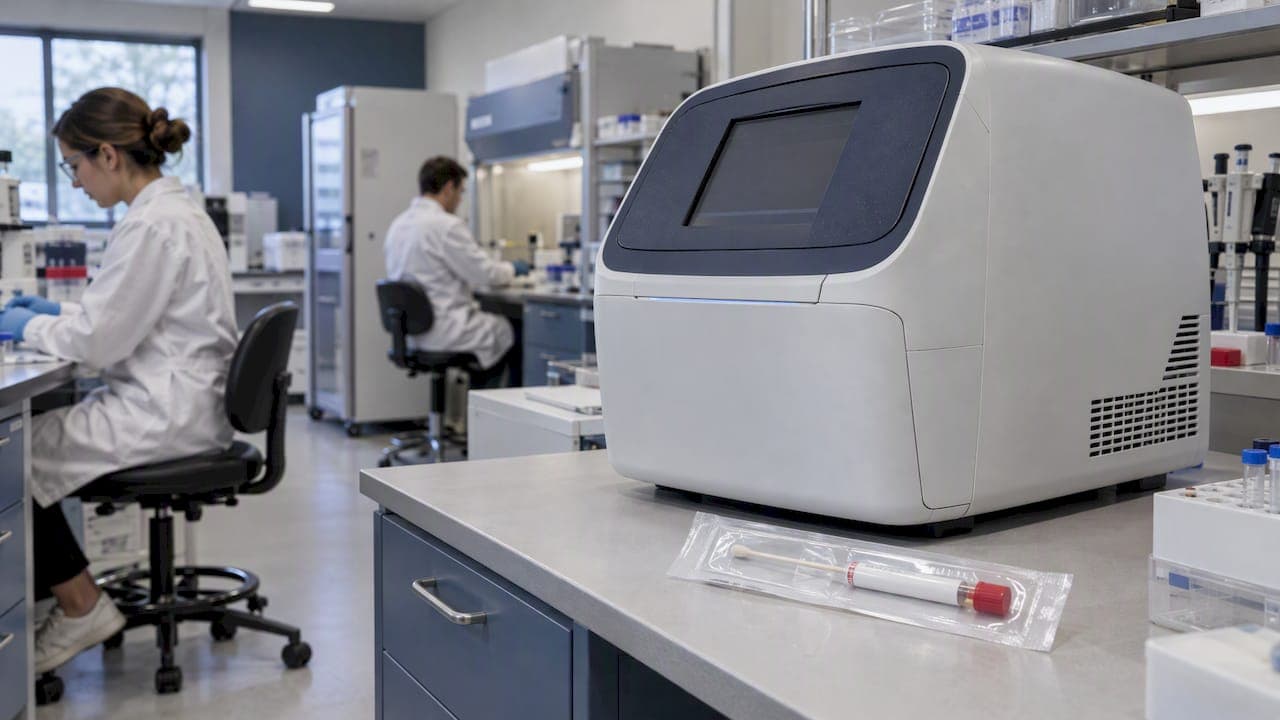
Wound infection PCR is a molecular test that looks for the genetic material of bacteria and other microbes in a sample taken from a wound. It can be fast and broad, and it can pick up organisms that standard culture misses. It does not replace clinical judgment, and for some wounds, culture is still the first-line test. This guide explains what the test finds, how it compares with a swab or tissue culture, and how to read a positive or negative result.
TL;DR
- PCR detects small amounts of pathogen DNA or RNA, including bacterial genetic material, so it can name organisms without waiting for them to grow.
- In chronic wounds, molecular methods find far more organisms than culture, but they cannot tell living bacteria from dead ones, and a positive result is not proof of infection.
- For diabetes-related foot infections, current guidelines still favor conventional culture of a tissue sample as the first-line test.
- A negative PCR does not rule out infection. Results must be read alongside the wound’s appearance, the patient’s history and recent antibiotic use.
- Your ordering clinician decides which test fits your wound. A lab like ours can run the molecular side and report it clearly.
Table of Contents
- What wound PCR actually measures
- Which wounds and infections are evaluated with PCR
- Why PCR finds more than culture
- What PCR cannot tell you
- Wound swab versus tissue culture
- How to read your result
- Perspective: how we think about molecular wound testing
- Getting a wound or skin test through EIV Diagnostics
- Choosing between PCR, swab culture and tissue culture
- FAQ
- Sources
What wound PCR actually measures
Polymerase chain reaction (PCR) copies a short stretch of genetic material many times over until it is easy to detect. According to MedlinePlus, PCR tests can detect small amounts of genetic material from a pathogen, and that includes bacteria. So yes, PCR tests for bacteria, though it does not “see” a bacterium the way a microscope does. It detects a DNA signature that belongs to a particular organism or group.
This is why a wound PCR panel is built around a list of targets. A typical design includes common wound bacteria, some resistance genes and sometimes fungi. A lab can only report what the panel was built to look for, so the target list matters as much as the technique. Broader approaches, such as sequencing a bacterial marker gene, cast a wider net but are used mostly in research and specialized labs.
If you want the general picture of how molecular tests work in a pathology lab, our explainer on molecular pathology tests covers the chemistry and the workflow.
Quantitative versus yes/no results
Some PCR methods report only whether a target is present. Quantitative (real-time) PCR also estimates how much is there. The amount can matter in a wound, because bacteria are common on skin and open tissue. A small amount of a skin organism may be colonization. A large amount of a known pathogen is more worrying. The report should say which type of result you are looking at.
Which wounds and infections are evaluated with PCR
PCR is most often considered when the question is hard to answer with a plain culture. Typical situations include:
- Chronic wounds that have not healed on schedule, such as pressure injuries, venous leg ulcers and diabetic foot ulcers, where several organisms may live together in a biofilm.
- Surgical site or post-trauma wounds that are not behaving as expected, especially after antibiotics have already started.
- Skin and soft-tissue infections where a clinician wants to know quickly whether a specific bacterium, a fungus or a virus is involved.
- Deep or hard-to-culture infections, where organisms such as anaerobes grow poorly in the lab.
Whether a particular wound qualifies is a clinical decision. A wound care physician, podiatrist, dermatologist or infectious disease specialist is the right person to ask, because the choice depends on the wound’s depth, location, healing history, and your overall health.
Why PCR finds more than culture
The strongest argument for molecular testing is the sheer difference in what it sees. In a 2012 study of chronic wounds, 16S DNA sequencing identified 145 unique genera, while aerobic culture identified only 14. Many wound bacteria are slow growers, need no oxygen or live in tight communities (biofilms) that culture handles poorly. The authors used this gap to illustrate how hard it is to understand polymicrobial wound communities with traditional methods alone.

The same study found that relative-abundance scores could help clinicians judge which bacteria were the most abundant and the most likely to show up in culture. In other words, more data can be turned into a useful ranking, not just a longer list.
Speed
PCR can also be faster. A peer-reviewed study in Clinical Microbiology and Infection, published in 2010 and covering 14 aerobic pathogens in chronic-wound tissue, reported that real-time PCR could return results in as little as 4 to 6 hours under optimal conditions, while culture-based diagnosis can take several days. Real-world turnaround is longer than the bench time. Transport, batching, the lab’s run schedule and reporting all add hours. Some tests may also be sent to a specialized laboratory, which lengthens the wait. The IDSA and ASM laboratory utilization guide notes that some tests require specialized labs or have prolonged turnaround times, and lists the samples, volumes, transport devices, times and temperatures each test needs.
What PCR cannot tell you
This is the part most product pages skip.
It cannot separate living from dead bacteria
DNA persists after a bacterium dies. The 2023 IWGDF/IDSA guidance on diabetes-related foot infections points out that molecular techniques identify a more diverse bacterial population, including anaerobes, but cannot distinguish living from dead cells. That can lead to unnecessary use of broad-spectrum antibiotics, and the guidance says the effect on clinical management remains unclear.
It does not prove infection
A wound is infected when the body shows it: spreading redness, warmth, swelling, pain, pus, fever or a wound that stops healing. Finding a bacterium’s DNA in a wound does not by itself mean that bacterium is causing harm. The same guidance stresses that clinical details, such as recent antibiotic use, patient history and signs of infection, are essential for interpreting microbiology results, and that clinicians should work closely with the microbiology staff on how results are reported.
The manufacturer instructions for one commercial real-time PCR wound panel say the same thing in plain terms: a negative result does not preclude infection, and results must be interpreted with clinical observations, patient history and epidemiological information.
It does not automatically choose your antibiotic
Some panels include resistance genes, which can hint at a drug that will not work. That is useful, but it is not the same as growing the organism and testing it against drugs directly. Culture with susceptibility testing is still the standard way to confirm what will work. The 2023 guidelines for diabetes-related foot infections go further: they strongly recommend conventional microbiological techniques, rather than molecular methods, for first-line pathogen identification in soft tissue or bone samples. They do not recommend molecular microbiology in daily practice for foot infections because of high cost, limited availability and the unclear meaning of positive findings.
That guidance is specific to diabetes-related foot infections. It should not be stretched to every wound, but it is a good reminder that PCR is an addition to culture in most settings, not a replacement.
Wound swab versus tissue culture
Readers often ask whether a swab is good enough. The honest answer: it depends on the wound and on the question.
| Surface swab | Tissue specimen (curettage or biopsy) | |
|---|---|---|
| How it is collected | Rubbed over the wound surface | Small piece of tissue taken after cleaning the wound |
| Ease | Quick, minimal discomfort | More involved, done by a trained clinician |
| Risk of surface contamination | Higher | Lower |
| What it represents | Organisms on the surface, which may not be the ones causing deeper infection | Organisms in the tissue itself |
| Best fit | Superficial wounds, or when a tissue sample is not feasible | Suspected deeper or soft-tissue infection |
The IWGDF/IDSA guidance acknowledges that superficial swabs are easier, yet advises collecting an aseptic tissue specimen by curettage or biopsy for culture when a diabetes-related foot soft-tissue infection is suspected. A swab can still be the practical choice for a shallow wound, and a swab can be tested by PCR as well as by culture. What matters is that the sample type matches the question, and that the lab report states what was collected.
Another route is wound fluid. Researchers have described wound exudate as a non-invasive sample for detecting pathogens, but this remains an area of active research, so ask your clinician what sample your lab accepts.
Before you collect anything
- Tell the clinician about any antibiotics, antiseptics or wound dressings used in the past few days. They can change the result.
- Follow the lab’s collection and transport instructions exactly. Time and temperature affect what the lab can recover.
- Do not swab a wound yourself unless your clinician has told you how, and use only the collection kit the lab supplied.
How to read your result
Think of a wound PCR result as one piece of evidence.
Positive for a pathogen. Your clinician will ask whether the wound looks infected, whether the organism is a usual wound pathogen or a common skin resident, and how much was detected. A positive in a wound that looks clean and is healing may reflect colonization. A positive in a red, painful, draining wound is more meaningful.
Negative. This lowers the odds of the organisms on the panel but does not clear you. The infection could involve a microbe outside the panel, the sample may have missed the infected area, or antibiotics may have reduced the amount of DNA. If the wound looks infected, treatment decisions are made on the clinical picture.
Mixed or multiple organisms. Chronic wounds often hold several organisms at once. Relative abundance helps here, and so does a clinician who knows the wound’s history.
The same logic of weighing context applies to other skin sites. Distinguishing infection from simple irritation is a common challenge with new piercings, for example, and guides that explain piercing infection versus irritation show why signs and timing matter as much as any test. If you are unsure whether a wound is infected, do not wait for a lab result: persistent or spreading redness, fever, pus, or a wound that is getting worse should be seen by a clinician promptly. People with diabetes or poor circulation should seek care early, since foot wounds can worsen quickly.

Perspective: how we think about molecular wound testing
At EIV Diagnostics, we run a molecular pathology service staffed by board-certified pathologists, and we work in a CAP-accredited environment. We like PCR because it answers questions culture cannot answer quickly. We are also wary of anyone who sells it as a cure-all.
Our view is simple. Molecular results are most valuable when the clinician who ordered the test and the pathologist who reports it are talking to each other. A report that lists organisms without context can push a prescriber toward broader antibiotics than the wound needs. A report that is read next to the wound’s appearance, the patient’s history and the right culture can help narrow treatment.
For patients, that means two practical things. First, ask what question the test is meant to answer before it is ordered. Second, keep your clinician in the loop on the result, even if you ordered the test yourself. Our role is to make the lab side accurate, timely and understandable, not to replace the clinical judgment of the person treating the wound.
— EIV Diagnostics
Getting a wound or skin test through EIV Diagnostics
EIV Diagnostics is an independent pathology laboratory in Fresno, California, serving patients and providers across Fresno, Clovis, Madera, Visalia and the surrounding Central Valley. Providers can send specimens to our molecular pathology team, and our clinical pathology and dermatopathology services support the wider workup of skin and tissue problems. Browse the full list on our services page.
If you are a patient who wants to order tests without a separate office visit, see our self-pay testing page. Mobile phlebotomy for blood draws at your home or office starts from $65 per visit, which helps when a wound, a cast or limited mobility makes travel hard. Before you order anything online, our guide to ordering lab tests online explains what to check, including a lab’s CLIA status. Availability of specific wound panels should be confirmed with us before you plan around one.
Choosing between PCR, swab culture and tissue culture
A practical way to frame the decision with your clinician:
- Is the wound clearly infected? If yes, treatment often starts on clinical grounds, and a good sample is taken first if possible.
- How deep is it? Deeper or bone-adjacent wounds call for tissue samples, not surface swabs.
- Do you have diabetes or poor circulation? Guidelines for diabetes-related foot infection favor tissue culture first.
- Has it failed to heal despite standard care? This is where adding PCR to culture can help uncover organisms that culture misses.
- Have you already taken antibiotics? Say so. It may change which test is more informative.
- Is speed critical? PCR can be quicker, but only if the lab’s logistics support it.
FAQ
Does PCR test for bacteria in a wound?
Yes. PCR looks for bacterial DNA, and for fungal or viral genetic material if the panel includes those targets. It shows which organisms are present, not whether they are alive or causing harm. Your clinician combines the result with how the wound looks and your history.
Is a wound swab or a tissue culture better?
Tissue is generally more reliable for suspected deeper infection because it avoids surface contamination, and guidelines for diabetes-related foot infections advise it over superficial swabs. A swab is easier and may be fine for shallow wounds or when tissue cannot be collected. Your clinician chooses based on depth, location and your health.
Can a negative wound PCR rule out infection?
No. A negative means the organisms on that panel were not detected in that sample. The infection may involve something else, the sample may have missed it, or antibiotics may have lowered the amount of DNA. Treatment decisions follow the clinical picture.
How fast are wound PCR results?
In research settings, real-time PCR from chronic-wound tissue has produced results in 4 to 6 hours under ideal conditions, versus several days for culture. In practice, transport and the lab’s schedule add time. Ask the lab for its typical turnaround before you order.
Can PCR tell me which antibiotic to take?
Not reliably on its own. Some panels detect resistance genes, which is helpful, but culture with susceptibility testing remains the standard for confirming which drugs will work. Only a clinician should choose or change an antibiotic.
Sources
- PCR Tests: MedlinePlus Medical Test
- Clinical identification of bacteria in human chronic wound infections (Rhoads et al., 2012)
- IWGDF/IDSA Guidelines on the Diagnosis and Treatment of Diabetes-related Foot Infections (2023)
- Real-time PCR assays compared to culture-based approaches for chronic wound tissue (2010)
- A Guide to Utilization of the Microbiology Laboratory (IDSA/ASM, 2018)
- Wound Panel Real Time PCR Detection, instructions for use (2022)