
By EIV Diagnostics · September 21, 2026
Patients: Thyroid Panel Explained, How to Get Tested Without a Doctor
Patient primer: what each thyroid panel marker means, why numbers can mislead, and how to order testing without a referral.
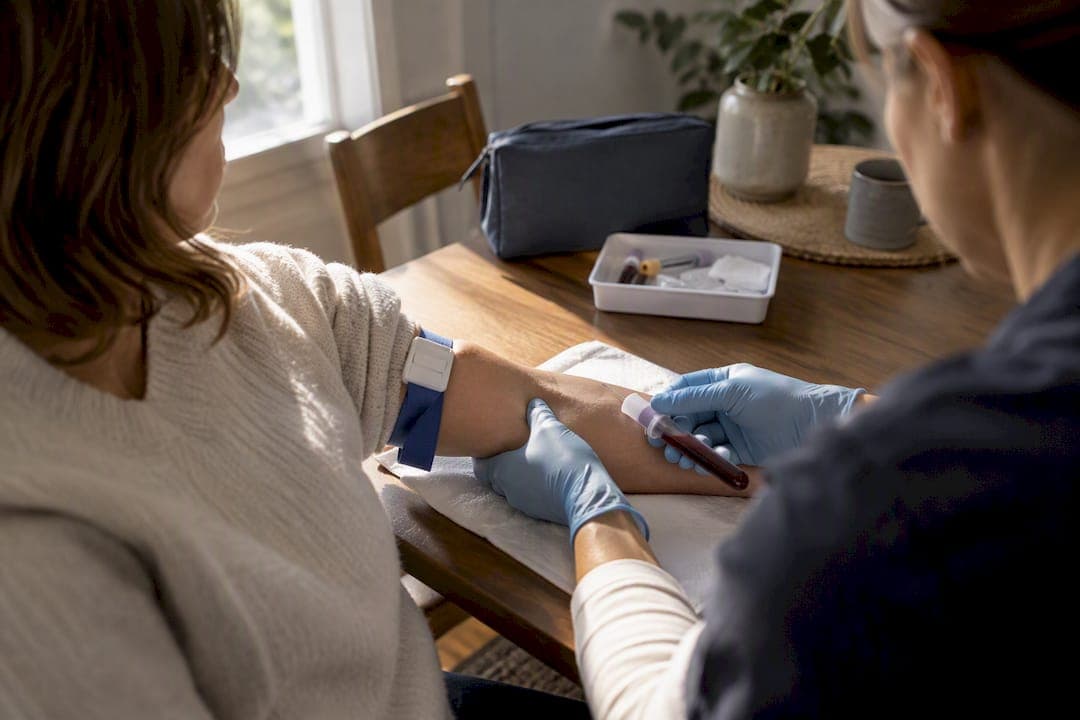
A thyroid panel is a set of blood tests that measure how well your thyroid gland is working and whether your immune system is attacking it. Most panels combine TSH with free T4, and sometimes free T3 and thyroid antibodies, to diagnose an underactive or overactive thyroid or to track how well treatment is working. The numbers only mean something in context, which is why a clinician reads them alongside your symptoms and history.
TL;DR:
- The TSH test remains the most sensitive screening marker, but its accuracy depends heavily on the assay method and comparison to specific lab ranges.
- Biotin supplements, pregnancy, steroids, and acute illnesses are common factors that can distort thyroid hormone readings if not disclosed or managed before testing.
- Results showing high TSH with low free T4 indicate hypothyroidism, while low TSH with elevated T4 or T3 suggest hyperthyroidism, but symptoms and history are crucial for diagnosis.
- Autoimmune markers like TPO and TgAb help identify autoimmune thyroid diseases such as Hashimoto’s or Graves’ before hormone levels are abnormal.
- Self-pay or mobile phlebotomy options from EIV Diagnostics make thyroid testing more accessible for patients without prescriptions or appointment delays.
Table of Contents
- What Tests Are In a Thyroid Panel and What Each One Measures
- Who Actually Needs a Thyroid Panel
- How the Blood Draw and Reporting Actually Work
- Preparing for the Test and What Can Throw Off Your Results
- Reading Your Results: What the Patterns Actually Mean
- Why Your Symptoms and Your Numbers Sometimes Don’t Match
- Getting a Thyroid Panel: Ordering Options and What EIV Diagnostics Handles
- Talking to Your Clinician About What Your Results Mean
- EIV Diagnostics Makes Thyroid Testing Easier to Actually Get Done
- Where This Information Comes From
- Sources
- FAQ
What Tests Are In a Thyroid Panel and What Each One Measures
TSH (thyroid-stimulating hormone) is the workhorse of the panel. It comes from your pituitary gland, not your thyroid, and it rises or falls in a tight, predictable relationship with free T4. Because that relationship is so consistent, TSH is generally the most sensitive first-line screening test for thyroid problems, and an abnormal result almost always triggers a second look at the hormones themselves.
Free T4 measures the portion of thyroxine actually available to your tissues, unbound to carrier proteins. Labs often prefer free T4 over total T4 because total T4 shifts with things like pregnancy or oral estrogen that change protein levels without changing actual thyroid function. Free or total T3 gets added mainly when hyperthyroidism is suspected, since T3 tends to rise earlier and more sharply in overactive thyroid disease, though T3 alone is a poor screening tool because levels can look normal even with clear thyroid dysfunction.
A standard panel typically includes some combination of the following:
- TSH, the primary screening marker
- Free T4, the active hormone level unaffected by protein-binding shifts
- Free or total T3, added when hyperthyroidism is on the table
- Thyroid peroxidase antibodies (TPO), thyroglobulin antibodies (TgAb), or TSI, which flag autoimmune thyroid disease
A full thyroid panel commonly bundles these markers together rather than ordering them one at a time. A positive TPO result, for example, points toward Hashimoto’s thyroiditis or Graves’ disease long before hormone levels swing out of range.
Who Actually Needs a Thyroid Panel
Fatigue that won’t lift, unexplained weight change, feeling cold or hot when nobody else does, thinning hair, or dry skin are the classic symptom cluster that sends people in for testing. None of these symptoms is specific to the thyroid on its own, but together they’re the most common trigger for a clinician to order the panel.
Certain situations push testing higher on the priority list:
- Pregnancy or active pregnancy planning, since thyroid hormone needs shift and untreated dysfunction affects fetal development
- A family history of thyroid disease or other autoimmune conditions
- Prior radiation to the head or neck
- Starting medications known to affect thyroid function, including amiodarone or lithium
If you’re already on levothyroxine or an anti-thyroid medication, routine panels aren’t optional extras. They’re how your clinician confirms the dose is still right, since thyroid needs can drift over months or years.
How the Blood Draw and Reporting Actually Work
The test itself is a standard venous blood draw, usually from the arm, with the only common risk being minor bruising at the site. Fasting is generally not required for thyroid-only testing, though your clinician may ask you to fast if the panel is combined with glucose or lipid tests drawn from the same visit.
Results typically come back within a few days to about a week, depending on the lab and whether antibody testing is included, since antibody assays often run on a different schedule than the core hormone panel. A few things that matter more than people expect:
- Reference ranges are method-specific: two labs running the same sample on different analyzers can report slightly different “normal” ranges
- When a lab switches assay platforms, the numeric cutoffs can shift even though your thyroid hasn’t changed at all
- Always compare your result to the range printed on that specific report, not a number you remember from a different lab or a website
Preparing for the Test and What Can Throw Off Your Results
If you take levothyroxine, ask your clinician whether to take your morning dose before or after the blood draw. Some prefer testing before the dose to get a cleaner baseline; timing instructions vary by patient. Beyond medication timing, a handful of common factors can quietly distort your numbers.
Biotin is the big one clinicians see most often. Popular in hair, skin, and nail supplements, biotin can interfere with the immunoassay technology many labs use, producing falsely high or low readings that have nothing to do with actual thyroid function. Stopping biotin 48 to 72 hours before testing is the standard recommendation when it’s feasible to pause.
Other factors worth flagging to whoever orders your test:
- Steroids and amiodarone, both of which can alter TSH or T4 readings independent of thyroid health
- Pregnancy, which shifts binding proteins and reference ranges
- Acute illness, including a bad flu or hospitalization, which can transiently suppress TSH in a pattern called sick euthyroid syndrome
Pro Tip: Write down every supplement you take, not just prescription medications, and hand that list to whoever draws your blood. Biotin hides in a lot of “hair growth” and multivitamin products, and most people don’t think to mention it.
Reading Your Results: What the Patterns Actually Mean
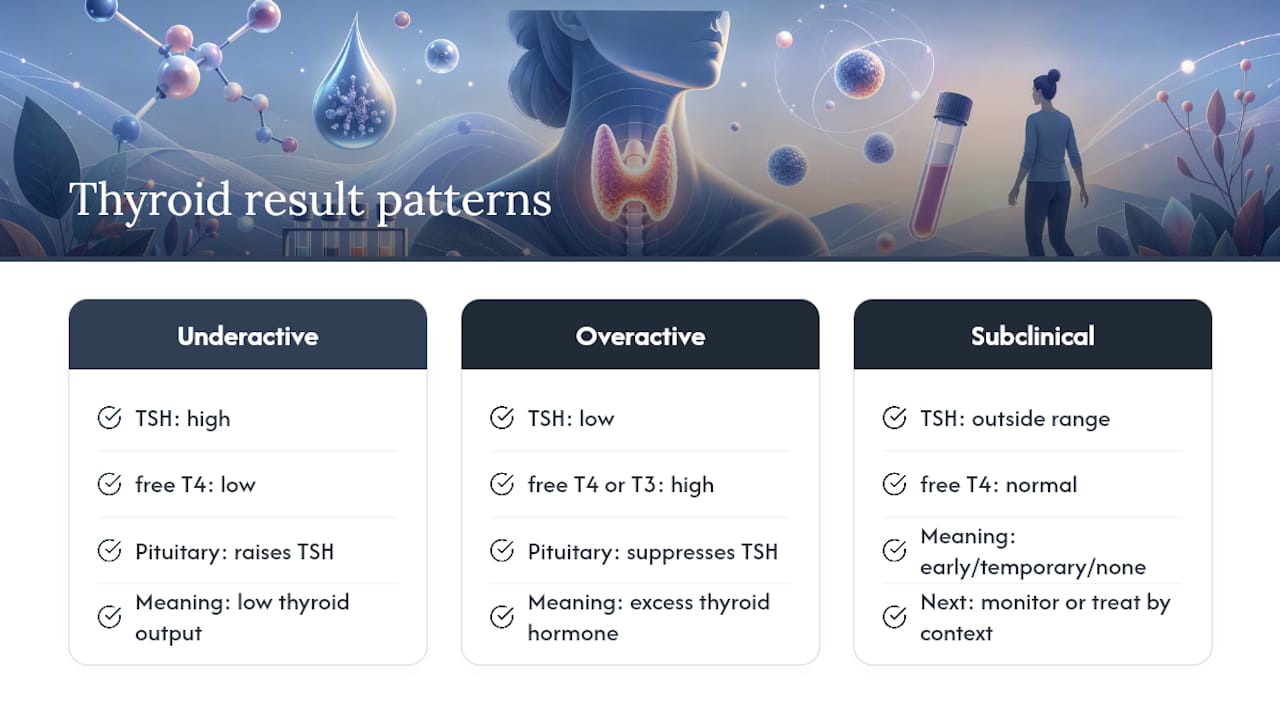
The classic pattern for an underactive thyroid is high TSH paired with low free T4. That combination usually means your pituitary is shouting louder (raising TSH) because your thyroid isn’t producing enough hormone in response. The typical next step is a repeat test to confirm the pattern, followed by a discussion about starting or adjusting thyroid hormone replacement.
Flip it around and you get the hyperthyroid pattern: low TSH with high free T4 or T3. Here, the pituitary senses too much hormone in circulation and shuts down its own signal. This pattern usually prompts antibody testing to check for Graves’ disease, and sometimes imaging, such as a thyroid ultrasound or a radioactive iodine uptake scan, to pin down the cause.
Subclinical results are the trickiest and probably the most common source of confusion. This is when TSH sits outside the normal range but free T4 looks completely normal. A mildly elevated TSH with normal free T4, for instance, might mean early hypothyroidism, a temporary blip, or nothing clinically significant at all. Whether that gets monitored with a repeat test in a few months or treated right away depends on symptoms, age, pregnancy status, and how far outside the range the number actually sits.
Antibody testing, ultrasound imaging, and radioactive iodine uptake studies aren’t part of every panel. Testing typically starts with TSH, and these additional tools get added only when the hormone results point toward a specific diagnosis that needs confirming.
Why Your Symptoms and Your Numbers Sometimes Don’t Match
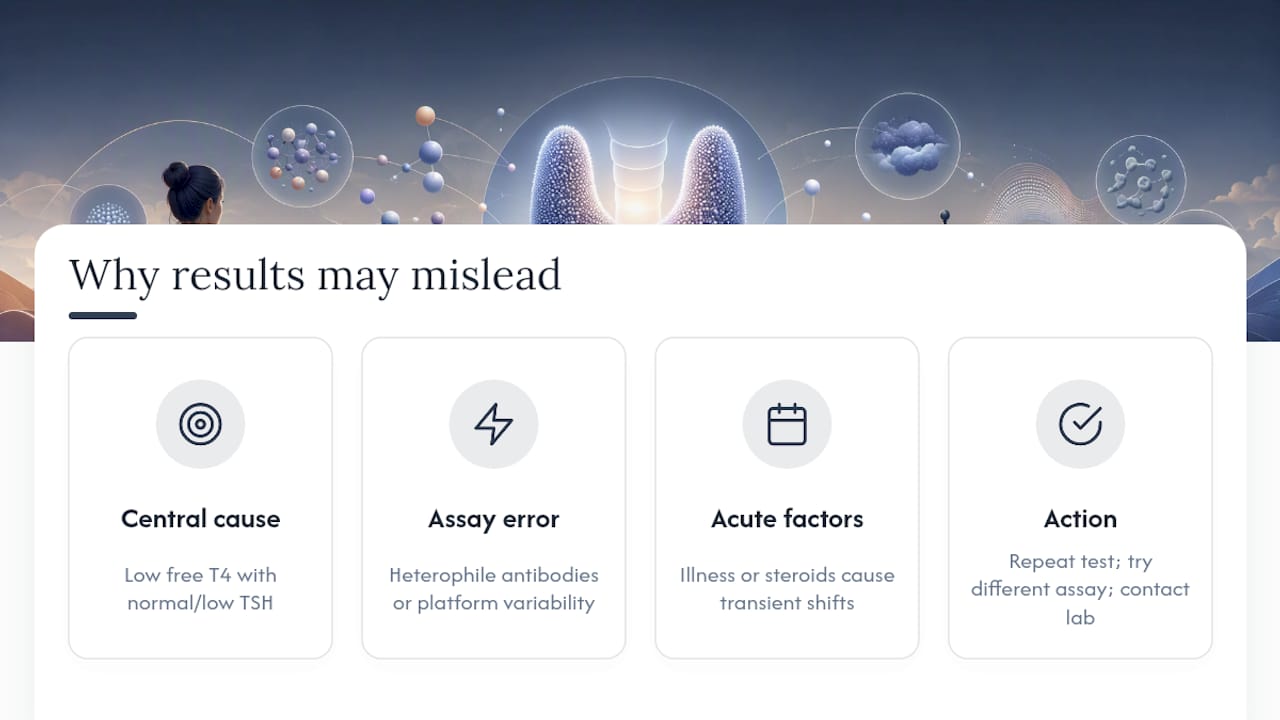
A normal-looking TSH doesn’t always mean your thyroid axis is behaving normally. Central hypothyroidism, where the problem originates in the pituitary rather than the thyroid gland itself, can produce a misleadingly normal or low TSH even when free T4 is genuinely low. This is one reason clinical guidance stresses reading thyroid results alongside symptoms and history rather than treating any single number as the final word.
Analytical interference is another common culprit. Heterophile antibodies, unusual proteins some people’s immune systems produce, can occasionally confuse lab assays and produce a spurious high or low reading that doesn’t reflect reality. Add in the assay variability between labs, and the American Thyroid Association acknowledges that standardization across different testing platforms remains an ongoing challenge, which is part of why a result that looks alarming on paper sometimes turns out to be a testing artifact rather than a diagnosis.
Acute illness and recent medication changes add another layer of noise. A hospital stay, a bad infection, or a new steroid prescription can shift your numbers for weeks without any lasting thyroid problem behind it. When results don’t line up with how a patient feels, the standard response isn’t to panic. It’s to repeat the test, sometimes with a different assay, and loop in the lab directly if something still looks off.
Getting a Thyroid Panel: Ordering Options and What EIV Diagnostics Handles
You can get a thyroid panel two main ways: through a provider’s order after an office visit, or directly as a self-pay test if you want to check your levels without waiting for an appointment. Both routes end at the same blood draw and the same lab report.
EIV Diagnostics supports either path. Patients with a prescription can have their panel processed through the lab, and direct-to-consumer patients can order self-pay testing without a physician referral. For anyone who’d rather skip the waiting room entirely, mobile phlebotomy brings the blood draw to your home or office.
A few practical things to keep in mind when booking:
- Mention any thyroid medication, biotin supplements, or pregnancy status to the phlebotomist before the draw
- Ask about expected turnaround when you schedule, since antibody results can take longer than the core hormone panel
- Board-certified pathologists review results before they’re finalized, and you or your provider can follow up with the lab directly on technical questions
Talking to Your Clinician About What Your Results Mean
Bring three things to your follow-up appointment: a current medication and supplement list, a short log of your symptoms and when they started, and your pregnancy status if relevant. That context does more to explain an odd number than the number itself ever will.
Worth asking directly: what pattern does my result show, does it need repeating, and what would change your recommendation. If a repeat test or antibody panel is ordered, ask what result would actually prompt treatment.
Some symptoms shouldn’t wait for a scheduled follow-up at all. A racing heart rate, fainting, severe swelling with extreme fatigue and confusion, or any sign pointing toward thyroid storm or myxedema coma need emergency care immediately, not a callback.
EIV Diagnostics Makes Thyroid Testing Easier to Actually Get Done
The hardest part of thyroid testing usually isn’t understanding the results. It’s finding time to sit in a lab waiting room. Some laboratories remove that barrier with mobile phlebotomy that brings a trained phlebotomist to your home or office, and self-pay testing for anyone who wants a thyroid panel without waiting on a referral.
Every sample is reviewed by pathologists, so the report your clinician reads carries rigorous quality regardless of how the blood draw was performed. If you’re already juggling symptoms, appointments, and a dozen other things, skipping the commute to get blood drawn is a small change that removes a real obstacle. Book a mobile phlebotomy visit for a draw at your home or workplace, or head to the self-pay testing page to order your thyroid panel directly and see current pricing.
— EIV Diagnostics
Where This Information Comes From
The clinical claims in this article draw on patient-facing resources from major medical institutions, cross-checked against peer-reviewed guidance on test interpretation.
- Cleveland Clinic’s thyroid panel overview
- MedlinePlus TSH test reference
- NIDDK/NIH thyroid diagnostic tests guide
- American Thyroid Association’s thyroid function tests page
Always discuss your specific results with your own clinician, since reference ranges and treatment thresholds vary by individual circumstances.
This article is general information, not a substitute for advice from a qualified doctor. Consult a qualified healthcare professional about your own circumstances before acting on anything here.
Sources
- Thyroid Panel: What It Is & Results — Cleveland Clinic
- Thyroid stimulating hormone test — MedlinePlus
- Biotin interference with laboratory assays — PMC
- Thyroid diagnostic tests — NIDDK/NIH
FAQ
How Do I Interpret the Results of a Thyroid Panel?
Start with TSH: high TSH with low free T4 usually points to an underactive thyroid, while low TSH with high free T4 or T3 points to an overactive one. Results outside the normal range don’t automatically mean disease, since clinical context, medications, and pregnancy status all factor into interpretation.
What Can Throw Off a Thyroid Test?
Biotin supplements are one of the most common culprits, and stopping biotin 48 to 72 hours before the draw is the standard fix. Steroids, amiodarone, acute illness, and pregnancy can also shift results without reflecting a real change in thyroid function.
What Is Included In a Full Thyroid Panel?
A full panel typically includes TSH, free or total T4, and often free or total T3, plus antibody tests like TPO when autoimmune disease is suspected. Not every panel includes every marker. Testing usually starts with TSH and expands based on what that result shows.
What Are the 12 Markers of a Full Thyroid Panel?
There’s no universally standardized thyroid panel definition. Definitions vary by lab, but the core, consistently used markers are TSH, free T4, total T4, free T3, total T3, and antibody tests such as TPO, TgAb, and TSI.
Can EIV Diagnostics Run a Thyroid Panel Without a Doctor’s Order?
Yes. EIV Diagnostics offers self-pay testing for patients who want a thyroid panel directly, without a physician referral, alongside standard provider-ordered testing.