
By EIV Diagnostics · September 4, 2026
30–60 Minute STAT Lab Tests: Why Governance Trumps Speed
A clinician and lab-manager guide to STAT lab tests: set realistic 30–60 minute TATs, prevent STAT overuse, and build governance that keeps urgent results...
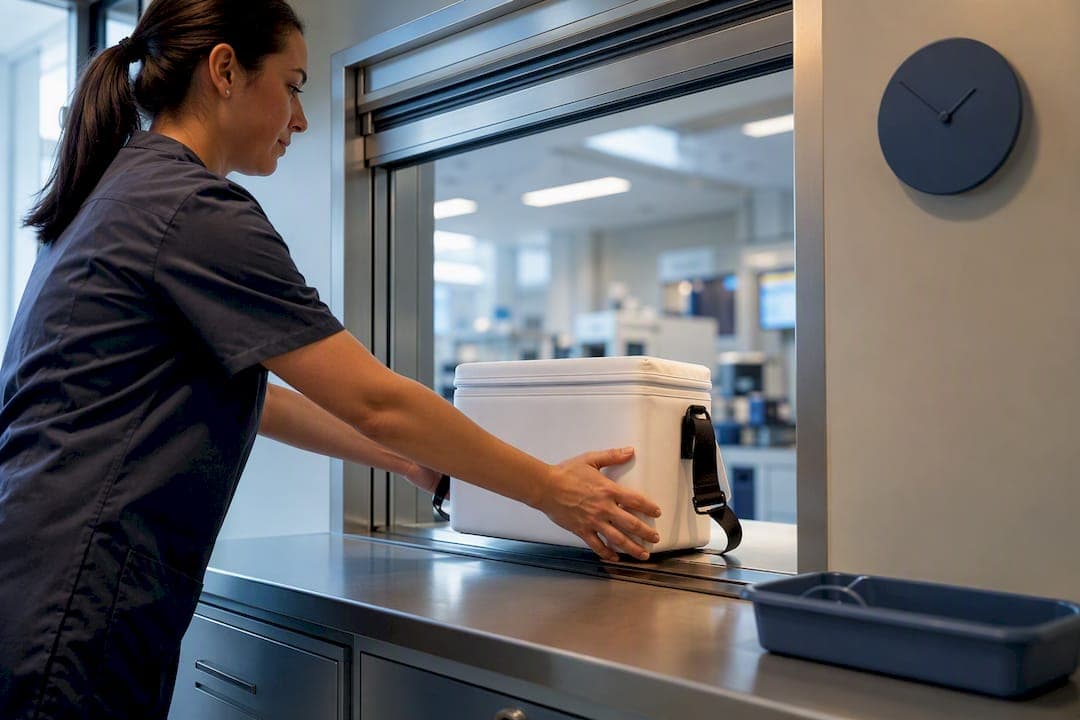
STAT means “immediately,” from the Latin statim, and it designates the highest processing priority a lab can assign. Order a STAT test when the result will change a clinical decision in the next few minutes to an hour, not because a patient or physician wants faster service. Most STAT chemistry and hematology results target a turnaround time of under an hour, and critical values typically require caregiver notification promptly after verification.
TL;DR:
- STAT tests should have a turnaround time of 30 to 60 minutes, with some critical assays like blood gas and troponin often completing in under 30 minutes.
- A clear, locally tailored STAT policy should include criteria such as immediate treatment impact and potential harm from delays, reviewed regularly with real-time data.
- Proper classification of specimens as STAT, urgent, or routine is crucial to avoid delays, resource waste, or missed timely interventions.
- Critical value notifications must be made within roughly one hour, using direct contact and documented confirmation protocols, with automatic LIS logging for audit purposes.
- The main causes of delays are pre-analytic transport and labeling, analytic batching policies, and post-analytic result verification, which can all be improved with process refinement and point-of-care testing.
Table of Contents
- What Does STAT Mean in Clinical Practice?
- STAT vs. Urgent vs. Routine: How Priority Changes the Workflow
- How Fast Should STAT Results Really Come Back?
- Which STAT Tests Matter Most in Acute Care?
- How Fast Must Critical Values Be Communicated?
- What Actually Slows Down STAT Results?
- Building a STAT Test List That Actually Holds Up
- What Regulations Govern STAT Testing?
- Our View: Why STAT Governance Matters More Than STAT Speed
- Get Reliable STAT and Rapid Testing Support From EIV Diagnostics
- Sources
- FAQ
What Does STAT Mean in Clinical Practice?
A STAT order is clinically justified only when the result directly informs an immediate management decision. Not “the patient is anxious,” not “the family wants answers before rounds,” but a genuine fork in the treatment path that depends on a number the clinician does not yet have. A potassium level in a patient with new arrhythmia is STAT. A repeat lipid panel to reassure a worried outpatient is not, no matter how it gets ordered.
The distinction sounds obvious until you look at how often it breaks down in practice. Emergency departments and ICUs generate the bulk of legitimate STAT volume, but plenty of STAT orders originate from convenience, habit, or a resident who does not want to wait. Every STAT order pulled ahead of the queue pushes something else back, so overuse has a real cost even when no single order looks unreasonable in isolation.
That is why the ASCP practice parameter on STAT testing steers labs away from a single rigid definition and toward turnaround-time goals tailored to actual patient need, built jointly by lab and clinical staff. A test list negotiated in isolation by the lab director tends to be either too permissive or too restrictive; one built with ED, ICU, and nursing input tends to hold up under real-world pressure.
Criteria worth codifying in a local STAT policy include:
- The result changes treatment, transfer, or discharge decisions within the hour
- The clinical scenario carries a real risk of harm if the result is delayed
- The test is technically capable of the faster turnaround without compromising accuracy
- The requesting service and the lab have agreed the analyte belongs on the STAT list
- The order includes enough clinical context for the lab to triage correctly
A test list without those guardrails drifts. Ask any lab manager who has watched a stable STAT list balloon from 15 analytes to 40 over a few years without anyone formally deciding it should.
STAT vs. Urgent vs. Routine: How Priority Changes the Workflow
Labs typically run three priority tiers, and each one triggers a different set of operational responses the moment a specimen hits accessioning.
- STAT specimens get expedited courier pickup, jump the queue at accessioning, and load directly into the next available analyzer run rather than waiting in a batch. Common examples: troponin for suspected acute coronary syndrome, arterial blood gas for respiratory failure, potassium for a patient with ECG changes.
- Urgent (sometimes called “ASAP”) specimens move faster than routine but do not always get courier priority or immediate analyzer slotting. They typically resolve within a few hours rather than minutes. Examples include a same-day preoperative CBC or a rheumatology panel needed before a same-day clinic decision.
- Routine specimens follow standard batch processing, often with same-day or next-day turnaround targets. Most outpatient chemistry panels, lipid profiles, and screening labs fall here.
The category a test lands in changes more than just queue position. STAT specimens usually bypass standard batching entirely, run on dedicated STAT-capable analyzers or point-of-care devices, and trigger direct notification protocols the moment a critical result verifies. Routine specimens, by contrast, might sit in a rack for 30 minutes before a technologist even loads the run.
Misclassifying a test in either direction causes problems. Mislabeling a routine send-out as STAT wastes courier resources and analyzer bandwidth. Mislabeling a genuinely urgent result as routine can delay a diagnosis that actually needed same-hour attention, which is the scenario every STAT policy exists to prevent.
How Fast Should STAT Results Really Come Back?
A common benchmark in laboratory medicine is to achieve completion of most common test results within about an hour. That figure comes from CAP Q-Probes data and repeated turnaround-time literature, and it functions as a reasonable starting target for any lab building its own STAT policy, according to a laboratory turnaround-time review.
Institutional benchmarks tend to sharpen that general target by analyte. A university hospital laboratory turnaround-time policy lays out a workable framework:
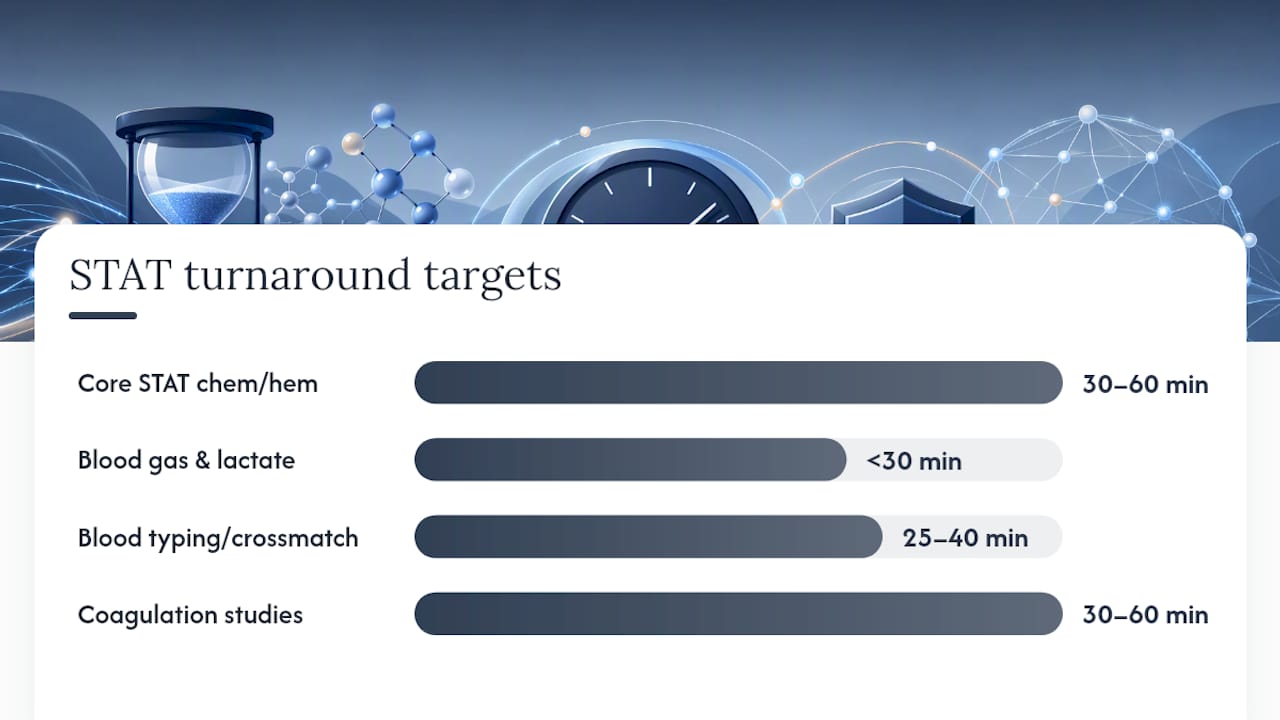
- Core STAT chemistry and hematology (electrolytes, CBC, basic metabolic panel components): 30 to 60 minutes
- Blood gas and lactate: often faster, frequently under 30 minutes given point-of-care availability
- Blood typing and crossmatch: institutions sometimes push for 25 to 40 minute internal goals given the transfusion-risk stakes
- Coagulation studies (PT/INR, aPTT): typically within the 30 to 60 minute STAT window, though instrument-dependent
- Routine outpatient panels: several hours to same-day, with same-day frequently meaning by end of shift rather than within the hour
Analyte-specific targets are not universal, and that is by design. A lab turnaround-time review emphasizes that local labs should calibrate targets to their own patient population, staffing, and instrument capability rather than importing a benchmark wholesale.
Measuring TAT correctly matters as much as setting the target. Average turnaround time hides the outliers that actually hurt patients, so most laboratory quality programs track the 90th percentile instead: the time within which 90% of specimens complete, which exposes the slow tail that a mean conveniently buries. Define your start and end points precisely, too. Is the clock starting at order entry, specimen collection, or receipt in the lab? Is it stopping at result verification or at clinician notification? Ambiguity here makes benchmarking meaningless.
Pro Tip: Track TAT from specimen receipt to result verification separately from verification to clinician notification. Bundling both into one number hides whether your delays are analytic or communication problems.
Which STAT Tests Matter Most in Acute Care?
A handful of assays account for most STAT volume in any acute-care setting, and each answers a specific, time-sensitive clinical question.
- Complete blood count (CBC), especially hemoglobin: Flags acute blood loss, guides transfusion decisions, and screens for infection via white cell count in a septic-appearing patient.
- Basic metabolic panel components, particularly potassium and creatinine: Potassium drives immediate cardiac risk assessment in arrhythmia; creatinine informs contrast decisions and acute kidney injury management.
- Blood gas and lactate: Central to assessing respiratory failure, shock states, and metabolic derangement. Lactate trending is one of the more reliable early indicators of sepsis severity and response to resuscitation.
- High-sensitivity cardiac troponin (hs-cTn): The backbone of acute coronary syndrome triage. Serial hs-cTn measurements at defined intervals now drive most rule-in/rule-out chest pain protocols in emergency medicine.
- Coagulation studies, PT/INR and aPTT: Essential before invasive procedures, in active bleeding, and for monitoring anticoagulant reversal.
Microbiology sits apart from this list, and it is worth saying plainly: culture-based testing cannot be made STAT in the way a chemistry panel can. Bacterial growth takes the time it takes; you cannot expedite biology. That gap is exactly why rapid molecular diagnostics and point-of-care platforms have expanded so quickly in infectious disease workups, since they deliver a pathogen signal in hours rather than the one to three days a culture requires. When a true STAT infectious question arises, such as suspected bacterial meningitis or a rapidly deteriorating septic patient, molecular panels or point-of-care assays are usually the more realistic path than waiting on conventional culture.
How Fast Must Critical Values Be Communicated?
A critical or “alert” value is a result so far outside the normal range that failing to act on it quickly carries a real risk of harm. Severe hyperkalemia, dangerously low hemoglobin, critically abnormal glucose. Every accredited lab maintains a defined list of these thresholds, though the specific analytes and cutoffs vary by institution.
The timing consensus across major guidance bodies is fairly tight. Multiple standards bodies converge on notifying the responsible caregiver within roughly one hour of result verification, according to a critical value notification advisory. A summary of critical-value communication recommendations similarly finds that while organizations disagree on which analytes qualify as critical, they largely agree on the notification window and on who bears responsibility for closing the loop.
Sound notification protocols generally include:
- Direct person-to-person verbal communication as the preferred method, not a fax or an inbox message
- A validated automated escalation path as an acceptable backup when direct contact fails after defined attempts
- A documented read-back confirmation from the receiving clinician or nurse
- A time-stamped record in the laboratory information system (LIS) noting who was notified, when, and how
- A defined escalation chain if the first contact attempt does not succeed within a set window
Pro Tip: If your LIS can log notification attempts automatically, use that data monthly to spot patterns, like a particular unit or shift where callbacks consistently take longer than the rest of the hospital. That is usually a staffing or contact-list problem, not a lab problem.
Documentation matters here beyond compliance. When a critical value notification gets challenged later, whether in a quality review or a legal proceeding, the LIS timestamp is often the only objective record of what happened and when.
What Actually Slows Down STAT Results?
Turnaround time breaks down into three phases, and each one has its own failure points worth managing separately.
Pre-analytic delays are usually the biggest and most fixable. Specimen transport time from a nursing floor to the lab, pre-registration bottlenecks at accessioning, and mislabeled tubes that require recollection all eat minutes before testing even starts. A review of specimen collection errors covers how much of this delay originates at the bedside rather than inside the lab itself.
Analytic performance depends on instrument throughput and whether the lab runs STAT specimens continuously or waits to batch them with routine work. Continuous processing costs more in staffing and reagent management but is usually the only way to hit a 30 to 60 minute goal consistently. Staffing models matter just as much as hardware: a STAT bench that is fully staffed only during day shift will show its worst outlier times overnight.
Post-analytic delays live in result verification workflows and notification. Auto-verification rules that release normal results without manual review can shave real minutes off STAT TAT, provided the validation behind those rules is solid.
A few operational levers worth weighing against their real costs:
- Point-of-care testing puts blood gas, glucose, and some cardiac markers at the bedside, cutting transport time to zero, though at the cost of tighter quality control and more decentralized staff training.
- Satellite labs near the ED can shorten transport distance, but the literature on STAT testing models notes that many systems get better return on investment by improving central lab processes and courier logistics instead of running a second, more expensive lab footprint.
- Continuous quality monitoring, paired with outlier analysis rather than average TAT, tends to surface the specific bottleneck worth fixing rather than a vague sense that “things are slow.”
Building a STAT Test List That Actually Holds Up
A STAT list built by the lab alone, or by clinicians alone, rarely survives contact with real patient volume. It needs governance from both sides, and that governance works best as a repeatable process rather than a one-time policy document.
- Assemble an interdisciplinary team. Include the lab director, ED and ICU physician representatives, nursing leadership, and quality or patient safety staff. This is the group the ASCP practice parameter points to when it recommends coauthored STAT lists rather than lab-imposed ones.
- Set inclusion criteria. Weigh clinical impact, ordering frequency, and resource cost together. A test that is ordered STAT twice a year does not need the same dedicated capacity planning as one ordered dozens of times daily.
- Write it down and train on it. Formal policies, defined escalation contacts, and staff training turn a consensus decision into something people actually follow at 3 a.m. on a busy shift.
- Review on a schedule using real data. TAT dashboards and clinician feedback, revisited quarterly or semiannually, catch list drift before it becomes entrenched.
Pro Tip: Put an expiration date on every addition to the STAT list. Force a re-justification at the next review cycle instead of letting “temporary” STAT designations become permanent by default.
What Regulations Govern STAT Testing?
STAT testing does not operate outside the standard laboratory regulatory framework. It just raises the stakes on requirements that already apply broadly.
Under CLIA, labs must maintain documented quality systems, verify personnel competence, and validate test performance, including for any test run at a faster STAT protocol than its standard validated method. A faster turnaround does not exempt a lab from proving the result is still accurate. ISO 15189 accreditation, where adopted, layers on additional quality-management expectations around turnaround-time monitoring and corrective-action tracking that align closely with the TAT benchmarking already discussed.
The Joint Commission’s expectations center heavily on critical-value notification. Surveyors look for a written policy, evidence that staff actually follow it, and documentation trails showing timely notification with defined escalation steps, consistent with the consensus timelines covered earlier. A lab’s CLIA certification framework is worth revisiting specifically through the lens of STAT testing, since auditors increasingly ask for TAT and notification data as part of routine inspection.
Practical documentation tips that hold up during audits:
- Keep a time-stamped log of every critical-value notification, including failed attempts and escalation steps
- Retain TAT performance data over time, not just current-month snapshots, to demonstrate a pattern of monitoring
- Document staff competency assessments specifically for any point-of-care or STAT-designated instrumentation
Our View: Why STAT Governance Matters More Than STAT Speed
Every lab wants to advertise fast STAT turnaround, but speed without governance just moves the problem around. EIV Diagnostics operates as an independent pathology laboratory across molecular pathology, dermatopathology, clinical pathology, and digital pathology, staffed by board-certified pathologists, and the pattern we see consistently is that TAT complaints are rarely an instrument problem. They are almost always a communication or list-governance problem dressed up as a speed problem.
The fix is not a faster analyzer. It is clearer ordering criteria, a defined contact path for critical results, and an agreed turnaround-time target that both the clinician and the lab actually believe in before a crisis tests it. Clinicians who partner with a lab on defined service-level expectations up front, rather than negotiating them mid-emergency, get better outcomes than clinicians chasing speed alone.
Any lab claiming perfect STAT performance without showing its outlier data is telling you half the story.
— EIV Diagnostics
Get Reliable STAT and Rapid Testing Support From EIV Diagnostics
EIV Diagnostics gives clinicians a diagnostic partner built around clear communication, not just fast machines. Molecular pathology, dermatopathology, digital pathology, and clinical pathology services all run through board-certified pathologists who understand what a STAT order actually needs to accomplish for patient care.

What sets this apart for clinicians managing urgent cases is the mobile phlebotomy option: rather than routing a patient or specimen through additional transport steps, mobile phlebotomy services bring specimen collection directly to a home or office setting, cutting pre-analytic delay at the exact point where most STAT turnaround gets lost. Combined with molecular pathology services built for precise, timely reporting, EIV Diagnostics fits clinics and providers who need dependable rapid diagnostic testing without building their own satellite lab infrastructure. Practices needing a diagnostic partner with defined turnaround expectations and a direct communication path for urgent results are encouraged to discuss their testing needs and set up a working relationship before the next urgent case arrives.
This article is general information, not a substitute for advice from a qualified doctor. Consult a qualified healthcare professional about your own circumstances before acting on anything here.
Sources
- Patient Safety Advisory — Critical value notification guidance
- Laboratory turnaround time (review) — PMC
FAQ
What Are STAT Laboratory Tests?
STAT lab tests are diagnostic tests processed at the highest priority level because the result is needed immediately to guide a clinical decision, typically within 30 to 60 minutes rather than the hours or days routine testing takes.
What Are the 5 Basic Laboratory Tests?
Commonly cited basic panels include the complete blood count (CBC), basic metabolic panel, urinalysis, lipid panel, and liver function tests, though the exact “five” varies by institution and clinical context.
What Are the 7 Blood Tests Doctors Order Most?
Frequently ordered blood tests include CBC, basic or comprehensive metabolic panel, lipid panel, thyroid panel, coagulation studies (PT/INR), hemoglobin A1c, and cardiac biomarkers like troponin, though the specific list depends on the clinical question.
How Long Does It Take for STAT Labs to Result?
Most STAT results target 30 to 60 minutes from specimen receipt to verification, with high-performing labs completing 90% of common tests within that window, according to turnaround-time benchmarking data. Some analytes, like point-of-care blood gas, often return faster, while others, like certain coagulation studies, may run closer to the full 60 minute mark depending on instrumentation.