
By EIV Diagnostics · August 19, 2026
Read a Pathology Report for Patients: What to Look For
Learn how to read a pathology report effectively to understand your diagnosis and treatment options. Key insights await you!

A pathology report tells you what a pathologist found when they examined your tissue or fluid sample under a microscope, and it’s the document your treatment plan gets built on. The single most important move: go straight to the final diagnosis line before anything else. Then flag three things for your clinician: the diagnosis itself, the grade or stage, and the margin and lymph node status if surgery was involved. Once you’ve spotted those, schedule time with your doctor to walk through the rest, and don’t hesitate to request the full report or your slides if something doesn’t add up.
Key Takeaways
Reading a pathology report correctly means starting with the final diagnosis line, then checking grade, stage, margins, and lymph node status before your clinician appointment.
| Point | Details |
|---|---|
| Read the diagnosis first | The final diagnosis line summarizes the entire report and drives your treatment plan. |
| Flag margins and nodes | Positive margins or involved lymph nodes typically prompt further surgery or systemic therapy discussions. |
| Expect some delay | Permanent sections take several days, and addenda may follow once IHC or molecular tests return. |
| Request slides for a second opinion | Ask for your report plus slides or digital images if you want an independent pathology review. |
| EIV Diagnostics offers review options | Board-certified pathologists provide digital pathology and molecular testing to support second-opinion requests. |
Table of Contents
- What Is a Pathology Report and When Do You Get One?
- How to Read a Pathology Report Section by Section
- Common Pathology Report Terms Explained
- Why Some Pathology Reports Take Longer Than Others
- How Your Care Team Uses the Pathology Report
- Preparing for Your Pathology Report Discussion
- Getting a Second Opinion or Digital Slide Review
- Trusted Resources for Understanding Your Report
- If You Need a Second Opinion or Slide Review
- Sources
- FAQ
What Is a Pathology Report and When Do You Get One?
A pathology report is a written record of what a pathologist saw when examining tissue or fluid removed from your body, typically after a biopsy, surgery, or fluid collection. It becomes part of your permanent medical record because it’s used to confirm a diagnosis, plan treatment, and track your case over time, according to the National Cancer Institute.
You’ll receive one after several common procedures:
- Core needle biopsy (a thin sample taken with a needle)
- Excisional biopsy (removal of an entire lump or area)
- Surgical resection (removal of an organ or larger tissue section)
- Cytology testing from fluids, such as a Pap smear or fluid drained from the lungs or abdomen
Some blood and stool tests generate a pathology report too, though most patients encounter the format after a tissue biopsy.
How to Read a Pathology Report Section by Section
Every pathology report follows a fairly predictable structure, even though the wording varies by lab. Learning this layout is the fastest way to interpret pathology results without getting lost in medical shorthand.
Reports typically run in this order:
- Patient identifiers: your name, date of birth, and specimen ID number, used to confirm the sample is yours.
- Clinical history: the reason the sample was taken, often a short note like “palpable breast mass” or “suspicious skin lesion.”
- Specimen/procedure: what was removed and how (biopsy, excision, resection).
- Gross description: what the tissue looked like to the naked eye, including size, color, and texture.
- Microscopic description: what the pathologist saw under the microscope, describing cell patterns and structure.
- Special studies: results from immunohistochemistry (IHC) or molecular testing, when ordered.
- Final diagnosis: the pathologist’s conclusion, often including cancer type, grade, and stage if applicable.
- Margins and lymph node status: whether abnormal cells reached the cut edge of tissue removed and whether nearby lymph nodes are involved.
- Comment/addendum: extra notes added after further testing.
- Pathologist signature: the name and credentials of the reviewing pathologist.
The final diagnosis is the anchor of the entire document. The American Cancer Society notes it summarizes everything else in the report and is the line that drives treatment decisions. Everything above it (the gross and microscopic descriptions) exists to support that conclusion.
Common Pathology Report Terms Explained
A pathology report summary is packed with terms that sound alarming even when they’re routine. Here’s what the most common ones actually mean:
- Diagnosis/final diagnosis: the pathologist’s official conclusion. Ask: “What exactly does this diagnosis mean for my treatment?”
- Benign vs. malignant: benign means noncancerous; malignant means cancerous. Ask: “Is there any uncertainty in this finding?”
- Grade: how abnormal the cells look, which hints at how fast a tumor might grow. Ask: “What grade is this, and what does it mean for my outlook?”
- Stage: how far a cancer has spread, usually based on tumor size and node/organ involvement. Ask: “What stage was I given, and by what system?”
- Margins: whether the edge of the removed tissue is free of abnormal cells (negative), contains them (positive), or is close. Ask: “Are my margins clear?”
- Lymph node status: whether cancer cells were found in nearby lymph nodes. Ask: “How many nodes were checked, and were any positive?”
- Metastasis: spread of cancer to another part of the body.
- Immunohistochemistry (IHC): a stain test used to identify specific proteins in cells, often to confirm a diagnosis type.
- Molecular test: DNA or RNA testing that can identify mutations guiding targeted therapy.
- Perineural invasion: cancer cells found tracking along a nerve.
- Lymphovascular invasion: cancer cells found in small blood or lymph vessels, both signals worth a direct conversation with your oncology team since they can point to more aggressive tumor behavior, per research on pathology reporting and prognostic factors.
- Addendum: an update added to the report after the original was issued.
Why Some Pathology Reports Take Longer Than Others
Turnaround time depends heavily on what kind of analysis your case requires.
- Frozen sections happen during surgery and give a rapid, preliminary answer in minutes, though they’re less precise than the final read.
- Permanent sections usually take several days, since the tissue needs to be processed, sliced, and stained properly before a pathologist reviews it, according to NCI’s pathology Q&A.
- Addenda get added when extra testing, like IHC or molecular panels, comes back after the initial report was issued.
If your initial report says “additional studies pending,” that’s normal; for immigration medical exams, you can learn more about what happens with abnormal lab results to understand your next steps. It means a more complete picture is still forming.
How Your Care Team Uses the Pathology Report
Your surgeon, oncologist, radiation oncologist, and pathologist all read this document differently, but they’re working from the same facts.
- Positive lymph nodes usually prompt a staging conversation and a discussion of systemic therapy like chemotherapy.
- Positive or close margins often lead to a re-excision surgery or a radiation therapy discussion.
- Molecular findings may open the door to targeted therapy or additional genetic testing, a step covered in more detail in molecular diagnostic testing.
Care planning typically starts within one to two weeks of the final report landing in your chart. Results that show a clear urgent finding, like a rapidly progressing infection or an unexpected malignant result, usually trigger a prompt call from your clinician rather than waiting for a scheduled follow-up.
Preparing for Your Pathology Report Discussion
Walking into your appointment with a short list of questions turns a confusing conversation into a productive one.
- What is my exact diagnosis, in plain language?
- Are my margins clear, close, or positive?
- Were any lymph nodes involved, and how many were tested?
- What additional tests or treatments do you recommend next, and on what timeline?
If you want your own copy, ask the lab or your clinician’s office how to request the full report, the glass slides, or the paraffin block. Some labs charge a modest processing fee for slide duplication, a detail worth confirming up front. Reading pathology results alone can bring up real anxiety, so consider bringing a family member or friend to your appointment, and don’t overlook hospital social work or patient navigator programs if you need extra support.
Getting a Second Opinion or Digital Slide Review

Every patient has the right to seek a second opinion on a pathology diagnosis, and the process is more straightforward than most people expect. Start by requesting the slides or digital whole-slide images from the lab that performed the original analysis, then ask your clinician’s office to forward your records to the reviewing pathologist or center, a process outlined by the National Cancer Institute.
Pro Tip: Request both the written report and the physical slides or digital images together, and ask ahead of time whether the receiving lab needs the actual paraffin block or can work from slides and scanned images alone. Skipping this step is the most common cause of delayed second-opinion reviews.
- Contact the original lab’s records department to request slide release.
- Confirm turnaround time and any transfer fees before authorizing the send.
- Ask your clinician to include relevant clinical history with the transfer.
EIV Diagnostics offers board-certified pathologists, digital pathology review, and molecular pathology testing, along with mobile phlebotomy for patients who need additional blood work drawn without a lab visit, all of which can support a second-opinion request without requiring you to travel.
Trusted Resources for Understanding Your Report
For deeper reading, several pathologist-reviewed guides are worth bookmarking or printing:
- College of American Pathologists (CAP) patient guide
- MyPathologyReport’s diagnosis guides and pathology dictionary
- American Cancer Society patient guide
- National Cancer Institute fact sheet
Keep a personal copy of every pathology report you receive. Specialists you see later will want it on hand.
A note from EIV Diagnostics
A pathology report reads the way it does because it’s written for clinicians, not patients, and that’s exactly why your care team exists to walk you through it.
If You Need a Second Opinion or Slide Review
There are other routes to double-checking a diagnosis: asking your original hospital’s pathology department, contacting a large academic cancer center, or going through your insurer’s second-opinion program. Each involves its own paperwork and wait times.
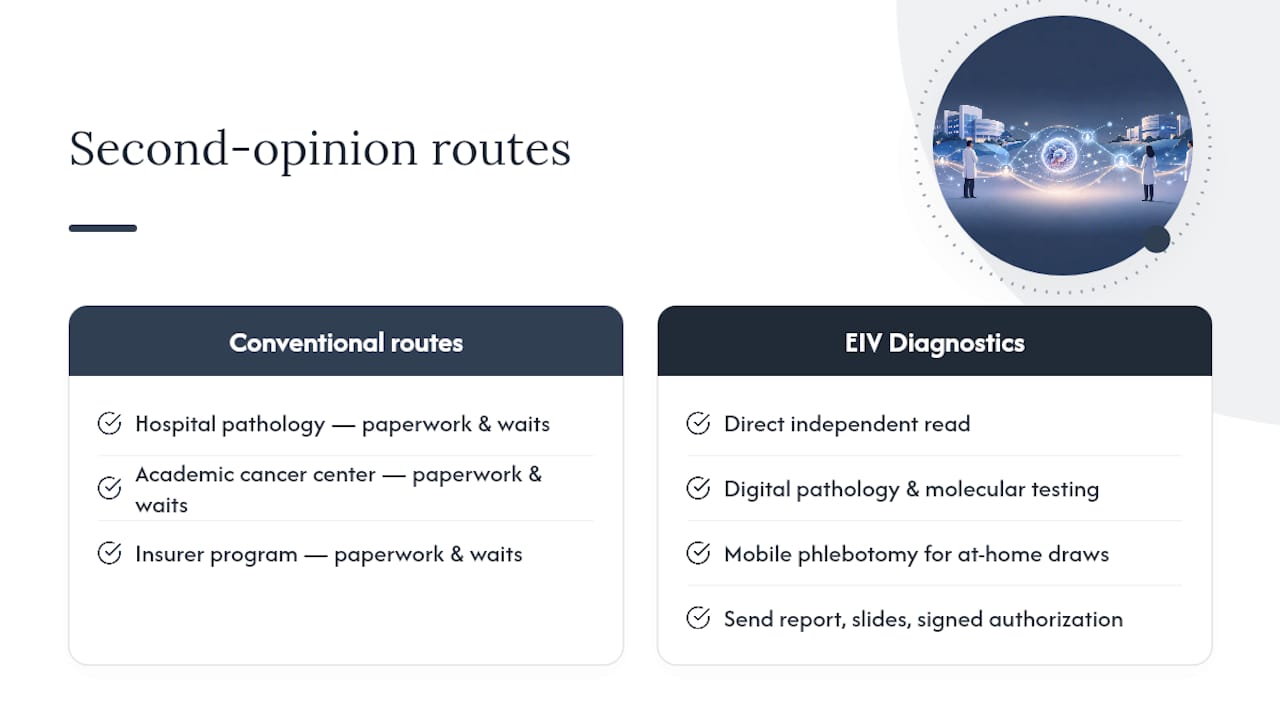
EIV Diagnostics offers a more direct path for patients who want an independent read without navigating a large hospital system’s referral process. Our board-certified pathologists provide digital pathology review and molecular pathology testing that can confirm or clarify a diagnosis, and our mobile phlebotomy service means any follow-up blood draws can happen at your home or office instead of a waiting room. To request a review, send your original pathology report along with your slides or digital whole-slide images and a signed authorization form. Reach out through our clinical pathology services page to start that request today.
Sources
- Pathology Reports fact sheet — National Cancer Institute
- Pathology Reports: Questions and Answers — National Cancer Institute (GovInfo)
- Understanding Your Pathology Report — American Cancer Society
- How To Read Your Pathology Report — College of American Pathologists (CAP)
This article is general information, not a substitute for advice from a qualified doctor. Consult a qualified healthcare professional about your own circumstances before acting on anything here.
FAQ
How Do I Read My Pathology Report?
Start with the final diagnosis section, then check the grade, stage, margins, and lymph node status before reviewing the gross and microscopic descriptions with your clinician.
Would a Pathology Report Say Cancer?
Yes, if cancer cells are present, the final diagnosis will name the specific cancer type; if none are found, it typically states “benign” or “negative for malignancy.”
What Does a Pathology Report Look Like for Cancer?
A cancer pathology report example includes the same standard sections as any report but adds specific detail on tumor type, grade, stage, margin status, and often molecular test results used for treatment planning.
Do Pathology Results Show Up on MyChart?
Often, yes. Many patient portals post pathology results as soon as they’re finalized, sometimes before your clinician has had a chance to call and explain them, so seeing unfamiliar terms before your appointment is common.
Recommended
- Clinical Pathology Labs: What Patients Need to Know | EIV Diagnostics | EIV Diagnostics
- Histopathology Services | EIV Diagnostics | EIV Diagnostics | EIV Diagnostics
- Clinical Pathology Services | EIV Diagnostics | EIV Diagnostics | EIV Diagnostics
- Skin Pathology Billing: A Clear Guide for Hanford Patients | EIV Diagnostics | EIV Diagnostics