
By EIV Diagnostics · November 5, 2026
Mobile Phlebotomy Requirements: Training, Licensing and Rules
What it takes to work as a mobile phlebotomist or arrange a mobile blood draw in the US: training, state licensing, CLIA, OSHA, ID and specimen rules.
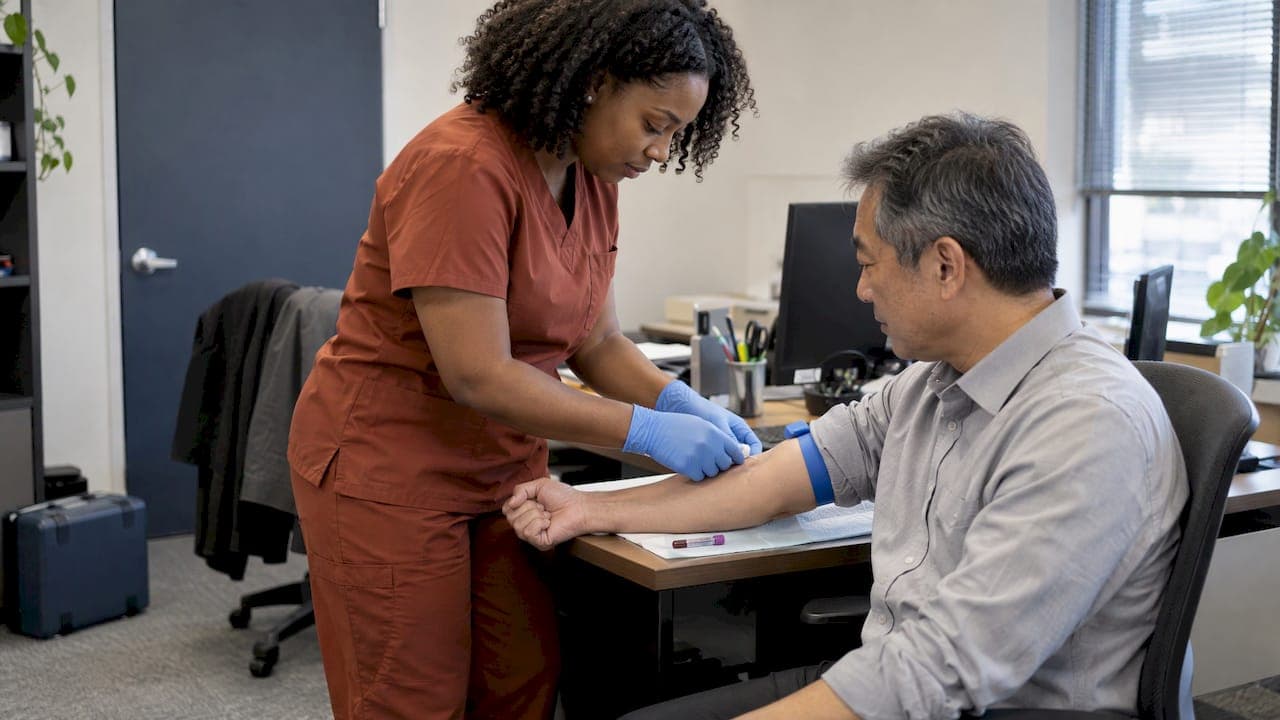
There is no single national license for mobile phlebotomy. The rules come from your state, from federal workplace safety and laboratory regulations, and from the lab that receives the specimen. In practice, a mobile phlebotomist needs the same training and credentials as one working in a clinic, plus a way to keep patient identification, specimen handling and privacy airtight outside a controlled building. This guide covers what is required, how it differs by state, and what patients and providers should confirm before booking a home or office draw.
TL;DR
- Most employers and certification bodies expect a high school diploma or equivalent, a phlebotomy program and documented supervised venipunctures.
- Licensing is state by state. California certifies phlebotomists, Florida licenses them, and Illinois does not require a state license to draw blood.
- A collection-only service does not need its own CLIA certificate in states such as Illinois, but any testing performed on site changes that.
- Every draw needs two patient identifiers, labeling in front of the patient, and safe sharps and transport practices.
- Before booking, confirm who orders the test, who credentials the phlebotomist and which lab receives the specimen.
Table of Contents
- What a mobile phlebotomist actually does
- Training and certification requirements
- State licensing: the biggest variable
- Business and laboratory rules for a mobile service
- Requirements for the draw itself
- Perspective: why requirements matter more when the lab comes to you
- What patients and providers should check before booking
- Mobile phlebotomy with EIV Diagnostics
- FAQ
- Sources
What a mobile phlebotomist actually does
A mobile phlebotomist travels to a home, workplace, care facility or other agreed location, collects blood or other specimens, and gets them to a laboratory. The skill set is the same as in a draw center: venipuncture, capillary sticks, labeling, and handling. What changes is that the phlebotomist works alone, in unpredictable settings, and is responsible for the specimen between the patient’s door and the lab’s receiving bench.
That is why the requirements split into three layers: the person (training and credentials), the service (business, laboratory and workplace rules) and the draw itself (identification, handling, privacy).
Training and certification requirements
Education and experience
The baseline is a high school diploma or GED and completion of a phlebotomy program. Job listings for mobile roles commonly add a certificate and some prior experience, because the work is unsupervised.
National certifications set the benchmark. For the National Healthcareer Association’s CPT exam, applicants need a high school diploma or equivalent and either a phlebotomy program completed within the last five years or qualifying work experience, and they must document 30 venipunctures and 10 capillary sticks. Other national certifying bodies have their own thresholds, so check the one your employer or state accepts.
What a good curriculum covers
California spells out its approved curriculum, and it is a useful checklist anywhere. The state’s approved content includes infection control, universal precautions, patient and specimen identification, tube additives and order of draw, post-puncture care, sharps disposal, specimen transport and storage, complications, quality assurance, ethics and legal issues. Transport, storage and identification matter more for mobile work than for a clinic phlebotomist who hands tubes to a colleague down the hall.
State licensing: the biggest variable
Where you draw blood decides what paperwork you need. Three states show the range.
| State | What the state says | Source |
|---|---|---|
| California | Phlebotomists must hold a state certificate. Training programs must be approved by Laboratory Field Services and include classroom and clinical instruction. | CDPH |
| Florida | Licensing is handled by the Board of Clinical Laboratory Personnel, with biennial renewal. | Florida Board |
| Illinois | No state license or CLIA certificate is needed to draw blood, but a high school diploma or higher and documented training set by the facility medical director or a certified training institution are required. | IDPH |
California in detail
Since EIV Diagnostics serves the Central Valley, California’s rules are the ones we work under. The California Department of Public Health says applicants with no or limited on-the-job experience must complete 40 hours of approved classroom training, 40 hours of clinical practice, at least 50 venipunctures and 10 skin punctures, observe arterial punctures, and pass an approved national exam. The Certified Phlebotomy Technician I certificate authorizes skin puncture and venipuncture blood collection. The same page notes that work experience as an unlicensed laboratory staff person generally does not count toward qualification, with a narrow exception for medical assistants drawing blood in a physician’s office or clinic. Always read the state page for the current form and fee schedule before applying.

If you plan to work across state lines, for example a service near a state border, you need to satisfy each state where the patient is located. Check the state health department or board directly rather than relying on a general job posting.
Business and laboratory rules for a mobile service
CLIA: collecting versus testing
The federal Clinical Laboratory Improvement Amendments apply when a facility performs testing on human specimens. Collection alone is treated differently. Illinois, for instance, says a collection-only site does not need its own CLIA certificate, but it must meet zoning and state laboratory-law requirements and collect under an authorized request or direction. The same state also distinguishes independent collection sites from testing laboratories and expects local and state clinical laboratory and blood bank requirements to be met.
Things change if a mobile unit runs tests in the field. Oregon’s guidance notes that mobile units performing laboratory testing may be covered under the CLIA certificate and address of a designated primary site. If you want a broader framework for how oversight works once testing is involved, these laboratory compliance guidelines walk through the main areas. For a plain-language primer from our side, see our explanation of CLIA certification.

Where the specimen goes
A collector is only as reliable as the lab behind them. CDC guidance says laboratories must have procedures for patient preparation, specimen collection and labeling, storage, transport, processing and acceptability, and that testing may be referred only to a CLIA-certified lab or one meeting equivalent CMS requirements. For a mobile service this means a written agreement with a qualified receiving laboratory and clear instructions on tubes, temperature and delivery timing.
Workplace safety: OSHA
Anyone who employs phlebotomists must follow the federal bloodborne pathogens standard. OSHA requires that the employer train each employee with occupational exposure at no cost and during working hours, at initial assignment and on a recurring schedule set out in the standard. A mobile service should also keep sharps containers, gloves, and spill supplies in the vehicle, since there is no clinic stockroom to rely on.
State-level mobile unit training
Some states go further for mobile operations. Maryland’s regulations, for example, require mobile laboratory personnel to be trained in confidentiality, emergency response, documentation and medical waste disposal, and phlebotomists to be trained in collection methods and infection control, including CDC recommendations. Even where a state does not mandate it, those four topics are a sensible training outline for any mobile team.
Requirements for the draw itself
Identify the right patient, twice
Wrong-patient errors are among the most preventable specimen problems. The CDC encourages collectors to use at least two unique patient-specific identifiers, such as name and date of birth. The Joint Commission’s 2026 goals go further for accredited settings: two identifiers when collecting specimens, no use of room number or location as an identifier, and labeling containers in the patient’s presence. At a kitchen table or office desk, that means checking a photo ID or asking the patient to state their name and birth date, then writing the label before leaving.
Protect specimen quality
The WHO’s phlebotomy guidance, hosted by the CDC, stresses that every step affects specimen quality and patient safety, including contamination, hemolysis, bruising, fainting and needlestick exposure. Practical mobile habits that follow from this:
- Confirm fasting or timing instructions before arriving.
- Draw tubes in the correct order and invert them as instructed.
- Label immediately, with date and time of collection.
- Keep specimens at the temperature the lab specifies and deliver them within its window.
- Dispose of sharps on site in a rated container, never in household trash.
Privacy
A draw in a living room or office hallway is still protected health information. Keep requisitions out of sight, avoid discussing results, and transport specimens in a closed, labeled container that does not display a patient’s full details to bystanders.
Perspective: why requirements matter more when the lab comes to you
We see mobile phlebotomy as a quality discipline first and a convenience second. A draw at someone’s home removes the waiting room, but it also removes the safety net of a busy lab floor, so the standards have to travel with the phlebotomist.
That is why we think of the chain as one piece: a trained collector, correct patient identification, careful handling, and a pathology team that receives the specimen. At EIV Diagnostics, our mobile phlebotomy service is built around that chain, with board-certified pathologists behind the results and a laboratory that holds CAP accreditation.
For patients and providers in the Central Valley, we believe the best way to judge any mobile draw is by how well it keeps the specimen’s story intact from the door to the report. That is the standard we hold ourselves to.
EIV Diagnostics
What patients and providers should check before booking
If you are ordering a draw rather than performing one, the requirements above translate into a short list of questions.
For patients
- Who orders the test? Some tests need a physician’s order. Others can be self-paid without one. Know which route you are using.
- Is the phlebotomist credentialed for your state? In California that means a state certificate.
- Where does the specimen go? Ask which laboratory processes it and how you will get results.
- What should you do to prepare? Fasting, hydration and medication timing affect results. Our guide to preparation steps that avoid rejected samples covers the basics.
- What does it cost? Visit fees and test fees are usually separate, so ask for both.
For providers and employers
- Confirm the order and requisition process, including who receives and signs off on results.
- Ask how the service handles two-identifier checks and labeling on site.
- Confirm the receiving lab’s accreditation and turnaround.
- For group draws at a workplace, plan space, privacy and contract terms. Our article on phlebotomy for employers outlines compliance and contract points.
If you want to compare the types of providers available in your area, our overview of mobile phlebotomy service providers explains what differs between them.
Mobile phlebotomy with EIV Diagnostics
EIV Diagnostics is an independent pathology laboratory in Fresno, serving Fresno, Clovis, Madera, Visalia, Hanford and nearby Central Valley communities. Our mobile phlebotomy service brings the blood draw to your home or office, with visits from $65. Samples go to a laboratory staffed by board-certified pathologists, so the draw and the diagnosis stay under one roof.
Providers can send orders for clinical pathology, molecular testing and more. Patients with or without a doctor’s order can use our self-pay testing. To book, start at our mobile phlebotomy page or see self-pay testing. For what to expect from a visit, read about mobile phlebotomy in the Central Valley.
FAQ
Do you need a license to be a mobile phlebotomist?
It depends on the state. California issues a state certificate, Florida licenses phlebotomists through its clinical laboratory board, and Illinois does not require a state license to draw blood. Check your state health department before you start working.
Does a mobile phlebotomy service need a CLIA certificate?
Not necessarily. CLIA applies to laboratory testing, and states such as Illinois say a collection-only site does not need its own certificate. If testing happens on site, additional certification applies, so confirm with your state agency.
What should a mobile phlebotomist verify at every draw?
They should verify the patient with at least two identifiers, such as full name and date of birth, and confirm the order. Tubes are labeled in the patient’s presence. Never rely on a location or room as an identifier.
What training does a phlebotomist need?
Typically a high school diploma or equivalent, a phlebotomy program, and documented supervised venipunctures and skin punctures. Some states set exact hours and counts, as California does. National certification is often expected by employers.
Sources
- NHA Certified Phlebotomy Technician (CPT)
- CDPH Phlebotomy Training Program FAQ
- CDPH Phlebotomy Training Program Information
- CDPH Phlebotomy Certificate
- CDPH CPT I Certificate
- Florida Board of Clinical Laboratory Personnel
- Illinois Department of Public Health CLIA FAQ
- Oregon multiple-site laboratory guidance
- CDC blood culture contamination quality tool
- OSHA Bloodborne Pathogens Standard
- Maryland COMAR 10.10.06.13
- CDC: Collect Adult Blood Culture Sets
- Joint Commission National Patient Safety Goals 2026
- WHO Guidelines on Drawing Blood