
By EIV Diagnostics · September 29, 2026
Onsite Blood Draws: 5 Medically Supervised Prep Steps to Avoid Rejected Samples
Prepare for an onsite blood draw with five medically supervised steps to avoid rejected samples, verify safety and billing, and learn how EIV Diagnostics...
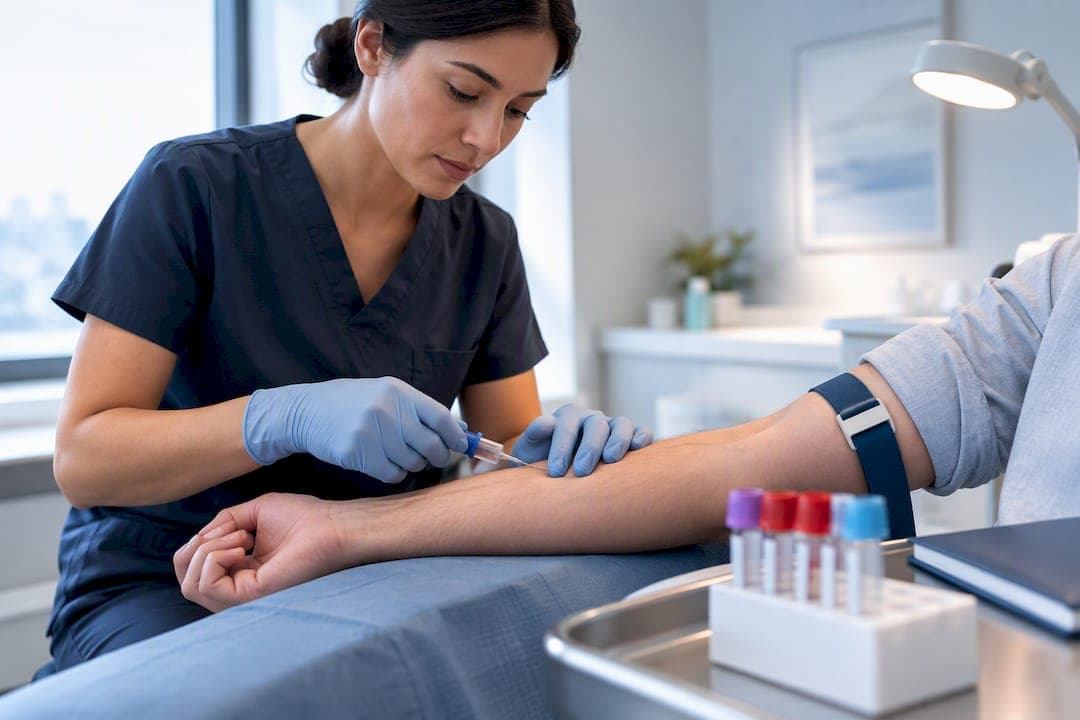
Onsite blood draws are visits by a trained phlebotomist who collects venous or capillary blood samples wherever you are, at home, at work, or inside a care facility, so the sample can be sent to a lab for testing. Mobile phlebotomy services along with in-house testing are available to support these visits. They suit people who are homebound, have limited mobility, or simply want privacy, and they typically involve some pretest preparation plus a possible collection or travel fee.
TL;DR:
- Trained phlebotomists verify identity, handle samples carefully to prevent errors like hemolysis, and ensure proper labeling to maintain sample integrity.
- Most routine tests such as metabolic, lipid, and thyroid panels can be safely collected at home or work without affecting test quality.
- Onsite blood draws are ideal for those with mobility issues, privacy concerns, or in assisted living, but urgent or stat tests are better done in a facility.
- Preparation steps like fasting, hydration, and medication listing can impact results and should be confirmed with your provider before the appointment.
- Medicare and insurance coverage depend on documented mobility limits and proper billing codes, with fees varying based on location and assistance needs.
Table of Contents
- Which tests and services are available during an onsite visit
- Who benefits most from onsite or at-home blood draws
- How to prepare for your blood draw appointment
- What happens during the draw and simple aftercare
- What to check on quality, safety, and billing before you book
- How EIV Diagnostics approaches mobile blood draws
- Booking a mobile phlebotomy visit with EIV Diagnostics
- Sources
- FAQ
Which tests and services are available during an onsite visit
Most routine blood work that a clinic can order can also be collected at home or on site. A phlebotomist arrives with the same equipment used in a lab draw station, so the sample quality and test menu are generally comparable.
- Basic and comprehensive metabolic panels (BMP, CMP) for kidney, liver, and electrolyte checks.
- Lipid panels for cholesterol and triglycerides.
- Complete blood count (CBC) to screen for anemia, infection, or clotting issues.
- Thyroid panels and HbA1c for diabetes monitoring.
- Toxicology panels when ordered by a provider.
Venipuncture is the standard method, drawing from a vein, usually in the arm, and is used for most of these panels. Capillary or finger-stick sampling, a smaller draw from the fingertip, is reserved for tests that need only a few drops, such as glucose checks. Specialized molecular or pathology testing sometimes requires extra coordination with the lab to confirm handling and transport steps before the visit is scheduled.
Who benefits most from onsite or at-home blood draws
Onsite draws make the most sense when getting to a clinic is the hard part, not the test itself.
- People who are homebound or have limited mobility due to age or illness.
- Residents of assisted living or skilled nursing facilities.
- Patients who want privacy for sensitive testing.
- Employees at workplace wellness events or health screenings.
A clinic visit is still the better choice for urgent testing or for tests that require immediate in-facility processing, such as certain stat labs tied to emergency care. For homebound Medicare patients or those in a skilled nursing setting, Medicare’s specimen collection and travel allowance rules spell out when a collection or travel fee applies, so eligibility often hinges on documented mobility limits rather than personal preference.
Pro Tip: Ask ahead whether your visit qualifies under Medicare’s homebound criteria; it can determine whether a travel fee applies.
How to prepare for your blood draw appointment
A few simple steps before the phlebotomist arrives can prevent a canceled draw or a skewed result.
- Confirm fasting instructions with your provider. Many glucose and lipid tests require 8 to 12 hours of fasting, with only plain water allowed, while other panels need no fasting at all.
- List your current medications and supplements, since some affect certain results and your provider may want to know before the draw.
- Stay hydrated and skip strenuous exercise beforehand, both of which can make veins easier to access.
- Have a photo ID ready, along with your provider’s order or confirmation that you are paying directly, plus insurance information if applicable.
- Wear loose sleeves for easy arm access and keep a light snack on hand for after the draw.
Our internal guide on fasting for blood tests covers test-specific prep in more detail.
What happens during the draw and simple aftercare
The visit itself usually takes only a few minutes once the phlebotomist arrives.
- The phlebotomist verifies your identity and confirms the tests ordered.
- They select a vein, typically in the inner arm, and clean the site with an antiseptic.
- The needle is inserted, tubes are filled in a specific order, and each is labeled immediately at your side.
- Pressure is applied to the puncture site and a bandage is placed once the draw is finished.
When only a small sample is needed, a finger-stick replaces the needle draw and takes even less time. Mild lightheadedness or a small bruise at the site are common and usually resolve on their own. Contact your provider if you notice ongoing bleeding, swelling, or signs of infection at the site in the days after your draw.
What to check on quality, safety, and billing before you book
Not every mobile draw service handles samples the same way, so it helps to know what separates a careful visit from a rushed one.
Trained phlebotomists verify identity, select an appropriate site, and manage labeling and infection control, steps that directly protect both patient safety and sample accuracy according to Cleveland Clinic. Skipping or rushing any of these steps raises the risk of a rejected sample.
Haemolysis, the rupture of red blood cells during or after collection, is the most frequent pre-analytical error and can invalidate lab results. PubMed Central
Haemolysis and other pre-analytical errors are largely preventable with correct needle gauge, gentle tube handling, and prompt transport, which is why trained technique matters more than it might seem for a routine draw.
On billing, Medicare’s CY2026 update outlines when specimen collection and travel allowance fees are payable for homebound or institutional patients, tied to specific CPT and HCPCS codes. Before booking, ask a provider about lab accreditation, expected turnaround time, how samples are transported and tracked, and how results will be reported to you or your physician. Veterans researching whether military-related exposure testing qualifies for coverage can check the VA benefits and exposure guide for context on eligibility documentation.

How EIV Diagnostics approaches mobile blood draws
Mobile phlebotomy is run alongside in-house pathology, so a sample collected at your home or office moves to pathologists without changing hands between unrelated labs. That continuity is built around three priorities: protecting sample integrity from the moment of collection, keeping the visit itself comfortable and unhurried, and returning a report that is clear enough for both patients and referring providers to act on quickly. Fast turnaround only matters if the underlying sample was drawn and handled correctly, which is why the visit itself gets as much attention as the lab work that follows.
— EIV Diagnostics
Booking a mobile phlebotomy visit with EIV Diagnostics
Getting a blood draw without the drive, the waiting room, or the parking search is the whole point of mobile phlebotomy, and this option is available to homes, workplaces, and skilled nursing facilities across service areas.
Whether you have a provider’s order or want to arrange testing yourself, the process starts the same way.
- Request a visit through the Mobile Phlebotomy page and choose a setting that fits, home, office, or facility.
- Bring a provider order if you have one, or ask about self-pay testing if you are ordering on your own.
- Have your insurance card or Medicare information ready so coverage can be confirmed before the visit.
- Contact customer service with any questions about scheduling, documentation, or expected turnaround.
Read more about who benefits most from at-home draws in our mobile phlebotomy guide, or reach out directly to get a visit on the calendar.
This article is general information, not a substitute for advice from a qualified doctor. Consult a qualified healthcare professional about your own circumstances before acting on anything here.
Sources
- What you need to know about blood testing - MedlinePlus
- Phlebotomists: Training & What They Do - Cleveland Clinic
- MM14345 – Travel Allowance Fees for Specimen Collections: CY 2026 Updates - CMS
FAQ
What are the three types of blood draws?
The three common collection methods are venipuncture, drawing from a vein, usually in the arm, capillary or finger-stick sampling for smaller volumes, and arterial puncture, which is reserved for specific clinical needs. MedlinePlus notes that venipuncture is the most frequently used of the three.
How much does a mobile phlebotomist charge per draw?
Pricing varies by provider and service area, so it is best confirmed directly before booking. EIV Diagnostics lists its mobile phlebotomy service starting from a competitive price per visit.
What is the most common site for blood draws?
The inner elbow, where a vein is usually easy to access, is the most common site for a standard venipuncture draw. For smaller sample needs, such as glucose checks, a finger-stick is often used instead.
Can I get blood drawn somewhere other than my arm?
Yes, blood can also be collected from the hand or, less commonly, from the foot when arm veins are difficult to access. Finger-stick capillary sampling is another alternative used when only a small sample volume is needed.