
By EIV Diagnostics · September 9, 2026
Clinicians: Close the Critical Lab Value Gap Seen in 0.1–1.1% of Tests
A clinician-focused guide to critical lab values: incidence (0.1–1.1%), reporting targets (~1 hour), immediate actions, and how to close policy-to-bedside...

A critical lab value is a result so far outside the normal range that it signals a potentially life-threatening condition, one that demands the lab notify a clinician immediately rather than waiting for routine reporting. Once identified, the laboratory has a duty to reach a responsible caregiver, get verbal read-back confirmation, and document the exchange, typically within about an hour. Exact thresholds differ by institution, so always confirm the specific cutoffs in your local lab directory before assuming a number applies universally.
TL;DR:
- Critical lab values typically occur in less than 1.1% of tests, with potassium and hemoglobin frequently flagged, especially in high-volume hospitals.
- Notification should happen within about one hour of result verification, with escalation protocols including read-back confirmation and documented communication.
- Thresholds for critical values vary by institution but commonly involve potassium above 6.0-6.5 mmol/L, glucose above 400-500 mg/dL, or hemoglobin dropping below 7 g/dL.
- Response protocols differ based on analyte and clinical context, often requiring immediate treatment for life-threatening levels, such as hyperkalemia with ECG changes.
- Failures often stem from system issues like shift handoffs and alert fatigue, not clinician ignorance, emphasizing the importance of reliable communication systems.
Table of Contents
- What Critical Lab Values Are and Why They Matter to Patient Safety
- Common Critical Analytes and Example Thresholds Clinicians Should Know
- Laboratory Reporting Workflow and Communication Best Practices
- Regulatory and Governance Expectations for Critical-Value Policies
- Clinical Action Priorities on Receiving a Critical Lab Value
- EIV Diagnostics Perspective: Implementing Critical-Value Policy in Practice
- The Gap Between Policy and Practice Is Where Patients Get Hurt
- Where EIV Diagnostics Fits Into Your Critical-Value Workflow
- Sources
- FAQ
What Critical Lab Values Are and Why They Matter to Patient Safety
The concept traces back to pathologist George Lundberg, who coined “panic value” in the 1970s to describe results requiring instant clinician action. That term has fallen out of favor. Most labs and accrediting bodies now prefer “critical value” or “alert value,” language that points to a structured, system-based response rather than a moment of alarm.
The numbers involved are small, but the stakes are not. Reported incidence across clinical laboratory testing typically falls between 0.1% and 1.1%, depending on the patient population and the test mix running through a given facility. That fraction sounds negligible until you consider volume. A hospital lab processing a large volume of tests monthly will generate critical results that require prompt action to avoid patient harm.
A critical value differs from a routine abnormal result and from a garden-variety STAT order. An abnormal potassium of 5.3 mEq/L might warrant a follow-up note in the chart. A potassium of 6.8 mEq/L needs a phone call, because it can trigger fatal arrhythmias before the ordering physician even opens the electronic record. STAT designations describe urgency of processing; critical values describe urgency of consequence. The two categories overlap but are not identical, and conflating them is one of the more common workflow mistakes in busy hospital labs.
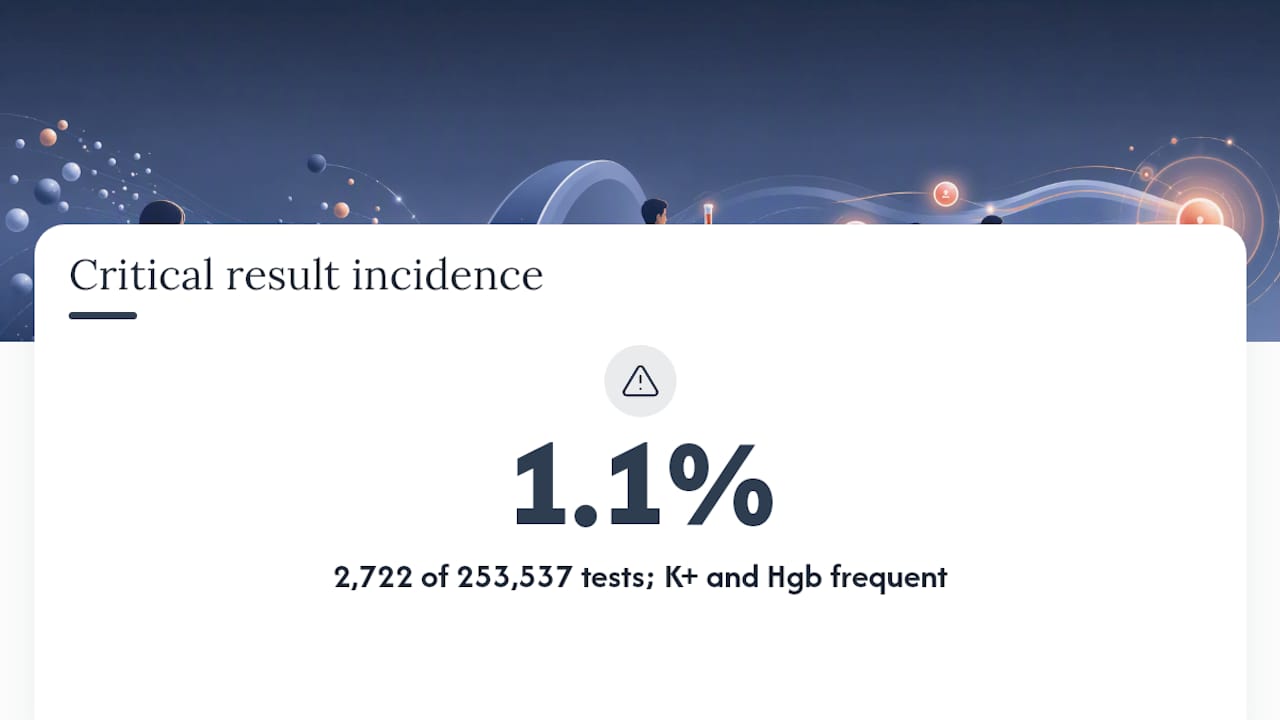
Critical value incidence at a glance: A one-month review at a large tertiary referral center found 2,722 critical results out of 253,537 total tests, an incidence of 1.1%, with potassium and hemoglobin among the most frequent flagged parameters.
That same study found something clinicians should sit with: notification measurably changed what happened next. When a critical value reached the treating team promptly, monitoring intensified and treatment decisions shifted in response. But notification completeness and response speed varied by parameter and by clinical setting, which is exactly the gap that turns a good policy on paper into an inconsistent one at the bedside.
Common Critical Analytes and Example Thresholds Clinicians Should Know
Certain analytes account for the overwhelming majority of critical-value calls, because they sit closest to organ failure, arrhythmia, or hemorrhage when they swing too far in either direction. Electrolytes and glucose top the list, but hematology and coagulation values, blood gases, and cardiac markers all generate their own alert protocols.
The ranges below reflect commonly cited examples pulled from published lab reference lists. They are not a substitute for your institution’s own published critical limits, which vary based on patient population, instrumentation, and local clinical consensus.
These figures come from an aggregated lab reference list at the University of Iowa, which is a useful benchmark but not a universal standard. Your hospital’s own thresholds may sit tighter or looser depending on the acuity of your patient mix.
A few analyte-specific notes worth keeping in mind:
- Potassium swings in either direction threaten cardiac conduction, and a critical high often triggers an immediate ECG order alongside the phone call.
- Glucose extremes at either end can produce altered mental status fast enough that a delayed callback becomes a safety event, not just a documentation lapse.
- Hemoglobin drops matter more for the trend than the single value. A patient trending from 11 to 7 over six hours is a different emergency than a stable chronic anemic sitting at 7.
- Platelets below roughly 20,000/microliter raise spontaneous bleeding risk sharply enough that most labs flag them regardless of the patient’s baseline.
- INR elevations demand context. A therapeutic warfarin patient at 4.5 is a different conversation than an unanticipated 4.5 in someone not on anticoagulation.
- Arterial blood gases showing severe acidosis or alkalosis, or profound hypoxemia, generally route through the same critical pathway even though blood gas panels are analyzed differently from a chemistry panel.
- Troponin, while handled somewhat differently across institutions, often carries its own rapid-notification protocol given the direct tie to acute coronary events.
The pattern across all of these analytes is the same: the number itself matters less than the physiologic cliff it represents. A lab tech flags a critical potassium not because 6.2 is an arbitrary line, but because past that line the myocardium starts misfiring.
Laboratory Reporting Workflow and Communication Best Practices
Getting a critical value from the analyzer to the bedside involves more steps than most clinicians realize, and each one is a place where the process can break down.
- Instrument flagging and technologist verification. The analyzer flags the result against pre-programmed critical limits, and a technologist checks for interference, sample integrity issues, or clerical error before treating the number as real.
- Repeat testing when indicated. Some results, particularly ones that seem physiologically implausible, get an immediate repeat run rather than an immediate phone call, to rule out a hemolyzed or mislabeled specimen.
- Identification of the responsible caregiver. The lab identifies who ordered the test and who is currently responsible for the patient, which in a hospital setting may not be the same person given shift changes.
- Notification attempt within the target window. Most institutions target notification within about an hour of result verification (https://pmc.ncbi.nlm.nih.gov/articles/PMC7065418/), with STAT and point-of-care results often expected faster still.
- Closed-loop read-back. The person receiving the call repeats the value back to the lab, confirming they heard it correctly. This single step catches a surprising number of transcription and mishearing errors before they become clinical ones.
- Escalation if the primary contact is unreachable. Many labs use a tiered escalation ladder: if the ordering clinician doesn’t answer, responsibility shifts to a covering physician, then a supervisor or pathology resident, with a failsafe rule to notify the on-call physician or emergency department if patient safety is at stake.
- Documentation in the laboratory information system. The lab logs who was called, when, what was communicated, the read-back confirmation, and any escalation steps taken, creating an audit trail that both protects the patient and satisfies accreditation review.
Pro Tip: If your unit frequently misses critical-value calls during shift changes, ask your lab whether its escalation ladder accounts for handoff timing. A five-minute mismatch between when the lab calls and when the outgoing nurse signs off is a common, fixable gap.
Two systemic risks undermine this workflow more than any single human error. The first is alert fatigue: when critical-value thresholds are set too sensitively, clinicians start treating every call as noise, which is exactly the failure mode that periodic threshold review is meant to prevent. The second is the handoff gap, where a result lands during a shift change and nobody owns the follow-up. Patient safety research on communication failures consistently points to these latent system issues, not individual carelessness, as the root cause of missed critical results. Redundant notification pathways, meaning more than one way to reach a responsible clinician, reduce that risk meaningfully.
Regulatory and Governance Expectations for Critical-Value Policies
The requirement to have a formal critical-value policy is not optional in the United States. It is written into federal regulation and reinforced by the accreditation bodies that certify hospital laboratories.
Under CLIA '88, every certified laboratory must maintain documented procedures for reporting critical values, spelled out in its laboratory procedure manual. This isn’t a suggestion buried in best-practice literature. It’s a condition of certification. The Joint Commission goes further with its National Patient Safety Goals, which specifically call for timely reporting of critical results and mandate read-back verification for any critical value communicated verbally.
The College of American Pathologists and ISO 15189 add another layer, focusing on governance rather than just procedure. Accreditation under these standards typically expects a lab to show, not just claim, that its critical-value list reflects clinical input and that performance is tracked over time.
In practice, meeting these expectations means:
- Maintaining a written, current critical-value list in the lab manual, reviewed on a defined schedule.
- Involving clinical stakeholders, not just laboratory staff, when setting or adjusting thresholds.
- Auditing notification timeliness and completeness against a defined performance target.
- Tracking read-back compliance as its own metric, separate from whether notification happened at all.
- Investigating outlier cases where notification was delayed or missed, and feeding findings back into policy.
The reason for the multidisciplinary review point deserves emphasis. There is no single universal list of critical limits, and surveys of laboratories show real variability in what counts as critical for the same analyte. A threshold set too conservatively floods clinicians with unnecessary calls; one set too loosely misses genuine emergencies. Getting that balance right requires input from the people actually managing the patients, not just the people running the analyzer.
Clinical Action Priorities on Receiving a Critical Lab Value
The phone rings, the lab reads back a critical potassium of 6.7, and now the clock that matters is yours, not the lab’s. What happens in the next few minutes should follow a predictable sequence rather than an improvised one.
- Verify the clinical context immediately. Does the number match the patient in front of you? A critical hemoglobin of 6.2 in a patient who looks comfortable and stable deserves a second look before triggering a transfusion cascade.
- Confirm with bedside or point-of-care tools where available. Hyperkalemia gets an immediate ECG to check for peaked T waves or widened QRS. Suspected hypoglycemia gets a fingerstick glucose check rather than waiting on a repeat venous draw.
- Decide whether to treat empirically or wait for repeat confirmation. Severe hyperkalemia with ECG changes gets treated now, not after a confirmatory redraw. A borderline, asymptomatic result without corroborating clinical signs may warrant a quick repeat before committing to intervention.
- Initiate first-line stabilization based on the specific analyte. Hyperkalemia calls for calcium gluconate, insulin/dextrose, and consideration of dialysis in refractory cases. Severe hypoglycemia calls for dextrose or glucagon. Severe symptomatic hyponatremia calls for cautious, monitored correction to avoid overcorrection injury. Markedly elevated INR with active bleeding calls for reversal agents rather than watchful waiting.
- Reassess and repeat testing on a defined interval. Document the repeat value and whether the intervention produced the expected physiologic response.
- Close the loop with the lab and the chart. Document what was done, when, and communicate the outcome, since that feedback is part of what accreditation reviewers and internal audits expect to see.
The instinct to wait for a confirmatory repeat before acting is often wrong when the clinical picture already matches the number. A critical value with matching symptoms is not a lab artifact to be double-checked at leisure. It’s a patient to be treated now.
EIV Diagnostics Perspective: Implementing Critical-Value Policy in Practice
Written policy only protects patients when it survives contact with an actual shift. An independent pathology laboratory serving Fresno and the surrounding Central Valley builds its critical-value procedures the way accreditation standards intend: documented in the lab manual, tied to a defined notification window, and closed out with read-back confirmation logged in the laboratory information system for audit purposes.
Qualified pathologists oversee result verification before any critical value goes out, which matters as much for accuracy as for speed. Because the laboratory also runs mobile phlebotomy for patients drawn at home or in a provider’s office, urgent findings from an off-site draw follow the same escalation ladder as an in-clinic result, with the ordering provider identified and contacted directly rather than left to a generic callback queue.
Clinicians working with EIV Diagnostics can review the lab’s current critical-value list and urgent contact procedures through its clinical pathology services, where reporting workflows and turnaround expectations are outlined for referring providers.
The Gap Between Policy and Practice Is Where Patients Get Hurt
The evidence here supports a specific, sometimes uncomfortable conclusion: most critical-value failures aren’t about clinicians not knowing what a dangerous number means. They’re about systems that fail quietly between the analyzer and the bedside, a missed page during a shift change, a threshold set too sensitively for anyone to trust anymore, a read-back skipped because everyone’s in a hurry.
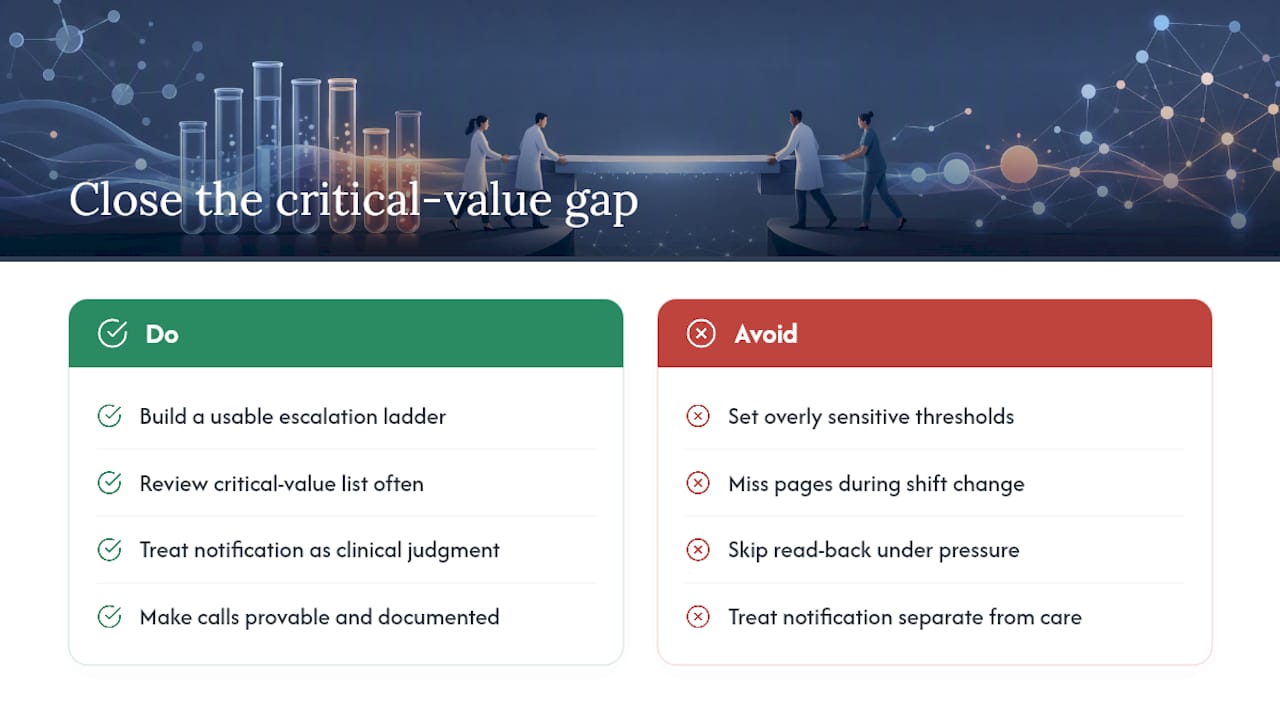
Conventional advice on this topic tends to focus almost entirely on memorizing thresholds, and that’s the easy part. The harder, more consequential work is building an escalation ladder that actually gets used at 3 a.m., and reviewing your critical-value list often enough that it reflects your actual patient population rather than a generic textbook range from a decade ago.
If there’s one priority to take from this, it’s to stop treating notification and documentation as separate from clinical judgment. They are the clinical judgment, applied at the system level. A lab that calls fast but can’t prove it, or a clinician who acts fast but never closes the loop, both leave the same gap open for the next patient.
— EIV Diagnostics
Where EIV Diagnostics Fits Into Your Critical-Value Workflow
If you’re a referring provider trying to reduce the lag between a dangerous result and a documented clinical response, the lab you work with matters as much as your own protocol. The laboratory is built around exactly that link: experienced pathologists reviewing results, a documented critical-value process, and mobile phlebotomy that brings collection to the patient without adding a step to the notification chain.
That structure matters most for practices managing homebound, elderly, or high-acuity outpatients, where a delayed draw or a missed callback carries real consequences. EIV Diagnostics’s molecular pathology services and broader diagnostic offerings are built for providers who need both precision and a lab that answers the phone when a result demands it. Reach out to the laboratory to review its published critical-value limits and confirm the notification procedures that would apply to your practice before you need them in an emergency.
Sources
For anyone drafting or auditing a critical-value policy, four sources carry the most direct practical weight. The Siriraj Hospital study on laboratory critical value reporting supplies incidence data and outcome evidence at scale. The University of Iowa’s aggregated critical lab value list gives a concrete reference point for typical thresholds. The pathology consultation review on critical value reporting lays out the regulatory language behind CLIA and Joint Commission expectations. The PLOS ONE analysis of notification variability shows where real-world response times and rates diverge from policy on paper. Cross-reference all four against your own institution’s lab manual before assuming any number applies to your setting.
- University of Iowa — common critical lab values
- Pathology consultation on reporting of critical values
- The effect of laboratory critical value reporting on patient management at Siriraj Hospital
FAQ
What Are Critical Values in Laboratory Tests?
A critical value is a test result far enough outside the normal range that it indicates a potentially life-threatening condition, requiring the lab to notify a clinician immediately rather than through routine reporting channels.
What Is Considered a Critical Lab Value?
There’s no single universal cutoff. Institutions set their own thresholds, though common examples include potassium above roughly 6.0-6.5 mmol/L or below 2.5-3.0 mmol/L, and glucose above about 400-500 mg/dL or below 40-50 mg/dL, according to aggregated reference lists.
What Are Critical Lab Values in Critical Care Settings?
In critical care, the same analytes apply, but the acceptable window often narrows because baseline patient acuity is higher, so ICU-specific critical-value lists sometimes differ from general ward thresholds at the same institution.
What Does a Critical Value in a CBC Test Indicate?
A critical hemoglobin or platelet count on a complete blood count typically signals a risk of severe hypoxia, hemorrhagic shock, or spontaneous bleeding, and it usually triggers immediate clinical assessment alongside the notification call.
How Fast Should a Lab Notify a Clinician of a Critical Value?
Most institutions target notification within about one hour of result verification, with STAT and point-of-care testing often held to a faster standard, based on guideline consensus on critical-value reporting.