
By EIV Diagnostics · November 27, 2026
Urine Adulteration Detection: How Labs Spot a Tampered Sample
How labs detect urine adulteration: creatinine, specific gravity, pH and oxidant checks, what the results mean, and where on-site strips fall short.
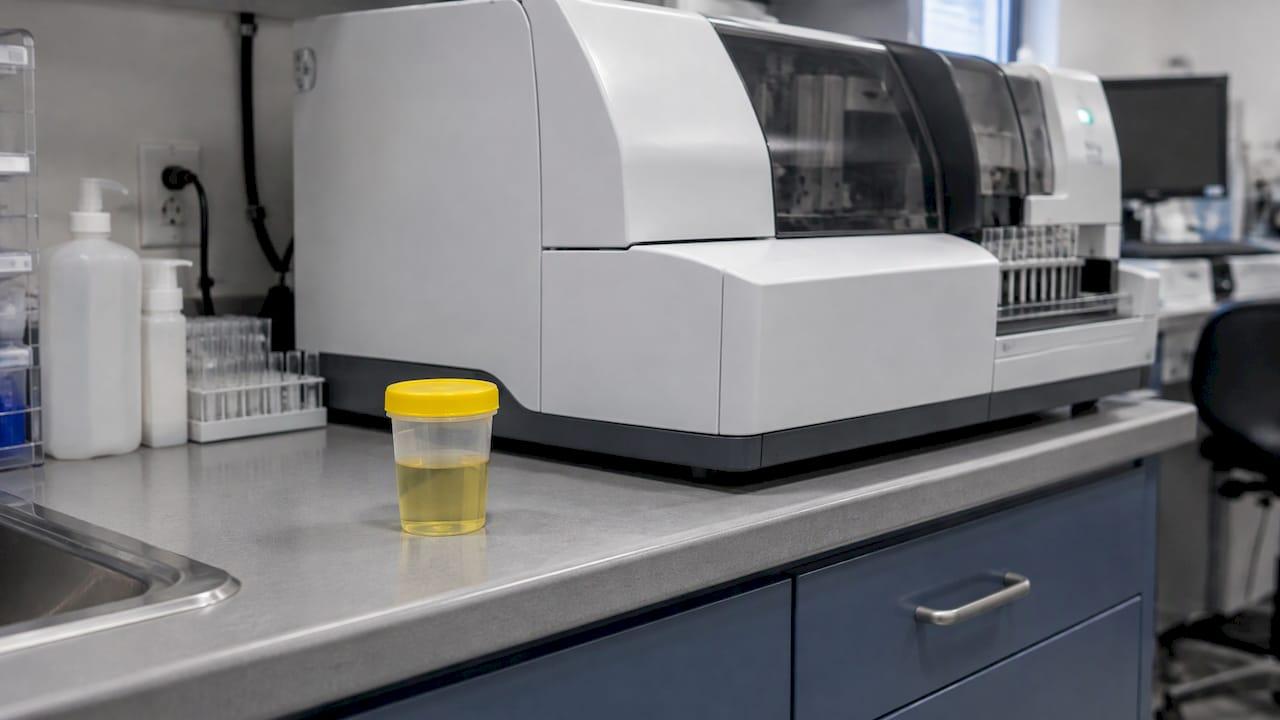
Labs detect urine adulteration with specimen validity testing (SVT): a set of checks on creatinine, specific gravity, pH and oxidizing chemicals that run alongside the drug screen and show whether the sample is real, intact and undiluted. A good collection comes first, and a laboratory with the right toxicology capability comes second. At EIV Diagnostics, an independent pathology laboratory in Fresno, we offer toxicology testing for providers and for self-pay patients, so this guide explains what the checks look for, what the results mean and where the weak points are.
TL;DR
- Adulteration means adding a substance to a urine sample to destroy or mask a drug. Dilution and substitution are different tampering methods, and SVT is designed to catch all of them.
- Labs check creatinine, specific gravity and pH on every specimen, plus oxidant tests for chemicals such as nitrite, chromium (VI) and glutaraldehyde.
- A dilute, invalid, adulterated or substituted result is a laboratory finding, not a verdict. In federal workplace testing a physician reviewer decides what it means.
- On-site test strips miss some adulterants and cannot reliably recognize synthetic urine, so the observed, documented collection matters as much as the chemistry.
- Federal cutoffs are being revisited: HHS proposed a change to the invalid pH cutoff in October 2026.
Table of Contents
- What adulteration means, and how it differs from dilution and substitution
- The checks a laboratory runs on every specimen
- What the result means: dilute, invalid, adulterated, substituted
- How well do adulteration strips and field kits work?
- The collection is the first line of defense
- What may change in the federal rules
- Getting a reliable toxicology result with EIV Diagnostics
- Our perspective
- FAQ
- Sources
What adulteration means, and how it differs from dilution and substitution
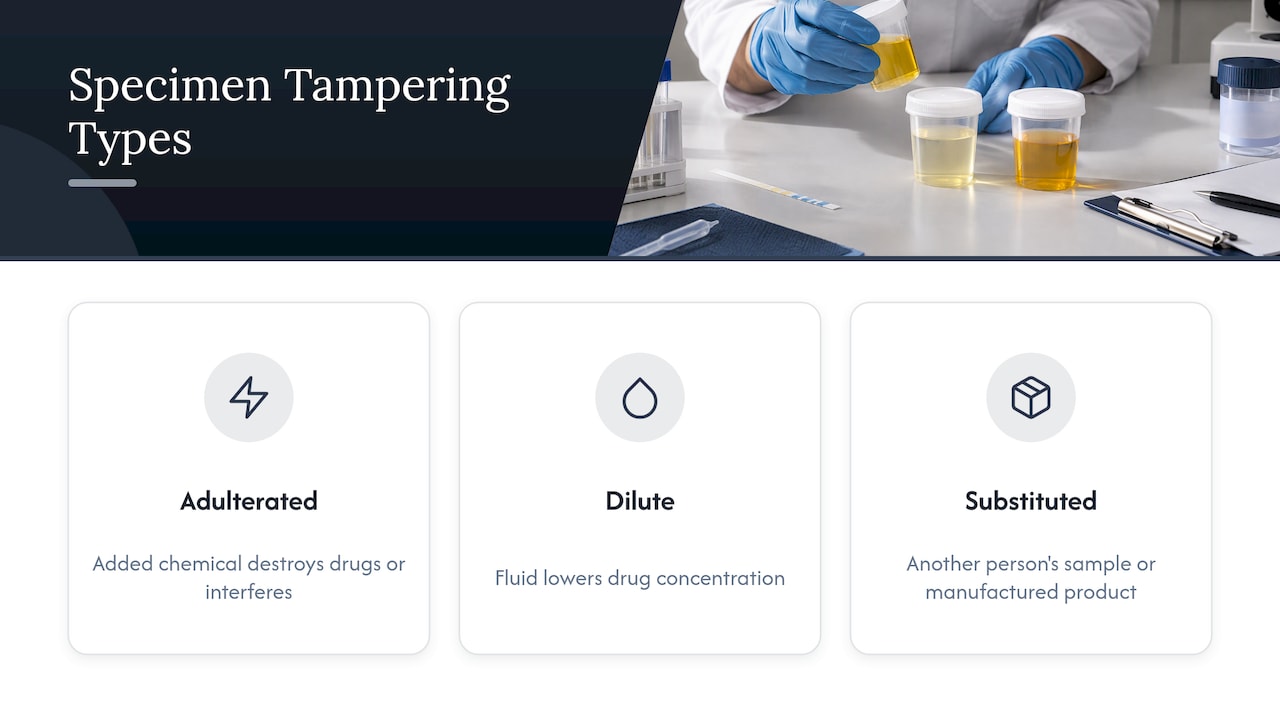
Three things are often lumped together as “tampering,” and labs separate them because each leaves a different chemical signature.
Adulteration is adding a substance to the specimen that destroys a drug or its metabolite, or interferes with the lab’s testing. Laboratory professionals define it as an in vitro addition, meaning the chemical goes into the cup, not into the body. Common examples include bleach, laundry detergent and table salt, plus commercial products built around glutaraldehyde, peroxidase, pyridinium chlorochromate and potassium nitrite. Glutaraldehyde in particular is used to produce false-negative cannabinoid results.
Dilution means the donor drinks a lot of fluid, or adds water, so the drug concentration falls. Training material for North Carolina corrections staff notes that two or three 12-ounce glasses of water at once can produce urine diluted about tenfold within half an hour. Dilution can also happen innocently, from heavy hydration or diuretics.
Substitution means handing in something else in place of your own urine: another person’s sample, or a manufactured product. It is a different act from adulteration, even though the two are often reported together.
In practice, SVT sorts each specimen into one of four categories: dilute, invalid, substituted or adulterated. The reader of a lab report mostly needs to know which of the four they are looking at.
The checks a laboratory runs on every specimen
In federally regulated (DOT) testing, 49 CFR 40.87 requires the laboratory to measure creatinine on each primary urine specimen, measure specific gravity when creatinine is below 20 mg/dL, measure pH, and run at least one oxidizing-adulterant test. If the specimen looks abnormal, reacts like an adulterant or shows signs of an unidentified interferent, the lab adds further validity tests. These rules apply to regulated workplace programs, but non-regulated testing commonly borrows the same logic.
Here is what each check tells the lab, using the ranges published by the National Laboratory Certification Program (NLCP):
| Check | Typical range for real urine | What a flagged result suggests |
|---|---|---|
| Creatinine | 20 mg/dL or higher | Dilution or substitution when low |
| Specific gravity | 1.0030 to 1.0200 | Dilution or substitution when outside the range |
| pH | About 4.5 to 9.0 | Acid or alkali adulteration; below 4.0 or 11.0 and above is reported as adulterated |
| Nitrite | Under 200 mcg/mL | 500 mcg/mL or more is adulterated |
| Chromium (VI) | Not present | 50 mcg/mL or more is adulterated |
| Halogens, glutaraldehyde | Not present | Detection at or above the lab’s quantitation limit |
Creatinine is a waste product the body releases at a fairly steady rate, so it is a good yardstick for how concentrated a sample is. Specific gravity measures the same thing from a different angle. Water and most store-bought liquids have almost no creatinine, which is why apple juice, soda or colored water fail the creatinine check.
Where the exact lines fall
The federal rules define the categories precisely. Under 49 CFR 40.88, a specimen is dilute when creatinine is at least 2 mg/dL but under 20 mg/dL and specific gravity is above 1.0010 but below 1.0030. It is substituted when creatinine is under 2 mg/dL and specific gravity is 1.0010 or lower, or 1.0200 or higher, confirmed on two separate aliquots (portions of the same sample). Those numbers describe a sample that is not plausibly human urine.
For the drug side of the report, our guide to federal urine and oral fluid cutoff levels lays out the thresholds used for the drug screen itself.
Why the lab often does not need to name the method
Different tampering methods can produce the same SVT result. An oxidant reading can come from an adulterant or from a substitution product, so the lab typically does not need to work out exactly which one was used. Both count as subverting the test.
Immunoassay screens are also sensitive to adulterants. Adulterant effects may be limited to a single drug class, and a lab may report a specimen invalid when interference appears on two separate aliquots, for example a “super-negative” screening reading or interference on a chromatogram. Our explainer on how confirmatory drug testing works shows how a second, more specific method follows the screen.
What the result means: dilute, invalid, adulterated, substituted
A laboratory flag starts a process. It does not end one. SAMHSA’s 2025 Medical Review Officer (MRO) Guidance Manual states that an invalid, adulterated or substituted lab result does not by itself identify a person as having tampered. A physician MRO reviews the result against the donor interview and the collection paperwork, and reports only verified results.
The same manual describes what happens next:
- Adulterated or substituted: the MRO contacts the donor to ask about a legitimate medical explanation. With none, the result is reported as a refusal to test.
- Invalid: the test is cancelled with the reason stated. If there is no legitimate explanation, the MRO directs an immediate recollection under direct observation. If that second specimen is also invalid, the MRO recommends another authorized specimen type or a clinical evaluation.
- Dilute: reported only together with a negative or positive drug result, with the creatinine and specific gravity values supporting it. A dilute specimen is not evidence of drug use, but it typically leads to a recollection.
For clinicians, a dilute result matters for another reason. Samples with creatinine under 20 mg/dL do not accurately reflect a patient’s drug use history, so a negative on a dilute specimen carries less weight. A peer-reviewed clinical review advises collecting a second specimen under observation when the first looks adulterated or diluted.
Innocent reasons for odd results
Not every unusual sample is tampered with. The same review notes that unusual color or out-of-range values can come from medications, foods or disease states, including diuretics, a strict vegetarian diet and high hydration, which is why documenting these factors is imperative when interpreting a result. Patients should tell the collector and the reviewing clinician about any medication or heavy fluid intake. For the drug-result side, see our guide to false positive drug test causes.
Two popular myths are worth settling. There is no evidence that taking vitamin B12 to color urine, or creatine monohydrate to raise creatinine, effectively alters or defeats SVT.
How well do adulteration strips and field kits work?
On-site adulteration strips are quick, and they have a place as a first look. They are also limited.
- In one study, commercial strips flagged only 5 of 13 adulterated samples. They detect oxidizing compounds but did not catch every adulterant at concentrations that could affect an immunoassay screen.
- A 2001 field evaluation of three on-site devices found large differences between products. One was the most sensitive when all its pads were read together, while another did not detect several commercial adulterants.
- Synthetic urine is harder still. A 2018 study found that eight of nine commercial synthetic urine products were reported valid or dilute by standard SVT at a federal laboratory, because they were formulated with realistic pH and creatinine and no oxidant activity. A dedicated field kit flagged all nine synthetic samples but also flagged 8 of 116 authentic specimens, about 6.9%.
The lesson is that no single strip or number settles the question. Laboratory chemistry works best as part of a chain that starts at the collection site.
Method choice inside the lab
How the lab measures matters too. A 2021 method comparison found 81.9% agreement between automated chemical specific gravity and a refractometer, and only 64.7% between the chemical method and a dipstick. It recommended automated chemical methods plus an oxidant assay for consistency and speed. Methods must also be validated before use and, except for pH and specific gravity, re-verified at least annually.
How common is manipulation?
Less common than many people assume. A review of more than 21,000 specimens reported a mean five-year manipulation prevalence of about 1.0% in workplace testing and about 3.8% in court-setting samples, with dilution the most frequent form in both. Online discussions now point to substitution as the most common strategy, with adulteration rarely mentioned.
The collection is the first line of defense
Because substitution is hard to catch chemically, the way the sample is collected carries real weight. Collectors using proper procedures are the most effective defense against substitution. Visual inspection and a temperature check at the time of collection are part of SVT alongside the lab tests. Direct observation reduces tampering but does not eliminate it, which is why the lab checks still run on every sample.
For providers, the practical steps are:
- Record the collection conditions, including the temperature check and anything unusual about the specimen’s appearance or smell.
- Note the patient’s medications, diet and fluid intake, since these explain many borderline values.
- Send the specimen to a laboratory that reports creatinine, specific gravity and pH values, not just a drug result.
- Treat a dilute or invalid result as a reason to recollect, ideally under observation, rather than as a conclusion.
- Confirm unexpected screening results with a more specific method. Our article on confirming unexpected results with LC-MS/MS covers this for pain management.
Collection mistakes can also mimic tampering. Mislabeled, mishandled or heat-exposed samples cause trouble of their own, and our guide to specimen collection errors and how to prevent them walks through the common ones. Heat matters for a specific reason: at pH above 9.5, analytes such as benzoylecgonine, PCP and 6-acetylmorphine are not stable, with losses of 61% to 100% after three days at room temperature.
What may change in the federal rules
The federal cutoffs are not frozen. In October 2026, HHS published a proposed rule in the Federal Register that would raise the invalid-specimen pH cutoff from 9.0 to 9.5. It would also let an MRO authorize a biomarker test on a specimen that is invalid because of creatinine or specific gravity, and let a split-specimen laboratory test any HHS-authorized biomarker to reconfirm substitution. HHS reasoned that the 9.0 to 9.5 range generates confirmatory testing, MRO review and recollections without identifying additional adulterated specimens, and cited data showing that extended time at high temperature can push pH to 9.1 to 9.3.
A proposal is not a final rule. Check the Federal Register page for its current status before relying on any new cutoff. The existing 2008 HHS Mandatory Guidelines define invalid results for pH from 3 to under 4.5 or from 9 to under 11 on two aliquots, and nitrite at 200 mcg/mL or more on the initial test with a confirmatory result from 200 to under 500 mcg/mL.
Getting a reliable toxicology result with EIV Diagnostics
If you are a provider who needs toxicology results you can interpret, or a patient who wants a test without a doctor’s visit, EIV Diagnostics is an independent, CAP-accredited laboratory in Fresno with board-certified pathologists, offering toxicology and other clinical services. Patients can order through self-pay testing, with or without a doctor’s order, and providers can send specimens for reporting built around rapid turnaround.

For draws away from the lab, mobile phlebotomy brings a draw to your home or office, from $65 per visit. We serve Fresno, Clovis, Madera, Visalia and the surrounding Central Valley communities.
Our perspective
Most of the confusion we see around adulteration comes from treating one number as a verdict. A low creatinine, an odd pH or a strip that changes color is a prompt to look closer, not a conclusion about a person.
We think the useful lab is the one that reports the supporting values with the drug result, so the clinician or reviewer can read the whole picture: creatinine, specific gravity, pH and the oxidant findings together. That is how a dilute sample gets recollected instead of misread, and how an unexpected screen gets confirmed instead of guessed at.
It is also why we pair CAP-accredited laboratory standards with board-certified pathologists and rapid turnaround. Providers need results fast enough to act on, and patients deserve results they can trust. A careful collection and a careful lab report are what make a sample result mean something.
EIV Diagnostics
FAQ
How can you tell if a urine sample has been adulterated?
Labs measure creatinine, specific gravity and pH, and run oxidant tests for substances such as nitrite, chromium (VI), halogens and glutaraldehyde. They add more tests if the sample looks or reacts unusually. A temperature check and visual inspection at collection support the lab work.
What is the difference between a dilute and an adulterated urine sample?
A dilute sample has low creatinine and specific gravity, usually from drinking a lot of fluid, and it is not evidence of drug use. An adulterated sample contains an added substance, or has a pH or oxidant level outside the reportable limits. A dilute result typically leads to a recollection.
Do adulteration test strips catch everything?
No. In one study, commercial strips flagged only 5 of 13 adulterated samples, and they cannot reliably separate synthetic urine from real urine. Laboratory validity testing and a well-documented collection give a more complete picture.
Does a flagged result mean the person tampered with the sample?
Not automatically. In federal workplace testing, a physician MRO reviews the lab result with the donor interview and collection documentation before anything is reported. Medications, diet and heavy hydration can all produce out-of-range values, so tell the collector and reviewer about them.
What happens after an invalid urine result?
Under SAMHSA’s 2025 guidance, the MRO reports the test as cancelled with the reason. If there is no legitimate medical explanation, an immediate recollection under direct observation follows. If that sample is also invalid, another specimen type or a clinical evaluation may be recommended.
Sources
- Validating Specimen Validity Testing, NLCP Drug Testing Matters, 2023
- An Introduction to Specimen Validity Testing in Workplace Drug Testing, NLCP, December 2025
- Adulteration and Dilution Checks, UNC School of Government course materials
- Drug Testing, StatPearls, NCBI Bookshelf
- 49 CFR Part 40 Subpart F, eCFR
- Medical Review Officer Guidance Manual for Workplace Drug Testing, SAMHSA, 2025
- Clinical Interpretation of Urine Drug Tests, 2017
- NDCI Benchbook, Chapter 6: The Fundamentals of Drug Testing
- Advances in testing for sample manipulation in clinical and forensic toxicology, 2023
- Can synthetic urine replace authentic urine to beat workplace drug testing, 2018
- Comparison of different methods used in drugs of abuse for specimen validity testing, 2021
- A Field Evaluation of Point-of-Care Urinalysis Drug Testing, SOFT 2001 meeting abstracts
- HHS proposed rule, Federal Register, October 29, 2026
- HHS Mandatory Guidelines, Federal Register, November 25, 2008