
By EIV Diagnostics · November 25, 2026
Home Blood Draw Insurance: What Is Covered in 2026
Does insurance pay for a home blood draw? See how Medicare, Medicaid and private plans treat the test and the visit, plus what to check before you book.
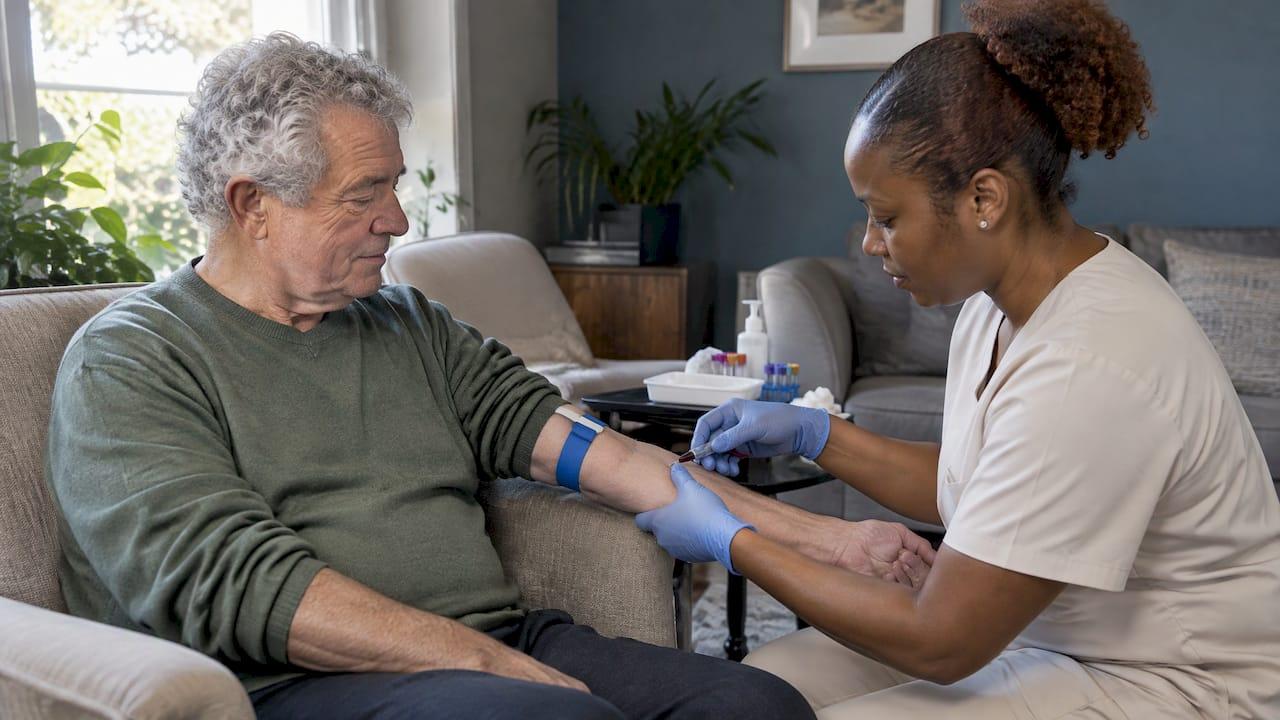
Insurance often pays for the lab test itself, but the home visit is a separate question. Medicare pays a specimen collection fee for a home draw only when the patient is homebound and a doctor has ordered the test. Medicaid and private plans set their own criteria, and many tie them to Medicare’s. If you don’t meet those criteria, you can book a mobile draw with a known visit fee instead of a surprise bill. At EIV Diagnostics, mobile phlebotomy starts at $65 per visit, and we draw at homes and offices across Fresno and the Central Valley.
TL;DR
- A doctor’s order is the starting point for any insured home draw. Medicare covers medically necessary lab tests ordered by a provider, and you usually pay nothing for the test itself.
- Medicare’s collection fee for a home draw requires the patient to be homebound. That doesn’t mean bedridden.
- Medicare’s 2026 collection fee is $9.34, and the travel allowance is $1.25 per mile or a flat $12.50 per trip. These amounts are paid to the lab and are separate from your test.
- Medicaid and private plans write their own home-draw rules. Ask your plan before the visit, not after the bill.
- If you are paying yourself, a published per-visit price lets you plan the cost. EIV Diagnostics mobile phlebotomy is from $65 per visit.
Table of Contents
- Two bills, not one: the test and the draw
- What Medicare covers
- Medicaid: the state sets the rules
- Private and Medicare Advantage plans
- A checklist before you book a home draw
- If you don’t meet the criteria: paying for the visit yourself
- What we think about home draws and coverage
- Book a draw in the Central Valley
- If a claim is denied
- FAQ
- Sources
Two bills, not one: the test and the draw
A home blood draw has two parts that insurers treat separately.
- The lab test. This is the analysis of your blood: cholesterol, A1C, thyroid, a metabolic panel and so on.
- The collection. This is the trained technician who comes to you, finds the vein and handles the specimen. It can include a travel allowance.
Your plan can cover the first and decline the second. That is where most surprise charges come from. The sections below show how each part is handled and what to confirm before the visit.
What Medicare covers
Medicare.gov states that Part B covers medically necessary diagnostic laboratory tests ordered by a health care provider. It adds that you usually pay nothing for Medicare-covered diagnostic lab tests. The exact amount you owe can depend on other insurance, assignment, and where the test is done.
The test must also relate to a reason. The Medicare Claims Processing Manual says lab services must relate to the patient’s illness, injury, symptom or complaint and be ordered by a physician. A routine panel you order for curiosity doesn’t fit that pattern.
The homebound rule for the collection fee
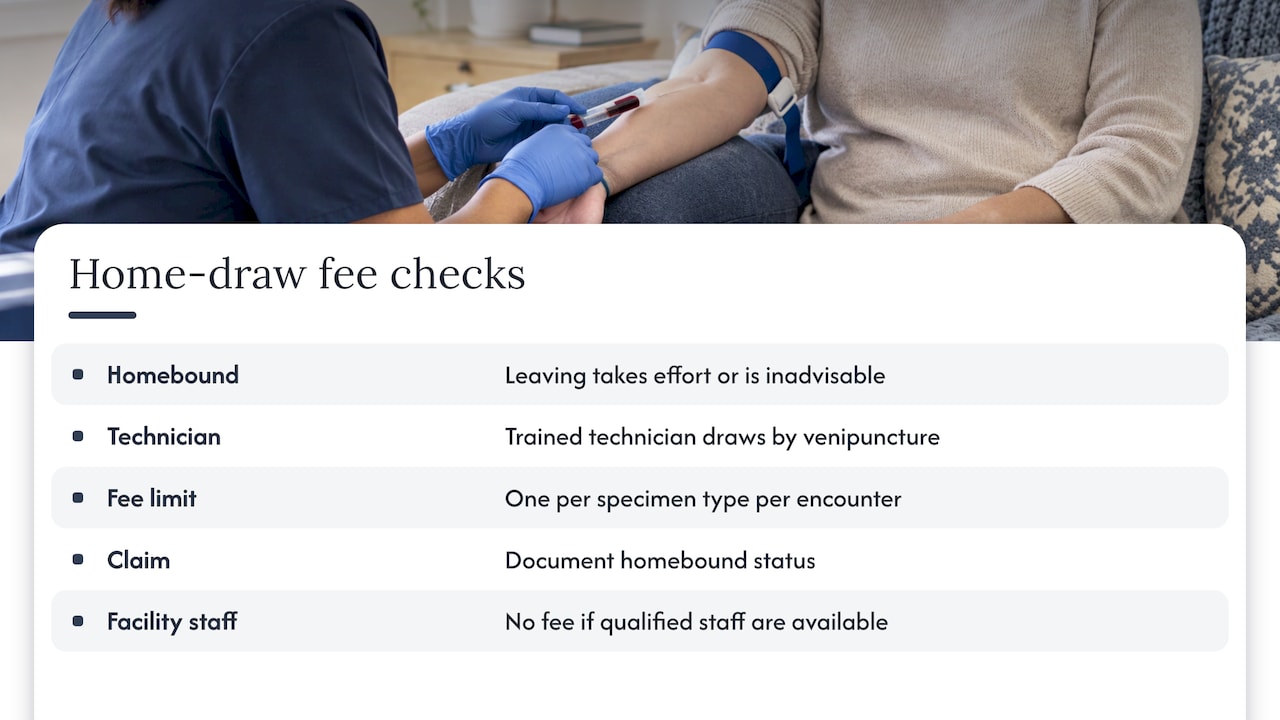
For the draw itself, CMS guidance says a specimen collection fee is payable when a trained technician, including a phlebotomist, personally draws blood by venipuncture from a homebound Medicare patient. The same document states that a homebound patient does not need to be bedridden. It also allows only one collection fee per specimen type per patient encounter.
In practice, “homebound” usually means leaving home takes real effort, such as a walker, wheelchair, special transportation or another person’s help, or leaving is medically inadvisable. The Medicare Claims Processing Manual also says the claim must be annotated to show the patient is homebound, and the fee isn’t paid if a facility has qualified staff on duty to draw.
If you are a healthy 58-year-old who would rather not take a lunch break to visit a lab, the Medicare collection fee isn’t designed for you. That is a good reason to look at a self-pay visit, covered further down.
What the 2026 Medicare amounts are
These figures are set by CMS each calendar year, so check the current transmittal when you read this.
| Item | CY 2026 amount | Source |
|---|---|---|
| General specimen collection fee | $9.34 | CMS MM14345 |
| Collection fee, skilled nursing facility or lab acting for a home health agency | $11.34 | CMS MM14345 |
| Travel allowance per mile (P9603) | $1.25 | CMS R13576CP |
| Flat travel allowance per trip, 20 eligible miles or less to one location (P9604) | $12.50 | CMS R13576CP |
The travel allowance is paid only when a specimen collection fee is also payable, according to the same CMS transmittal. The $1.25 per-mile rate combines the IRS standard mileage rate of $0.725 with $0.52 for phlebotomist personnel costs.
On your side of the bill, CMS stated for 2025 that deductible and coinsurance do not apply to the specimen collection amount for clinical diagnostic laboratory tests. That is why a covered, correctly documented home draw often costs a Medicare patient nothing.
Notice how small these amounts are. A Medicare collection fee of $9.34 plus a flat $12.50 trip allowance is a fraction of what it costs a technician to schedule and drive to a home visit. That gap is why the paperwork matters so much, and why the plan’s rules, not the technician’s skill, decide whether a draw gets paid.
Medicaid: the state sets the rules
Medicaid is run by each state, so there is no single answer. A few points hold broadly.
- Federal guidance ties lab payment to Medicare. The Claims Processing Manual says state Medicaid agencies may not pay more than Medicare for lab services and specimen collections if they want federal matching funds.
- Home draws are usually tied to medical necessity and homebound status. New York’s Medicaid laboratory manual, for example, allows travel reimbursement for in-home phlebotomy when testing is medically necessary and the member is homebound and in a Medicaid-covered home care program. It pays a maximum of $9.35 one way, billed under code P9604.
- Other states differ. Arkansas, for instance, says venipuncture alone doesn’t qualify a person for skilled nursing under its home health benefit.
If you have Medi-Cal or another state program, call the number on your member card and ask whether in-home specimen collection is a covered benefit for your situation. Ask by name: “in-home venipuncture” or “home phlebotomy.”
Private and Medicare Advantage plans
Private plans publish medical policies, and the details vary. Two examples show the pattern.
- Kaiser Permanente Southern California’s 2026 criteria for Medicare members cover home venipuncture when the patient is confined to the home, a physician or pharmacist certifies it, collection needs a technician’s skills, and the home is in the plan’s service area.
- Geisinger Health Plan’s home phlebotomy policy approves the service when a member receives home health services, is bed confined, gets physician home visits, or is homebound. Requests outside those criteria are reviewed case by case for Pennsylvania Medicaid.
Billing codes also matter on the provider side. UnitedHealthcare’s Medicare Advantage policy follows CMS bundling rules, with one collection fee per specimen type per encounter, and it requires the treating physician to order and document the tests. Some plans also don’t reimburse the home-visit code S9529 and instead expect the standard venipuncture code with the right place-of-service code, as EmblemHealth’s payment policy describes.
The lesson for a patient is simple. The same draw can be paid by one plan and denied by another, and the difference is often a documentation detail.
A checklist before you book a home draw
Use this list whether you are a patient or a clinician’s office scheduling for a patient.
- Get the order in writing. The test needs a provider’s order that names each test. Without it, a Medicare-type plan has nothing to pay against.
- Confirm the reason. The order should reflect a symptom, condition or diagnosis, not just “routine.”
- Ask whether the plan covers in-home collection. Use the words “in-home venipuncture” and ask separately about the collection fee and any travel allowance.
- Check homebound status. For Medicare and many plans, the patient’s situation must meet the plan’s definition, and the clinician’s notes should say so.
- Confirm the lab and the draw are billed in a way your plan accepts. Ask the scheduling team who submits what, and whether the visit is billed to your plan or to you.
- Get the price in advance if you’re paying yourself. The test price, the visit fee and any distance charge should all be stated before the technician arrives. Our guide on getting a good faith estimate for a home blood draw walks through what to ask.
- Prepare for the draw. Fasting instructions and hydration affect whether a sample is usable. See our steps for preparing for an onsite blood draw.
If you don’t meet the criteria: paying for the visit yourself
Many people who want a home draw are not homebound. They are caregivers, shift workers, parents with small children, or patients recovering from a procedure who can’t easily travel. Insurance collection rules weren’t written for them, and a known visit fee is the cleaner path.
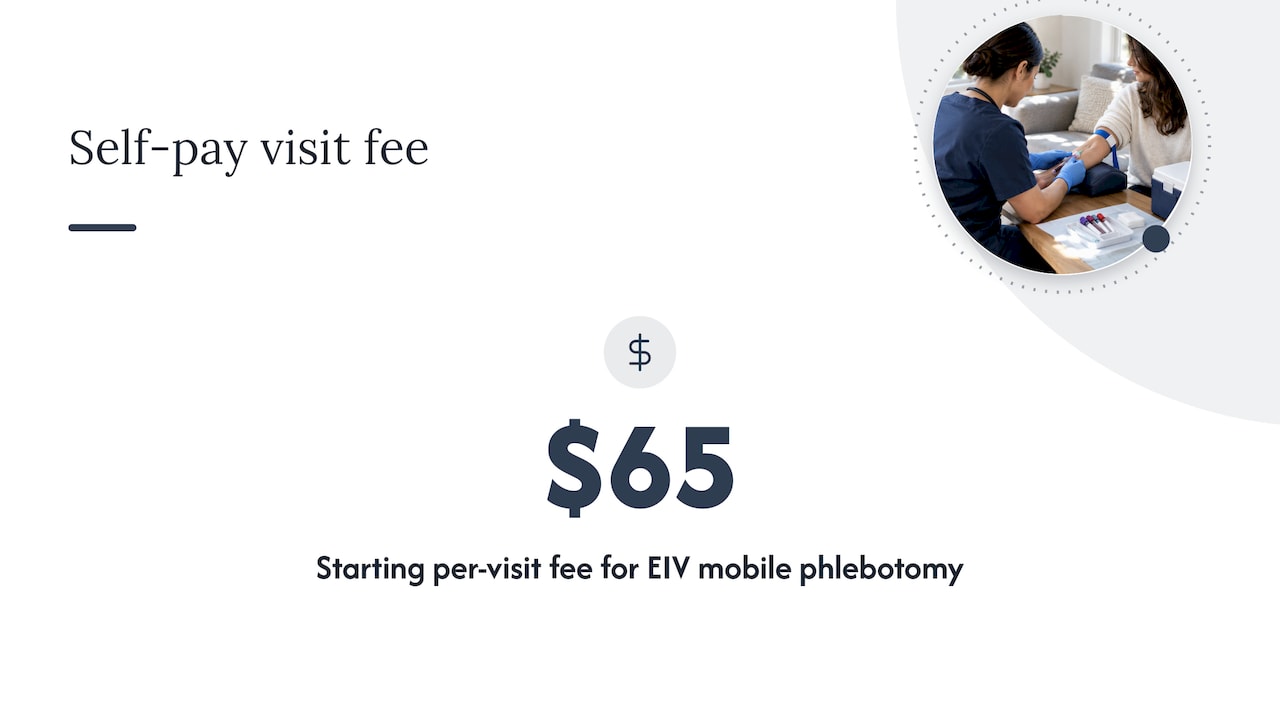
EIV Diagnostics offers mobile phlebotomy at homes and offices, with pricing from $65 per visit. We also work with patients who bring a prescription, and with direct-to-consumer customers who self-pay for lab tests. Our self-pay guide explains how that works and what to expect.
There is a practical advantage to this route. When you pay a stated visit fee, you aren’t waiting on a claim, a homebound certification or a denial letter. You know the amount before the technician arrives. For Fresno-area readers, we break down local ranges in mobile blood draw costs in Fresno.
If you’re deciding whether you need a doctor’s order at all, our overview of direct access lab testing covers ordering your own labs, and our guide to ordering lab tests online explains the lab credentials to look for.
What we think about home draws and coverage
We start from what the patient is trying to do. Someone with a hectic week, a mobility limit or a sick family member wants a reliable result without losing half a day. Insurance rules decide who gets a collection fee paid, but they don’t change how much time a clinic visit takes.
That is why we built mobile phlebotomy around the patient’s door. A technician comes to your home or office, and the sample goes to a laboratory with board-certified pathologists and CAP-accredited quality standards. Keeping the draw and the diagnostics connected is how we aim for rapid turnaround and precise reporting.
We also think people deserve to know the price. Mobile phlebotomy at EIV Diagnostics starts from $65 per visit, and we work with patients who have a prescription as well as those who choose to self-pay. Whichever route you take, ask for the details of the visit in advance, and we are glad to answer those questions.
EIV Diagnostics
Book a draw in the Central Valley
If you live or work in Fresno, Clovis, Madera, Visalia, Hanford or elsewhere in our service area, EIV Diagnostics can bring the draw to you. Mobile phlebotomy is from $65 per visit, and our laboratory handles the testing, from routine clinical pathology to molecular and pharmacogenomic panels.
Start at our mobile phlebotomy page to schedule a visit, or explore the full list of laboratory services. Healthcare providers who want a lab partner for their patients’ home draws can reach us the same way.
If a claim is denied
Denials are usually fixable, and the first step is to read the notice closely. It should state the reason, such as missing order, missing homebound documentation or a bundled collection code.
Deadlines are short. Vermont’s Medicaid rules, for example, require an internal appeal within 60 days of the denial notice, with a decision in up to 44 days for a standard appeal or 17 days for an expedited one. Other states and plans set their own windows, so find the one printed on your notice. Ask your doctor’s office for a letter that states the medical reason for the test and, where it applies, why you can’t leave home.
FAQ
Does insurance cover a blood draw at my home?
Sometimes. The test is usually covered when a provider orders it and it is medically necessary. The home collection is covered under narrower conditions, most often when you are homebound, and the rules differ by plan and state. Ask your plan about in-home venipuncture before the visit.
Does Medicare pay for a home blood draw?
Medicare pays a specimen collection fee when a trained technician draws blood from a homebound patient, and it can add a travel allowance. For 2026 the general collection fee is $9.34. The test must be ordered by a physician and tied to an illness, injury or symptom.
Do I owe a copay for the collection fee?
For Medicare, CMS stated that deductible and coinsurance don’t apply to the specimen collection amount for clinical diagnostic lab tests. Other plans set their own cost-sharing, so the member services number on your card is the place to confirm it.
Can I get a home draw without a doctor’s order?
Yes, through self-pay. EIV Diagnostics offers direct lab testing with or without a doctor’s order, and mobile phlebotomy from $65 per visit. Paying yourself means no insurance approval is needed, and you can ask about the total price before you book.
What should I do if my plan denies the home draw?
Read the denial reason, then ask your doctor’s office for supporting documentation and file an appeal before the deadline on the notice. Medicaid programs publish appeal windows, such as 60 days in Vermont, so act quickly.
Sources
- Medicare.gov: Diagnostic laboratory tests
- CMS MM14345: Travel Allowance Fees for Specimen Collections, CY 2026
- CMS MM13947: Travel Allowance Fees for Specimen Collection, 2025 updates
- CMS transmittal R13576CP
- CMS Medicare Claims Processing Manual, Chapter 16
- New York State Medicaid Fee-for-Service Laboratory Manual
- Arkansas Medicaid rules, Part 622
- Kaiser Permanente Southern California home venipuncture criteria
- Geisinger Health Plan policy MP037, Home Phlebotomy Program
- UnitedHealthcare Medicare Advantage Laboratory Services Policy
- EmblemHealth Laboratory/Venipuncture Payment Policy
- Vermont Agency of Human Services Health Care Administrative Rules