
By EIV Diagnostics · October 19, 2026
Stool Calprotectin Test: Results, Ranges and Next Steps
What a stool calprotectin test measures, how to collect the sample, what normal and high levels mean, and what usually happens after an abnormal result.
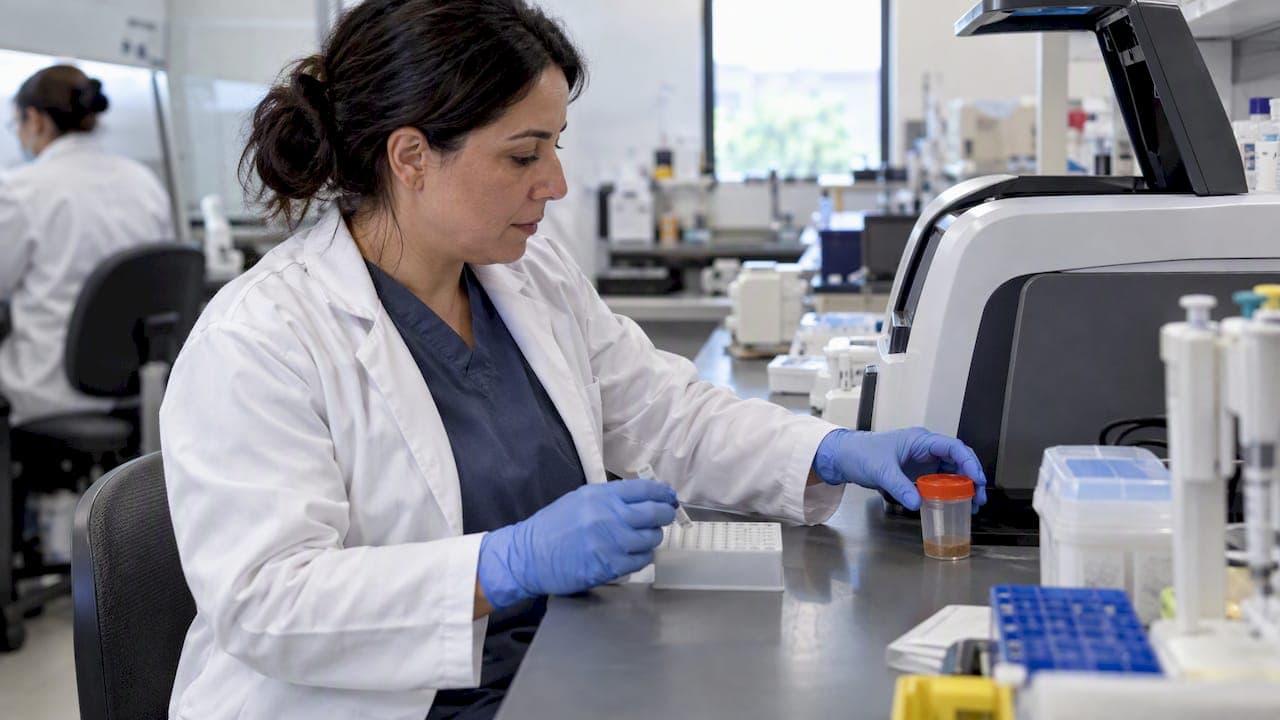
A stool calprotectin test measures a protein released by white blood cells called neutrophils. When those cells gather in the intestinal lining, more calprotectin ends up in your stool. That makes the test a simple, non-invasive way to check for inflammation in the gut. It is often used to help separate inflammatory bowel disease (IBD), such as Crohn’s disease or ulcerative colitis, from irritable bowel syndrome (IBS). It can’t diagnose either condition on its own. This guide covers how the test works, how to collect the sample, what your number may mean, and what usually comes next.
TL;DR
- The test detects gut inflammation, not a specific disease. A low result makes active IBD less likely. A high result means more investigation is needed.
- MedlinePlus lists under 50 mcg/g as normal, 50 to 120 mcg/g as borderline, and over 120 mcg/g as abnormal. Your lab’s own report ranges take priority.
- NSAIDs, infections and other conditions can raise the number, so interpretation always depends on your symptoms and history.
- Different labs use different assays. If you need repeat testing, use the same lab each time.
- Stool collection is something you do yourself. Blood tests that often go alongside it can be drawn at home through mobile phlebotomy.
Table of Contents
- What the test measures and why doctors order it
- Stool calprotectin levels: what the numbers mean
- Factors that can skew the result
- How to collect a stool sample for calprotectin
- Calprotectin at home or in a lab
- Our perspective: a number is a starting point
- Getting tested in the Fresno area
- What happens after the test
- FAQ
- Sources
What the test measures and why doctors order it
Calprotectin is a protein found mostly in neutrophils. According to a review of faecal calprotectin in PMC, it appears in stool because neutrophils migrate into the intestinal lumen when the bowel wall is inflamed. The more inflammation, the more calprotectin, which is why the American Family Physician review describes it as a sensitive indicator of gastrointestinal inflammation.
Clinicians typically consider the test for people with ongoing, unexplained digestive symptoms, such as:
- Diarrhea lasting several weeks
- Abdominal pain and cramping
- Urgency or frequent bowel movements
- Symptoms that don’t fit a clear pattern
The main use is triage. Colonoscopy is the definitive way to look at the bowel, but it is invasive and costly. A stool test can help a physician decide who needs one soon and who can be watched or treated for a functional problem first. The AFP review says the test is most useful when the chance of IBD is low to moderate before testing. For initial diagnosis it reports sensitivity and specificity of roughly 85%. That means some people with IBD test negative and some without it test positive.
The same test is also used for monitoring. For someone with known IBD, a rising level can suggest a flare before symptoms get worse, and a falling level can suggest treatment is working. Your gastroenterologist decides how often to repeat it.
Stool calprotectin levels: what the numbers mean
MedlinePlus gives these reference values for the test:
| Result (mcg/g) | Category | What it generally suggests |
|---|---|---|
| Below 50 | Normal | Active gut inflammation is unlikely |
| 50 to 120 | Borderline | Unclear; often repeated or interpreted with symptoms |
| Above 120 | Abnormal | Inflammation is likely present; cause needs to be found |
Treat these as a guide, not a verdict. Labs set their own ranges based on the assay they use, and the units may be mcg/g or mg/kg on your report. The PMC review notes that assays are not globally standardized, so a value from one lab is not always directly comparable with a value from another. If you are tracking changes over months, ask your doctor to send every sample to the same lab.
If your result is normal
A normal result makes active IBD less likely, which can be reassuring when symptoms are persistent. It does not explain the symptoms. Your doctor may look at other causes, such as IBS, food intolerance, celiac disease, medications or infection. If symptoms continue or you see red flags such as blood in the stool, unintended weight loss, or nighttime symptoms, tell your doctor even after a normal result.
If your result is borderline
Borderline results are common and frustrating. Doctors often repeat the test after a few weeks, review medications, or combine it with blood work. Don’t try to settle it by comparing your number against the table. Bring the report to your physician.
If your result is high
A high value means inflammation, not necessarily IBD. As the AFP review explains, calprotectin is not specific to IBD. Raised levels can also come from NSAID use, a recent bacterial infection, or colorectal cancer, among other causes. That is why an abnormal result is usually followed by further evaluation, commonly a colonoscopy, rather than a diagnosis on the spot. Call your doctor promptly. If you have severe abdominal pain, heavy rectal bleeding, fever or signs of dehydration, seek urgent care instead of waiting for a follow-up appointment.

Factors that can skew the result
Several things can push the number up or cloud its meaning:
- NSAIDs. Ibuprofen, naproxen and similar drugs can irritate the gut lining. Don’t stop a prescribed medication on your own. Ask your doctor whether and when to pause it before testing.
- Gut infections. A recent bacterial infection can raise calprotectin even when IBD is not the cause.
- Other bowel conditions. Cancer and other inflammatory problems of the bowel can produce high values.
- Different testing platforms. Two labs can return different numbers from the same stool.
- Sample handling. A sample left too long or stored incorrectly may not reflect the true level.
This is the reason every result needs a clinician. The number is one input alongside your history, exam, blood tests and sometimes imaging or endoscopy.
How to collect a stool sample for calprotectin
Collection is done at home, and the details depend on the lab. Always follow the instructions that come with your kit or order. As a general pattern:
- Get the right container. Labs normally supply a collection container or kit. A sterile screw-cap container such as this 30 mL sterile stool container is the kind of item used for stool samples, but check with your lab before using any container other than the one it specifies.
- Collect a random sample. Most calprotectin tests accept a single random stool, not a full day’s collection. Avoid contaminating it with toilet water or urine. Placing a clean collection hat or paper over the bowl can help.
- Transfer a small amount. Use the scoop or spatula to fill the container to the line, no more.
- Label it. Write your name, date of birth and the collection date and time.
- Store it as directed. Many labs ask for refrigeration, and they publish limits on how many days a sample stays valid. Confirm your lab’s window before you collect.
- Return it promptly. Drop it off or arrange pickup so the sample doesn’t sit.
If you take NSAIDs, mention it to your doctor before you collect, since that can change how the result should be read.
Calprotectin at home or in a lab
Some readers ask whether a home kit is as good as a lab test. Two things matter here.
First, the sample is the same either way. You collect stool yourself, so “home versus lab” is really about where the measurement happens and who reviews it. A laboratory assay runs on calibrated analyzers under a quality system. Rapid at-home devices that give you a reading yourself differ in how they work, and the sources we reviewed did not compare them head to head, so we won’t claim one is more accurate than the other. What is clear is that a number only helps if someone qualified interprets it alongside your symptoms.
Second, the same logic applies to other tests people consider doing at home. Vitamin D is a good example. It is measured in blood, so a home finger-prick kit and a draw at a lab or by a phlebotomist can both provide a sample, but the assay and the reporting standards behind it are what determine reliability. Ask who runs the analysis, whether the lab is accredited, and who will explain the result.

Our perspective: a number is a starting point
At EIV Diagnostics we are an independent pathology laboratory in Fresno, and we see what happens when a single result is read without context. A calprotectin value is a useful signal, but it is a signal about inflammation, not a label for a disease. We would rather a patient understand three things than memorize a range.
First, ask what your lab’s reference range is and which method it uses. Second, keep serial tests at one lab so the numbers can be compared. Third, bring the result to a clinician who knows your history. Pathology is a medical discipline, and that is why we work with board-certified pathologists and why our lab is CAP-accredited.
We also know that getting tested can be the hard part. Many patients in the Central Valley are juggling work, distance and long waits. That is why we offer self-pay testing and mobile phlebotomy, so blood draws can happen at home or the office. If your doctor wants blood markers alongside a stool test, such as inflammation markers or a blood count, you don’t have to take time off to sit in a waiting room.
— EIV Diagnostics
Getting tested in the Fresno area
EIV Diagnostics serves patients and providers in Fresno, Clovis, Madera, Visalia, Hanford, Sanger, Reedley and across Fresno, Madera, Tulare and Kings counties. We work with providers, with patients who have a prescription, and with self-pay customers.
- Mobile phlebotomy. For blood tests ordered with or alongside your stool test, we can come to your home or office. Mobile phlebotomy starts from $65 per visit.
- Self-pay testing. If you want to order tests without going through insurance, see our self-pay testing page.
- Clinical pathology. Our clinical pathology services support providers who need reliable lab results for patient care.
Before you plan around a specific stool test, contact us to confirm availability, pricing and collection instructions for your situation. We don’t publish a price for individual tests other than mobile phlebotomy, so we won’t quote one here. If you are a physician, you can see the full list of lab services we offer.
What happens after the test
The path depends on the result and your symptoms.
- Results go to the ordering clinician. Turnaround varies by lab and method, so ask when to expect it.
- You discuss the number in context. Bring your symptom timeline, medication list (including over-the-counter pain relievers) and any recent infections.
- Next steps are chosen. A normal result may point toward functional causes or a different workup. A borderline result may be repeated. A high result commonly leads to a referral to a gastroenterologist and possibly a colonoscopy, where tissue samples can be taken and examined by a pathologist.
- Monitoring, if needed. For known IBD, your care team may repeat the test to follow disease activity. Use the same lab each time.
Tissue biopsies from endoscopy are where pathology becomes central. A pathologist examines the samples under a microscope to confirm inflammation patterns and rule out other causes. That is the definitive part of the workup that a stool test can only point toward.
FAQ
Can a stool calprotectin test diagnose Crohn’s disease or ulcerative colitis?
No. It shows whether there is inflammation in the intestines, not what is causing it. A diagnosis of IBD generally needs endoscopy with biopsies, plus your history and other tests. The calprotectin result helps your doctor decide how urgently those are needed.
What is a normal fecal calprotectin level?
MedlinePlus lists below 50 mcg/g as normal, 50 to 120 mcg/g as borderline and above 120 mcg/g as abnormal. Your lab’s report may use different cut-offs because assays vary, so go by the ranges printed on your own result.
Can ibuprofen or other medicines affect the result?
Yes. NSAIDs such as ibuprofen and naproxen can raise calprotectin. Ask your doctor before testing whether you should pause them, and don’t stop prescription medication without that advice.
Do I need a doctor’s order for the test?
That depends on the lab and the state. At EIV Diagnostics we work with providers, with patients who have a prescription, and with self-pay customers. Contact us to confirm what is available for the test you want. Even if you order on your own, share the result with a clinician.
Can I use a different lab for each repeat test?
It’s better not to. Assays are not standardized across labs, so numbers from different labs may not compare cleanly. Use the same lab for serial monitoring when you can.