
By EIV Diagnostics · October 18, 2026
Specific IgE Blood Test: What It Shows and How to Read It
A specific IgE blood test measures antibodies to one allergen at a time. Learn how it works, what kU/L results mean, its limits, and how to get tested in Fresno.
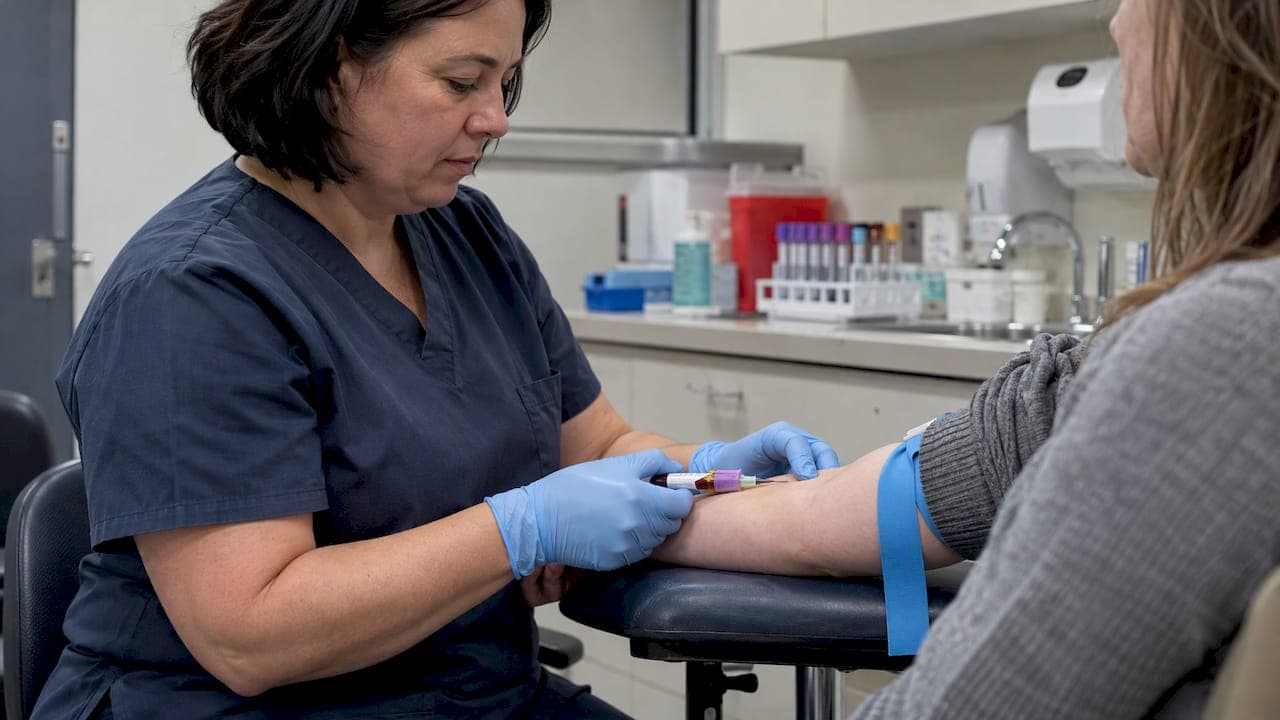
A specific IgE blood test measures how much IgE antibody your immune system has made against one particular allergen, such as peanut, cat dander or dust mite. It takes one blood draw. The lab then runs a separate measurement for each allergen your clinician suspects. The result tells you whether your body has become sensitized to that substance. On its own, it does not tell you whether you are truly allergic, and it does not tell you how severe a reaction would be.
That distinction is where most confusion starts. This guide covers what the test measures, how to read the numbers, where it misleads people, and how to get one done in the Central Valley.
TL;DR
- A specific IgE (sIgE) test measures antibodies to a single allergen. Total IgE is a different test and is not a reliable allergy test by itself.
- A positive result means sensitization. A true allergy also needs a matching history of symptoms.
- A higher number means an allergy is more likely. It does not predict how bad a reaction will be.
- You generally do not need to stop antihistamines before a blood draw, unlike skin prick testing.
- Choose allergens based on your history. Broad panels with no clear suspicion often produce confusing false positives.
Table of Contents
- What a specific IgE blood test actually measures
- Who gets this test, and why
- How to read your results
- Why a positive result is not the same as an allergy
- What about autoimmune antibody panels?
- How to prepare for the blood draw
- Our perspective at EIV Diagnostics
- Getting tested in Fresno, Clovis and the Central Valley
- Questions to bring to your clinician
- FAQ
- Sources
What a specific IgE blood test actually measures
IgE is an antibody class involved in allergic reactions. When your immune system treats a harmless substance as a threat, it makes IgE aimed at that substance. MedlinePlus explains that an allergy blood test measures the amount of these allergy-causing antibodies in your blood.
The word “specific” matters. Children’s Hospital of Philadelphia describes allergen-specific IgE testing as a blood test that measures levels of different IgE antibodies, each tied to a named allergen. The lab runs one measurement per allergen. If your clinician suspects egg, birch pollen and cat, you get three results, not one.
Most of these tests are immunoassays. A World Allergy Organization position paper notes that they include enzyme-linked immunosorbent assays (ELISA) and related methods. The exact platform varies by lab, which is one reason numbers from different labs are not always interchangeable.
Specific IgE versus total IgE
People often mix up the two tests, so here is the difference.
| Specific IgE | Total IgE | |
|---|---|---|
| What it measures | IgE against one named allergen | All IgE in your blood, regardless of target |
| Answers the question | Am I sensitized to this? | Is overall IgE unusually high? |
| Useful for allergy diagnosis | Yes, with history | Limited |
| Can a normal result rule out allergy? | A negative result makes allergy less likely for that allergen | No |
Total IgE has no single normal range. The World Allergy Organization paper discusses how levels vary with age, and they generally rise through childhood and decline later in life. Very high total IgE can point toward parasitic infection, allergic bronchopulmonary aspergillosis, or rare conditions such as hyper-IgE syndrome. For that syndrome, a review in PMC describes a serum IgE above 2,000 IU/mL as an arbitrary diagnostic level. Normal total IgE does not rule out an IgE-mediated allergy, either.
Who gets this test, and why
Clinicians use specific IgE testing in several situations:
- Suspected food allergy, to find likely triggers after a reaction.
- Respiratory symptoms, such as hay fever or asthma that may have an allergic driver. A 2022 review on using sIgE in primary care asthma notes that asthma guidelines recommend identifying causal or trigger allergens.
- Atopic eczema and other skin conditions where allergens may be involved.
- Patients who cannot do skin testing, for example because of widespread skin disease or medications they cannot pause.
That last point is practical. The CHOP page on allergen-specific IgE testing explains that, unlike skin prick testing, a blood test does not require you to stop antihistamines first. For someone with severe eczema who needs those medications, blood testing can be the easier route.
Skin prick testing is still often the preferred first tool. The AAAAI’s allergy diagnostic testing practice parameter describes prick and puncture tests as the preferred techniques for IgE-mediated hypersensitivity. Blood testing complements skin testing. It does not replace an allergist’s judgment.
How to read your results
Results are usually reported in kU/L (kilounits per liter), sometimes as IU/mL. Many labs also report a “class” from 0 to 6. Here is the main anchor point. Guidance from 2022, discussed in the primary care review on sIgE, treats concentrations of 0.35 kU/L or higher as reflecting clinically relevant sensitization for many purposes. The same source stresses that results must be read against your clinical history and symptoms.
A few rules of thumb help:
- Below the cutoff is usually called negative. That makes allergy to that substance less likely, but not impossible.
- Above the cutoff means sensitized. You have made IgE against the substance. That is a lab finding, not a diagnosis.
- Higher numbers mean greater likelihood, not greater severity. This is the most common misunderstanding. Someone with a low value can still have a serious reaction, and someone with a high value may have mild symptoms or none.
- Compare like with like. Cutoffs and classes differ between labs and assays. Ask your clinician to interpret the report from the lab that produced it.
A worked example
Imagine two people, both with a positive peanut result.
The first had hives and lip swelling within minutes of eating a peanut butter cookie last spring. A positive result fits the story, and an allergist will likely treat it as a probable peanut allergy and plan next steps.
The second eats peanut butter several times a week without symptoms, and the test was part of a broad panel. A positive result here is more likely sensitization without clinical allergy. Cutting peanut from the diet on the number alone could be the wrong move.
Same lab value, different meaning. The history decides.

Why a positive result is not the same as an allergy
Specific IgE tests are sensitive but not always specific. They catch most people who are truly allergic, and they also flag some people who are not. The AAAAI’s food allergy guidance points to an allergist/immunologist as the specialist who can determine whether symptoms come from a food allergy or from another food-related disorder. The gold standard for confirming a food allergy remains a supervised oral food challenge in a medical setting.
Two practical consequences follow:
- Do not remove foods based on a test alone. Restrictive diets built on positive results alone can cause nutritional gaps and anxiety, and they can make real allergy management harder. If you have already had a reaction, talk to an allergist before changing your diet, and carry any emergency medication you have been prescribed.
- Do not order everything. The primary care review linked above supports choosing allergens based on a specific clinical suspicion. A big panel with no history behind it raises the odds of false-positive findings you then have to explain.
Example: alpha-gal syndrome
Alpha-gal syndrome is a tickborne allergy to mammalian products. The CDC’s July 2026 MMWR report describes diagnosis as requiring both compatible symptoms and detectable alpha-gal-specific IgE. Symptoms typically show up hours after eating, not minutes. Because some people are sensitized without symptoms, the CDC cautions against testing people with no compatible history. Alpha-gal is a clear example of why the question you ask before the test matters as much as the test.
When IgE is the wrong tool
Not every skin or breathing problem is an IgE reaction. A rash after wearing a new fragrance, for instance, may be irritation or a delayed contact reaction rather than an IgE allergy. Patch testing is a different approach, and this guide on perfume allergy versus sensitivity explains when it is used. If you have a persistent or unexplained rash, a dermatologist can tell you which kind of testing fits.
What about autoimmune antibody panels?
Some readers arrive here looking for an autoimmune antibody panel. Specific IgE testing is not that. It looks at allergic sensitization, while autoimmune testing looks for different antibodies that react against your own tissues, and clinicians order those based on symptoms. If you are unsure which category your symptoms fall into, a physician can sort that out before you spend money on the wrong test. High total IgE alone is not a marker of autoimmune disease.
How to prepare for the blood draw
Preparation is simple:
- Fasting is typically not required, but follow any instructions given with your order.
- Keep taking your antihistamines unless your clinician says otherwise. CHOP notes that blood testing does not require pausing them.
- Bring your history. Write down what you ate or were exposed to, when symptoms started, how long they lasted and what helped.
- Tell the person drawing blood about any previous severe reactions, fainting with needles or blood thinners.
- Plan the follow-up. Book a visit with the clinician who will review the results with you.
If you have had a severe reaction, such as trouble breathing, throat tightness or fainting after exposure, do not wait for a lab test. Seek emergency care and ask your doctor about referral to an allergist.
Our perspective at EIV Diagnostics
We see the same pattern again and again: a patient gets a long list of results with no context, then worries about foods or pets that were never a problem. A lab report is only as useful as the question behind it.
Our view is simple. Pick the allergens that match your story. Treat a positive as a starting point. Have the report read by someone who understands both the assay and the clinical picture. As an independent pathology lab with board-certified pathologists, we put clear, accurate reporting at the center of what we do, for both providers and patients.
We also think access matters. Many people avoid testing because getting to a draw site is a hassle, or because they cannot easily get a doctor’s visit first. That is why we offer self-pay testing and mobile phlebotomy, and why we encourage everyone to share results with a clinician before acting on them.
— EIV Diagnostics
Getting tested in Fresno, Clovis and the Central Valley
EIV Diagnostics is an independent pathology laboratory in Fresno, serving patients and providers in Fresno, Clovis, Madera, Visalia, Hanford, Sanger, Reedley and surrounding communities. We work with providers, with patients who have a prescription, and with direct-to-consumer customers who want to self-pay.
If a physician has already ordered your test, you can bring the order to us. If you want to start on your own, our self-pay testing page explains how it works. Ask our team whether the specific allergen you are asking about is available, and what the result will include.
If getting to a draw site is the obstacle, our mobile phlebotomy service brings the blood draw to your home or office, starting from $65 per visit. It suits parents juggling school schedules, people with eczema flares who would rather not sit in a waiting room, and busy professionals. Our wider clinical pathology services support providers who need reliable lab results for patient care.
If your concern is the skin itself, such as a persistent rash or a changing lesion, allergy blood work may not be the right test. Our dermatopathology service supports physicians who need an accurate diagnosis from a skin sample.

Questions to bring to your clinician
Before or after the test, these questions make the visit count:
- Which allergens are we testing for, and why those?
- What cutoff does this lab use, and where does my result fall?
- Does my history match the result?
- Do I need skin testing or a supervised food challenge to confirm?
- Should I change my diet, home or medications now, or wait?
- Do I need a referral to an allergist/immunologist?
If you are testing a child, bring the same questions to the pediatrician. Children’s allergy patterns change as they grow, so a result is a snapshot, not a lifelong verdict.
FAQ
What is a specific IgE blood test?
It is a blood test that measures IgE antibodies against one named allergen, like peanut, mold or dust mite. The lab runs a separate measurement for each allergen. A positive result shows sensitization and has to be matched to your symptoms before anyone calls it an allergy.
What level of IgE is concerning?
There is no single number that works for everyone. For specific IgE, many clinicians treat 0.35 kU/L or higher as meaningful sensitization, but the number does not predict severity. For total IgE, normal ranges depend on age, and very high values can point to conditions like parasitic infection or hyper-IgE syndrome. Your clinician should interpret the value alongside your history.
What happens if IgE is high in blood?
High total IgE can occur with allergic disease such as eczema or asthma, but it can also reflect parasitic infection or rare immune disorders. It is not a reliable test for a specific allergy. If yours is high, ask your doctor which follow-up tests, if any, make sense.
Do I need to stop antihistamines before a specific IgE blood test?
Generally no. Unlike skin prick testing, blood testing is not affected by antihistamines, according to CHOP’s patient information. Still, follow any instructions from the clinician who ordered your test.
Can I get a specific IgE test without a doctor’s visit?
Some labs, including ours, offer self-pay testing, so you can order certain tests without a prescription. Contact us to confirm what is available. Plan to review the results with a clinician, because a positive result alone should not drive changes to your diet or medications.
Sources
- Allergy Blood Test, MedlinePlus
- Allergen Specific IgE Test, Children’s Hospital of Philadelphia
- A Pragmatic Primary Practice Approach to Using Specific IgE in Allergy Testing in Asthma, PubMed
- IgE allergy diagnostics and other relevant tests in allergy, World Allergy Organization position paper
- An update on the hyper-IgE syndromes, PMC
- Food Allergy, AAAAI
- Allergy Diagnostic Testing: An Updated Practice Parameter, AAAAI
- MMWR, Volume 75, Issue 25, CDC