
By EIV Diagnostics · September 3, 2026
2026 U.S. PSA Screening Guidelines: Start, Stop, Repeat (2–4 yrs)
2026 aligned U.S. PSA screening guidance: who to screen (ages 40–55 by risk), when to stop, and why repeat testing every 2–4 years with rapid lab follow-up.

Prostate cancer screening comes down to one decision: talk with your clinician using shared decision-making, weighing your age, race, family history, and health status against the real trade-offs of testing. Major guidelines agree screening should start somewhere between ages 40 and 55 depending on your risk profile, repeat every 2 to 4 years for most men, and stop once life expectancy drops below roughly 10 years. PSA testing offers a modest mortality benefit but comes with real risks of overdiagnosis, so the right move is a conversation, not a reflex. EIV Diagnostics processes the bloodwork and follow-up biomarker testing that makes that conversation useful.
TL;DR:
- Most men should consider PSA screening starting between ages 45 and 55 based on risk factors, with intervals of 2 to 4 years, and stop once life expectancy drops below 10 years.
- Repeating a PSA test after 4 to 8 weeks is essential, as 17% to 40% of elevated results normalize on retesting, avoiding unnecessary biopsies.
- For high-risk groups like Black men, those with a family history, or known germline mutations, screening should begin as early as 40 to 45 years old.
- The primary risks of PSA screening include overdiagnosis, biopsy complications, and potential treatment-related side effects like incontinence and erectile dysfunction.
- A guided, stepwise approach with secondary tests such as PSA density or MRI improves accuracy before recommending invasive procedures, supported by specialized labs like EIV Diagnostics.
Table of Contents
- What Do the Major PSA Screening Guidelines Actually Say?
- How Does PSA Screening Actually Work, Step by Step?
- How Should You Interpret Your PSA Number?
- What Are the Risks of PSA Testing?
- Who Should Start Screening Earlier?
- What Should You Do Before a PSA Test?
- How Does EIV Diagnostics Support PSA Follow-Up Testing?
- The Real Problem With PSA Screening Isn’t the Test
- Get PSA Testing and Follow-Up Done Right
- Where This Guidance Comes From
- Sources
- FAQ
What Do the Major PSA Screening Guidelines Actually Say?
The four organizations that shape American prostate cancer screening practice, the USPSTF, the American Urological Association, the American Cancer Society, and NCCN, mostly agree on the big picture and disagree on the details that matter for your actual appointment.
The USPSTF takes the most conservative stance. It gives individualized PSA screening for men aged 55 to 69 a Grade C recommendation, meaning the decision should hinge on patient values, not a blanket protocol. For men 70 and older, it issues a Grade D, recommending against routine screening because the harms tend to outweigh the benefits at that point in most cases.
The AUA, in its 2026 guideline update, pushes earlier and more actively than USPSTF. It strongly endorses shared decision-making, names PSA the first-line screening test, and suggests clinicians can offer a baseline PSA between ages 45 and 50 for men who want one. For most men aged 50 to 69, the AUA recommends screening every 2 to 4 years rather than annually, adjusting based on risk and life expectancy.
The American Cancer Society stratifies by risk from the start. It recommends the screening conversation begin at 50 for average-risk men, 45 for high-risk men (Black men and those with one first-degree relative diagnosed young), and 40 for very-high-risk men with multiple affected relatives. ACS also ties retest intervals directly to the PSA number: men with a PSA under 2.5 ng/mL can wait two years between tests, while men at or above that level should test annually.
NCCN takes a more clinical, chart-based approach, giving practitioners specific PSA thresholds and re-testing cadences tied to age bands rather than a single blanket rule, which makes it a common reference in urology practices managing borderline results.
Here’s where the practical friction shows up for clinicians running shared decision-making conversations:
- USPSTF and AUA diverge sharply on men 70 and older. USPSTF says stop; AUA says personalize based on health, not age alone.
- ACS starts the conversation up to 15 years earlier than USPSTF for very-high-risk men, a gap that matters enormously for Black men and men with strong family history.
- AUA’s 2-to-4-year interval directly contradicts the old habit of annual PSA testing that many primary care practices still default to.
- None of the four organizations recommend PSA screening without some form of documented patient discussion first.
How Does PSA Screening Actually Work, Step by Step?
A PSA test measures prostate-specific antigen, a protein produced by both healthy and cancerous prostate tissue. That’s the core problem with the test: an elevated number tells you something is going on in the prostate, but not what. Benign prostatic hyperplasia, prostatitis, recent ejaculation, and cancer can all push the number up, which is why a single high reading should never trigger an automatic biopsy referral.
The evidence-based workflow looks like this:
- Baseline PSA draw, timed to the age and risk thresholds discussed above.
- If elevated, repeat the test in 4 to 8 weeks rather than escalating immediately. Studies show 17% to 40% of elevated PSAs normalize on retest, which means a meaningful share of “abnormal” results are noise, not disease.
- If still elevated, add secondary tools before biopsy: percent free PSA, PSA density, a validated multiplex biomarker panel, or multiparametric MRI (mpMRI).
- Use a risk calculator informed by those results to decide whether biopsy is warranted or whether continued monitoring makes more sense.
Digital rectal exam isn’t a first-line screening tool in asymptomatic men under current guidance, though many clinicians still use it alongside PSA when a patient is already in the room for a physical. Molecular testing on any tissue obtained later can also clarify ambiguous pathology, an area where molecular testing results increasingly shape treatment planning rather than just confirming a diagnosis.
Pro Tip: Always repeat an elevated PSA before ordering a biomarker panel or scheduling a biopsy. Skipping that step is the single most common reason men end up with an unnecessary invasive procedure for a number that would have normalized on its own.
How Should You Interpret Your PSA Number?
Context is everything at 4.0 ng/mL. Read alone, that number tells you almost nothing. Read against your age and prior results, it starts to mean something.
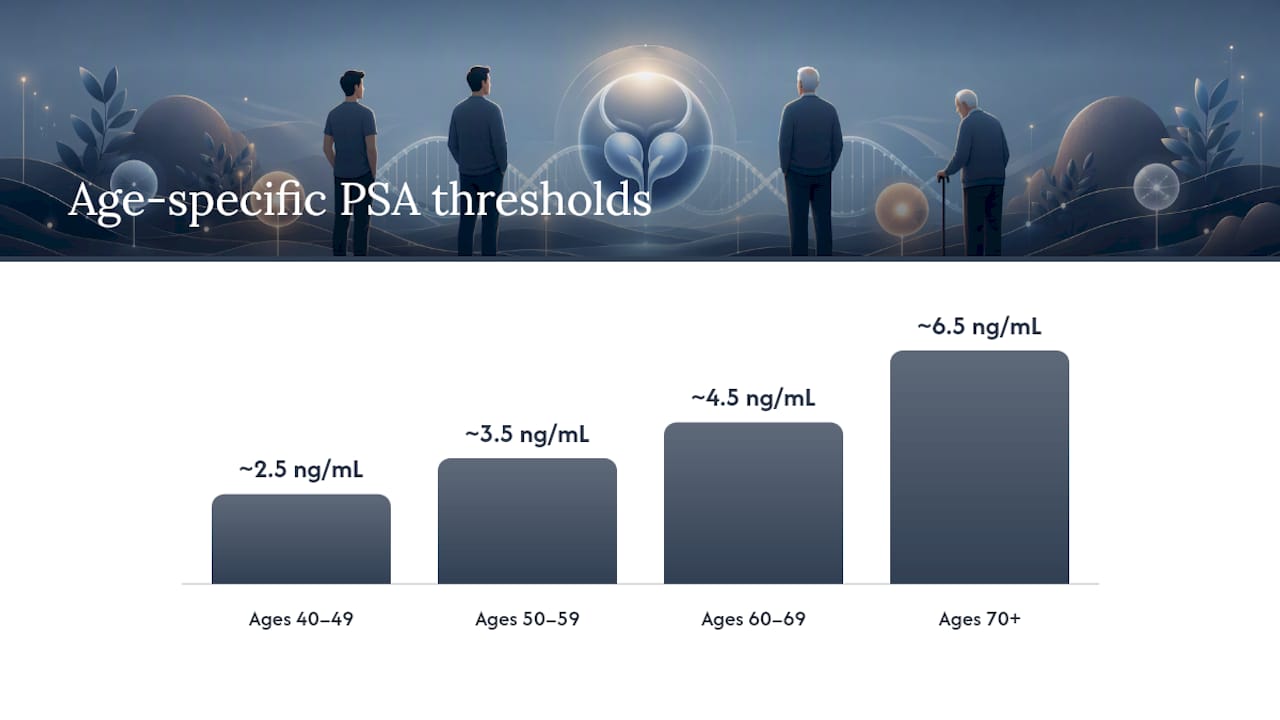
Many practices use age-varying thresholds rather than one fixed cutoff for every man:
- Ages 40 to 49: around 2.5 ng/mL
- Ages 50 to 59: around 3.5 ng/mL
- Ages 60 to 69: around 4.5 ng/mL
- Ages 70 and up: around 6.5 ng/mL
These aren’t universal mandates, and different labs and clinics apply them somewhat differently, but they reflect a real clinical insight: prostate volume and baseline PSA both tend to rise with age, so the same raw number carries different weight at 45 versus 68.
Between 17% and 40% of newly elevated PSA results return to normal on a repeat draw, according to evidence reviewed in the AUA guideline literature. That range alone justifies the repeat step before anything more invasive happens.
Once a repeat test confirms elevation, the decision tree branches. A low percent-free PSA raises suspicion for cancer over benign enlargement. Elevated PSA density (PSA relative to prostate volume on imaging) does the same. An mpMRI can identify a suspicious lesion worth targeting or, just as usefully, show nothing concerning enough to justify a biopsy at all. Validated risk calculators combine these inputs with age, family history, and prior biopsy results to generate a personalized probability of clinically significant cancer, which is often a more honest number than PSA alone.
For men diagnosed with low-grade, low-volume disease, active surveillance, meaning regular PSA checks, imaging, and periodic biopsies instead of immediate treatment, has become the preferred management path in current guidelines rather than the exception. It keeps men out of surgery and radiation until the cancer shows signs of actually progressing.
What Are the Risks of PSA Testing?
The uncomfortable truth about PSA screening is that many of the harms are certain and immediate, while the benefit is probabilistic and delayed by years. That asymmetry is exactly why every major guideline insists on individualized discussion rather than automatic testing.
Overdiagnosis is the biggest one. It means detecting a cancer that would never have caused symptoms or death in that man’s lifetime, yet treating it anyway because a positive biopsy is hard to leave alone. A meaningful share of PSA-detected prostate cancers fall into this category, particularly in older men with slow-growing, low-grade tumors.
The downstream harms compound from there:
- Biopsy complications, including infection and bleeding, occur in a small but real percentage of men who undergo the procedure.
- Treatment complications from surgery or radiation include urinary incontinence and erectile dysfunction, both of which can be permanent. Men weighing treatment often research ED treatment options as part of that conversation, since it’s a common and often underdiscussed consequence.
- Psychological burden from a false positive or an overdiagnosed cancer that still requires monitoring or treatment.
Harm magnitude climbs with age and comorbidity, which is exactly why life expectancy, not birthday count, drives the USPSTF’s cutoff for men 70 and up. The absolute benefit and mortality context from national data helps frame just how small the mortality reduction is at the population level compared with how common the downstream harms are. Screening harms tend to show up within months. Any survival benefit, if it exists for a given man, typically doesn’t show up for a decade or more.
Who Should Start Screening Earlier?
Race, family history, and genetics move the start date for the screening conversation earlier than the default, sometimes by 10 to 15 years.
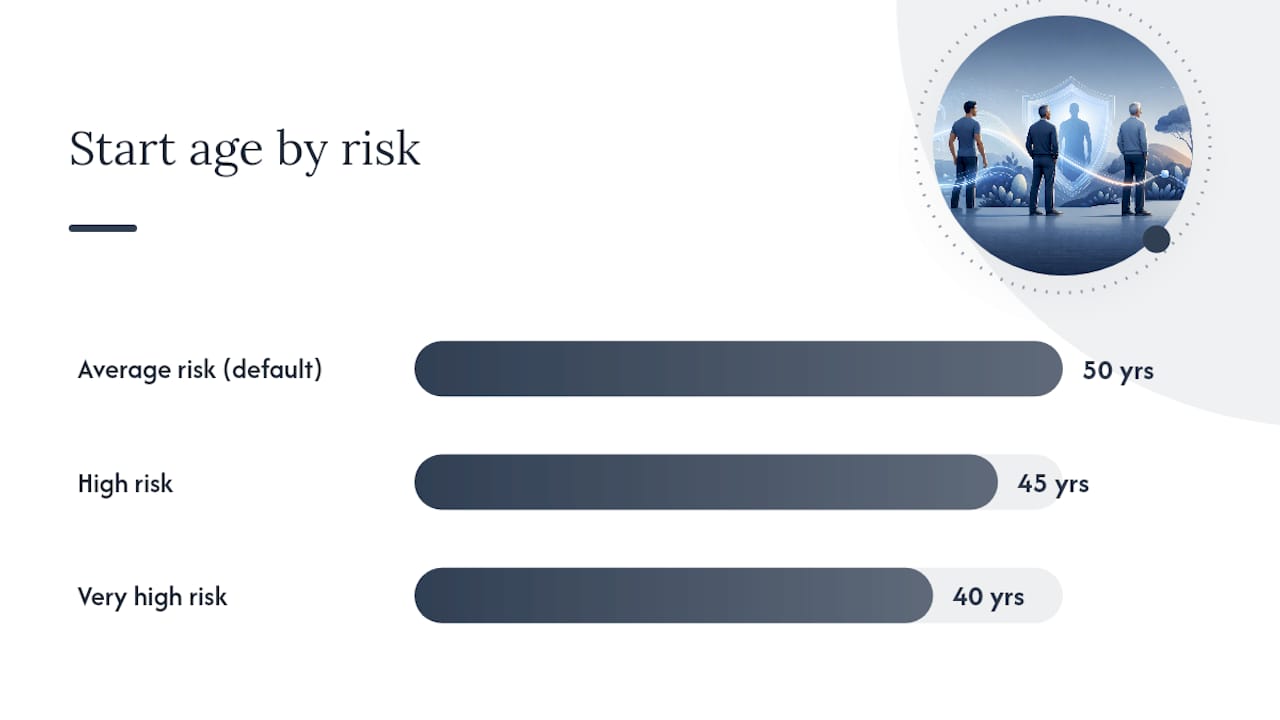
Black men carry a higher lifetime risk of both developing and dying from prostate cancer than the general population, which is why ACS puts the discussion age at 45 for this group instead of 50. Men with one first-degree relative diagnosed with prostate cancer, especially before age 65, fall into that same high-risk, start-at-45 category. Men with multiple affected relatives, or a strong pattern across the family tree, are considered very high risk, with guidelines suggesting the conversation start as early as 40.
Germline mutations add another layer. BRCA2 mutations in particular are linked to more aggressive prostate cancer, and men with a known family history of BRCA1/BRCA2 or Lynch syndrome mutations are often candidates for genetic counseling alongside earlier PSA discussion. Testing for these mutations doesn’t replace PSA screening. It refines who should be screened more aggressively and who might reasonably delay.
- High risk (start at 45): Black men, one first-degree relative diagnosed young
- Very high risk (start at 40): multiple affected relatives, known germline mutation carriers
- Life expectancy under 10 years generally outweighs risk category when deciding whether to continue screening
- Polygenic risk scores and updated risk calculators are emerging as tools to sharpen these categories further, though they remain adjuncts to, not replacements for, clinical judgment
Health status matters as much as the risk category itself. A 68-year-old very-high-risk man in excellent health may still be a reasonable screening candidate; a 62-year-old average-risk man with serious comorbidities limiting life expectancy may not be, regardless of what a chart says.
What Should You Do Before a PSA Test?
A few simple steps before the blood draw prevent a falsely elevated number from triggering an unnecessary workup.
Commonly recommended in the 48 hours before testing: avoid ejaculation, skip vigorous cycling, and hold off on prostate manipulation like a DRE right before the draw. The evidence behind some of these, particularly cycling, is thinner than clinicians sometimes imply, so treat them as reasonable precautions rather than hard rules.
Medications matter too. 5-alpha reductase inhibitors like finasteride and dutasteride, commonly prescribed for BPH or hair loss, lower PSA levels, sometimes by roughly half after sustained use. Clinicians typically need to adjust the interpretation upward to approximate a true baseline in men on these drugs.
Finasteride is FDA-indicated for men only. Women who are or may become pregnant must not handle crushed or broken finasteride tablets, due to the risk of harm to a male fetus. It can also cause sexual side effects (reduced libido, erectile dysfunction) in a minority of men, which usually resolve after stopping treatment. Discuss these risks with a physician before starting.
No fasting is required for a PSA draw, which makes logistics simple. For patients who’d rather not sit in a waiting room, mobile phlebotomy brings the blood draw to a home or office instead.
Pro Tip: Bring a list of current medications and any recent procedures (biopsy, catheter, cystoscopy) to your PSA appointment. That context can be the difference between a false alarm and an accurate read.
How Does EIV Diagnostics Support PSA Follow-Up Testing?
Once a PSA result comes back elevated, the next steps depend on getting accurate, fast answers from ancillary testing, and that’s the gap EIV Diagnostics fills for both clinicians and patients navigating a workup.
EIV Diagnostics operates as an independent pathology laboratory built around molecular pathology, digital pathology, and board-certified pathologist review, all of which matter when a biopsy or reflex biomarker test needs an unambiguous read rather than a delayed or generic one.
- Board-certified pathologists review specimens directly, supporting faster, more confident biopsy decisions
- Molecular pathology and PCR-based testing add precision when a borderline PSA needs biomarker clarification
- Digital pathology enables rapid second opinions and consistent reporting across providers
- Mobile phlebotomy brings the blood draw to the patient, useful for repeat testing without a repeat office visit
Faster, more precise reporting shortens the anxious gap between an abnormal PSA and a clear plan, which is exactly what shared decision-making needs to work in practice.
The Real Problem With PSA Screening Isn’t the Test
The test itself gets blamed for a lot that isn’t really its fault. PSA is a reasonably good biomarker used badly for two decades: ordered reflexively, interpreted with a single rigid cutoff, and followed by biopsies that should have waited for a repeat draw. The 2026 guideline landscape, taken together, reads less like a retreat from screening and more like a correction of that sloppiness.
What gets underestimated is how much of the harm in prostate cancer screening comes from skipping the repeat PSA step, not from the test existing. Somewhere between 17% and 40% of elevated results normalize on their own, yet plenty of men still get referred straight to biopsy off a single number. That’s a workflow failure, not a screening failure.
What we’d tell readers to prioritize first: don’t ask “should I get screened?” as a yes or no question. Ask your clinician where you fall on age, race, and family history, then ask what the retest and confirmation plan looks like before anything invasive happens. That second question gets skipped far too often, and it’s the one that actually protects you from overtreatment.
— EIV Diagnostics
Get PSA Testing and Follow-Up Done Right
Once you and your clinician land on a plan, the next step is getting accurate bloodwork without the workflow gaps that cause unnecessary biopsies. EIV Diagnostics runs the molecular pathology testing that supports biomarker follow-up after an elevated PSA, backed by board-certified pathologist review and fast turnaround so you’re not waiting weeks for an answer that shapes a major decision.

If you’d rather not sit in a lab waiting room for a repeat draw, mobile phlebotomy brings the blood collection to your home or office. Clinicians can order molecular and reflex testing directly, and patients with a prescription, or those who want to self-pay, can request PSA-related testing through EIV Diagnostics without waiting on a referral to move things forward.
Where This Guidance Comes From
The recommendations here draw directly from the primary guideline documents and federal data sources clinicians actually rely on:
- USPSTF prostate cancer screening recommendation statement
- AUA/SUO 2026 guideline on early detection of prostate cancer
- American Cancer Society screening recommendations
- SEER prostate cancer statistics
- CDC prostate cancer screening guidance
- EIV Diagnostics for lab testing and mobile phlebotomy services
This article is general information, not a substitute for advice from a qualified doctor. Consult a qualified healthcare professional about your own circumstances before acting on anything here.
Sources
- Prostate cancer screening — USPSTF recommendation statement (clinical summary)
- Early detection of prostate cancer: AUA/SUO Guideline (2026)
- American Cancer Society recommendations for prostate cancer early detection
FAQ
What Are the New Guidelines for PSA Testing?
The 2026 AUA guideline strongly endorses shared decision-making, names PSA the first-line screening test, and recommends screening every 2 to 4 years for ages 50 to 69 rather than annually, with optional baseline testing at 45 to 50.
What Should You Avoid 48 Hours Before a PSA Test?
Most clinicians recommend avoiding ejaculation, vigorous cycling, and prostate manipulation like a DRE in the 48 hours before a PSA draw, though the evidence behind some of these precautions is stronger than others.
How Often Is PSA Screening Recommended?
The AUA recommends every 2 to 4 years for most men aged 50 to 69, while ACS ties frequency to your PSA level: under 2.5 ng/mL means every two years, and 2.5 ng/mL or higher means annual testing.
Why Is PSA Screening Sometimes Discouraged for Older Men?
The USPSTF recommends against routine screening for men 70 and older because the harms, including overdiagnosis and overtreatment, tend to outweigh the benefits at that stage, particularly when life expectancy is under 10 years.
What Happens if My PSA Comes Back Elevated?
Guidelines recommend repeating the PSA in 4 to 8 weeks before further workup, since 17% to 40% of elevated results normalize on retest, followed by secondary tools like percent free PSA or mpMRI if the level stays elevated.