
By EIV Diagnostics · September 5, 2026
10× Sensitivity Gap: Which Toxicology Screening Method Clinicians Need
Match the toxicology test to the clinical question. Compare immunoassay, GC MS, LC MS/MS, and HRMS; learn how cutoffs, specimen choice, and workflows...

Toxicology screening methods split into two functional categories: rapid presumptive tests, mostly immunoassays, and confirmatory laboratory techniques that rely on chromatography and mass spectrometry, including GC‑MS, LC‑MS/MS, and high-resolution MS. Immunoassays give speed and automation for triage; mass spectrometry methods deliver the sensitivity and specificity a definitive answer requires. The right choice depends on the clinical question being asked, the specimen available, and how far down the sensitivity ladder the answer needs to go, since cutoffs and detection windows shift the interpretation either way.
TL;DR:
- Immunoassays are rapid and cost-effective but can produce false positives due to cross-reactivity and miss low-level positives compared to mass spectrometry techniques.
- Urine remains the default specimen for screening because of its long detection window, but it cannot reliably determine the timing or dose of exposure.
- Confirmatory testing with GC-MS or LC-MS/MS offers higher sensitivity and specificity and is essential for legal, forensic, or low-threshold monitoring cases.
- A layered testing approach, often starting with immunoassays and followed by targeted MS confirmation, optimizes both speed and accuracy based on clinical context.
- Clear documentation of limits of detection, specimen validity, and confirmatory versus presumptive results is vital for trustworthy toxicology reports.
Table of Contents
- What Toxicology Screening Methods Actually Do
- Which Specimen Should You Collect, and Why It Changes the Answer
- How Do Immunoassay, GC-MS, and LC-MS/MS Differ?
- Screen-With-Reflex vs. MS-First: Which Workflow Fits the Case?
- Why Do Toxicology Screens Give False Positives or Negatives?
- How Should Method Choice Change Across Clinical Settings?
- What Should a Toxicology Lab Report Actually Show You?
- How EIV Diagnostics Supports Toxicology Testing for Clinicians
- Why Clinicians Should Stop Treating Screening as One Test
- Ready to Order Toxicology Testing or Request a Consult?
- Sources
- FAQ
What Toxicology Screening Methods Actually Do
Every toxicology order starts with a question, and the question should dictate the method, not the other way around. A clinician managing an unresponsive patient in the emergency department needs a fast qualitative answer within minutes. A pain management physician monitoring adherence needs a quantitative, low-cutoff result that can catch a missed dose or a diverted prescription. A workplace testing program needs a legally defensible chain of custody rather than speed. These are different jobs, and matching the analytic goal to the clinical scenario is where most testing decisions go right or wrong.
Common indications and their matching analytic goals include:
- Suspected overdose or altered mental status: qualitative presumptive screening first, with confirmatory testing to guide antidote decisions or ICU management.
- Medication adherence or diversion monitoring: quantitative, low-limit-of-detection confirmatory testing, often LC‑MS/MS, because immunoassay cutoffs miss too much.
- Workplace and pre-employment testing: presumptive screening with mandatory confirmatory testing on any non-negative result, following federal panel requirements.
- Forensic and medicolegal cases: confirmatory methods exclusively, with full documentation, because presumptive results alone rarely hold up under legal scrutiny.
Turnaround time matters as much as accuracy in acute care. A stat toxicology panel run on an automated immunoassay platform can return in under an hour, while a comprehensive LC‑MS/MS confirmatory panel routinely takes a day or more depending on the lab’s batching schedule. That gap is the reason presumptive testing still dominates emergency settings even though it is the less specific of the two approaches. No single analytic method covers every compound a patient might have on board, which is why toxicologists increasingly treat screening as a layered process rather than a single test.
Which Specimen Should You Collect, and Why It Changes the Answer
Specimen choice is not a logistics detail. It determines what window of exposure you are actually testing, whether you can quantify a result, and how vulnerable the sample is to tampering.
- Urine offers the longest detection window for most drug classes and remains the default for qualitative screening, but it cannot reliably tell you when exposure occurred or at what dose.
- Blood or serum is the specimen of choice when timing and concentration matter, such as toxic alcohol levels or acetaminophen dosing, because it reflects circulating drug levels rather than accumulated metabolites.
- Oral fluid captures recent use, typically within the last 24 to 48 hours, making it useful for workplace testing where recent impairment is the concern rather than historical use.
- Hair extends the detection window to weeks or months, valuable for documenting a pattern of chronic exposure but useless for anything acute.
- Sweat, collected via patch, supports continuous monitoring over days, a niche but genuinely useful option in some probation and treatment-monitoring contexts.
Collection matters as much as specimen type. Labs check specimen volume, temperature at collection (urine outside 90 to 100°F within four minutes raises a substitution flag), and use appropriate preservatives and cold-chain transport to prevent degradation of unstable analytes before analysis.
Specimen validity testing catches manipulation before it wastes a result. Creatinine and specific gravity flag diluted or substituted urine, and labs screen for common adulterants like bleach, glutaraldehyde, or excessive water intake. For any test that might carry legal or employment consequences, chain-of-custody documentation, meaning a signed, unbroken record of who handled the specimen and when, is not optional paperwork. It is what makes the result defensible later.
How Do Immunoassay, GC-MS, and LC-MS/MS Differ?
Each analytical method answers a different question with a different tradeoff between speed and certainty.
Immunoassays (ELISA, EMIT) use antibody binding to flag the presence of a drug class within minutes, run on fully automated platforms, and cost far less per test than mass spectrometry. The tradeoff is cross-reactivity. Bupropion metabolites can trigger a false-positive amphetamine result, and certain cough suppressants cross-react with PCP assays. Immunoassays detect classes, not specific compounds, and their cutoffs are set conservatively to control false positives, which means they miss lower-concentration true positives by design.
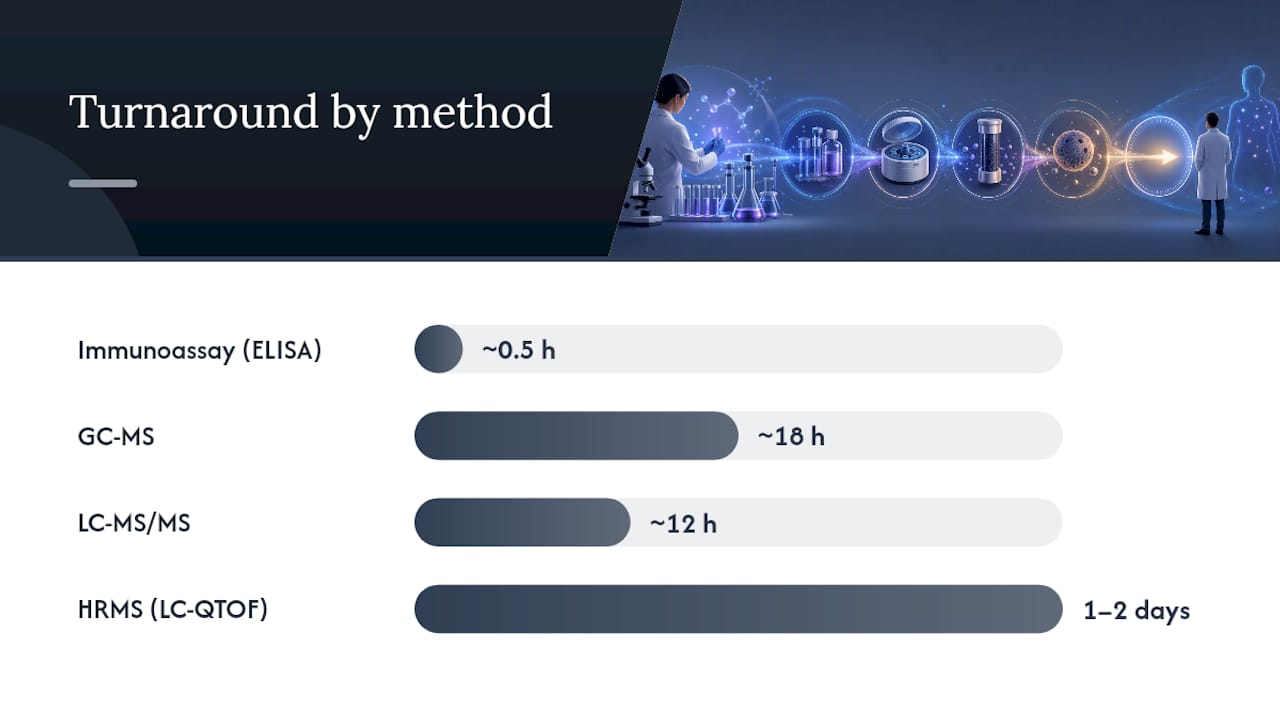
GC‑MS has been the confirmatory standard for decades. It separates compounds by volatility and identifies them by mass spectrum, offering strong specificity for a defined menu of analytes. Its main practical limitation is that many drugs need derivatization before they will volatilize properly, adding time and technical complexity to the workflow.
LC‑MS/MS avoids that volatility problem entirely, which is why it has become the workhorse for polar and thermolabile drugs, benzodiazepines, opioids, and their metabolites among them. It quantifies with tight precision, and it is the backbone of most laboratory-developed tests (LDTs) built for adherence monitoring and low-cutoff confirmatory work. A validation comparing LC‑MS/MS against ELISA across 100 forensic specimens found the mass spectrometry panel detected additional analytes ELISA missed entirely, while also lowering per-specimen screening cost.
HRMS (LC‑QTOF, Orbitrap) pushes further into broad, untargeted screening. Instead of hunting for a fixed list of compounds, it captures full mass spectra that can be searched retrospectively. A reanalysis of 919 blood specimens using LC‑QTOF-MS turned up 709 additional positive findings across 67 compounds that immunoassay screening had missed, a striking illustration of how much a targeted method can leave on the table. HRMS is also the method of choice for detecting novel psychoactive substances that predate any commercial immunoassay.
| Method class | Detection sensitivity | Typical turnaround | Best clinical use |
|---|---|---|---|
| Immunoassay (ELISA/EMIT) | Moderate, class-level | Minutes to 1 hour | Rapid triage, workplace initial screen |
| GC‑MS | High, compound-specific | Several hours to 1 day | Confirmatory ID, forensic casework |
| LC‑MS/MS | High, quantitative | Same day to 1 day | Adherence monitoring, confirmatory ID |
| HRMS (LC‑QTOF/Orbitrap) | Very high, broad-scope | 1 to 2 days | Comprehensive screening, NPS detection |
Screen-With-Reflex vs. MS-First: Which Workflow Fits the Case?
Most labs default to a screen-with-reflex model: run the immunoassay first, and only escalate to confirmatory GC‑MS or LC‑MS/MS testing if the screen comes back non-negative or if the clinical picture doesn’t match the presumptive result. The advantage is cost and speed on the majority of negative results. The disadvantage is a lag, sometimes a full day or more, before a positive result becomes a confirmed, quantitative one.
A growing number of labs now offer MS-first or hybrid workflows, running mass spectrometry as the initial test rather than a backup step. This approach catches compounds immunoassays are structurally blind to, cuts down on false positives from cross-reactivity, and gives a quantitative result in a single pass rather than two. The operational cost is real: MS-first testing requires more instrument time, more technical expertise, and generally a higher per-test price, which is why it tends to get reserved for cases where the stakes justify it.
- Request quantitative MS confirmation immediately when a dosing decision depends on it, such as suspected toxic alcohol ingestion or acetaminophen overdose management.
- Request MS-first testing when the clinical picture doesn’t match a negative or ambiguous immunoassay result.
- Default to screen-with-reflex for routine, low-acuity monitoring where a same-day answer isn’t clinically urgent.
Pro Tip: If a patient’s presentation strongly suggests a specific substance class and the initial immunoassay screen comes back negative, don’t treat that as the final word. Ask the lab whether a targeted MS confirmatory test is available for that compound before ruling out exposure.
Why Do Toxicology Screens Give False Positives or Negatives?
Cutoffs are the hinge point of every interpretation problem in toxicology, and they are set very differently between methods. Many benzodiazepine immunoassays use a cutoff around 200 ng/mL, while MS-based laboratory-developed tests quantify reliably down to 20 ng/mL or lower. That tenfold gap means a patient with a clinically relevant benzodiazepine level can screen negative on immunoassay and still test positive on confirmatory MS, a discrepancy that matters enormously in a suspected polysubstance overdose.
By the Numbers: A blood specimen reanalysis using LC‑QTOF-MS identified 709 additional positive findings across 67 compounds that immunoassay-based testing had missed entirely, out of 919 specimens tested, according to comparative research published in the Journal of Analytical Toxicology.
Detection windows compound the interpretation problem. Urine detects most drug classes for one to three days, though chronic cannabis use can extend that window to several weeks. Blood reflects a much narrower window, often hours, tied closely to the drug’s half-life. Oral fluid sits close to blood in timing. Hair can reach back months but tells you nothing about recency. A breakdown of detection windows by specimen and substance is worth keeping on hand for exactly this reason.
Common causes of unexpected results include:
- False positives: cross-reactive medications (bupropion, certain antihistamines, some quinolones), which a confirmatory test resolves definitively.
- False negatives: concentrations below the immunoassay cutoff, a drug class outside the panel’s scope, or collection too far outside the detection window.
- Dilute or substituted specimens: flagged through creatinine and specific gravity testing, requiring recollection.
A negative screen never definitively rules out exposure. It may simply mean the panel didn’t include the substance, the specimen was collected outside the detection window, or the concentration sat below the assay’s limit of detection. Treat an unexpected negative as a prompt to ask what the test could and couldn’t see, not as a closed case.
How Should Method Choice Change Across Clinical Settings?
- Emergency medicine calls for immediate qualitative screening to guide acute management, paired with targeted quantitative serum assays for toxic alcohols, salicylates, and acetaminophen where a specific number changes treatment. Serial sampling helps track a rising or falling level in real time.
- Pain management benefits most from MS-based laboratory-developed tests because adherence monitoring depends on low limits of detection and the ability to distinguish parent drug from metabolite. A confirmatory LC‑MS/MS approach for unexpected pain management results resolves ambiguity that immunoassay screening alone cannot.
- Workplace testing runs on strict procedural rules: SAMHSA panel requirements, split-specimen collection, mandatory confirmatory testing on any non-negative screen, and documented chain of custody at every step, since a result that can’t survive a challenge is functionally useless to an employer.
- Forensic toxicology requires validated methods with full documentation, defined thresholds, and a level of analytical rigor built to withstand legal cross-examination, not just clinical review.
What Should a Toxicology Lab Report Actually Show You?
A trustworthy toxicology report tells you not just what was found, but how confident the lab is and why. Before trusting a quantitative result, confirm the method has documented limits of detection and quantitation (LOD/LOQ), evidence of controlling for matrix effects, and, for MS-based quantitation, the use of isotopically labeled internal standards to correct for extraction and ionization variability.
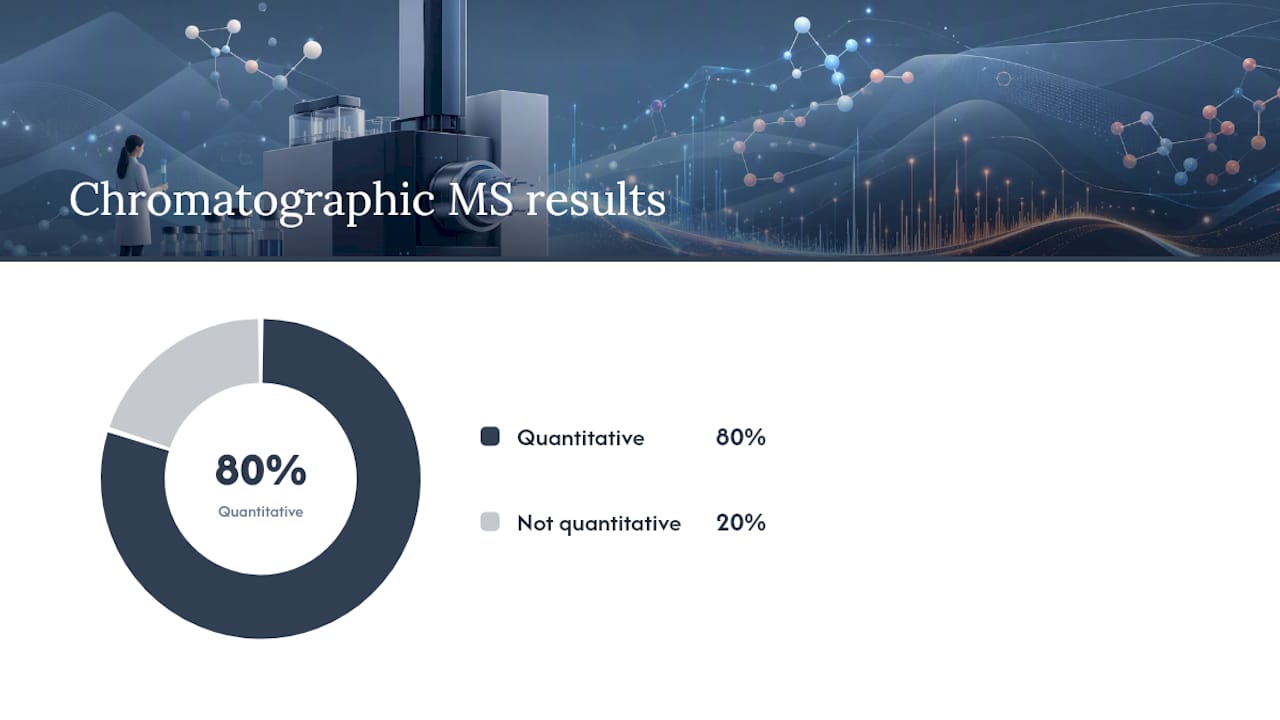
Proficiency testing is the industry’s honesty check. Participation in CAP’s Diagnostic Immunology and Mass Spectrometry survey shows a lab’s results hold up against blind, external comparison rather than resting on internal validation alone. Recent survey data cited in that review found roughly 80% of participating labs’ chromatographic MS results were quantitative, a sign of how far LDTs have displaced older qualitative-only reporting.
A well-structured report should also make the distinction between presumptive and confirmed results explicit, never blending them, and should carry interpretive comments explaining cutoff levels, cross-reactivity caveats, and specimen validity findings. If a report doesn’t tell you which stage of testing produced the number in front of you, ask.
- LOD/LOQ documentation for every quantitative analyte reported
- Isotopically labeled internal standards for MS-based quantitation
- Clear presumptive versus confirmed labeling with interpretive notes
- Specimen validity results reported alongside drug findings
How EIV Diagnostics Supports Toxicology Testing for Clinicians
EIV Diagnostics operates as an independent pathology laboratory offering toxicology testing alongside molecular pathology, dermatopathology, clinical pathology, and pharmacogenomic services, giving clinicians a single lab relationship that spans presumptive screening through confirmatory workup. Providers can order testing directly, and patients with a prescription or those pursuing direct self-pay testing have a path to the same lab infrastructure.
Turnaround and reporting clarity matter most when a result changes a treatment decision, and pathologists typically review findings before they reach the ordering clinician. For collection logistics, mobile phlebotomy brings the draw to a patient’s home or office, removing a scheduling barrier that often delays testing longer than the lab work itself does.
Why Clinicians Should Stop Treating Screening as One Test
The biggest misconception in toxicology screening is that a single test, whatever the panel, gives a complete answer. It doesn’t, and it was never designed to. Immunoassays are a triage tool, not a diagnosis, and treating a negative screen as reassurance rather than a limited-scope result is where clinical decisions go wrong most often.
The conventional advice, “run the standard panel and trust it,” undersells how much a cutoff or a panel’s scope can hide. The LC‑QTOF-MS reanalysis finding 709 missed positives out of 919 specimens should unsettle anyone who assumes immunoassay negatives are the end of the conversation.
What actually works is asking the analytic question before ordering the test: is this triage, monitoring, or a legal record? That question, not brand loyalty to one platform or another, should drive whether you accept a presumptive result or push for MS-based confirmation. Prioritize matching method to clinical stakes over defaulting to whatever panel is fastest or cheapest.
— EIV Diagnostics
Ready to Order Toxicology Testing or Request a Consult?
Some pathology laboratories provide clinicians with a way to move between presumptive and confirmatory toxicology testing without splitting the workup across multiple labs. Providers may be able to place orders directly, and patients with a prescription or those pursuing direct self-pay testing can schedule testing.
For complex cases, whether that’s an ambiguous pain management result, a suspected cross-reactive false positive, or a workplace case that needs airtight documentation, EIV Diagnostics’s molecular pathology and toxicology services team can walk through which confirmatory approach fits. Collection doesn’t have to slow things down either: mobile phlebotomy brings the draw to the patient rather than the other way around. Reach out through the toxicology services page to start an order or request a consult on a case that needs a second analytic opinion.
Sources
- Toxicology Screening - StatPearls
- LC-MS-MS vs ELISA: Validation of a Comprehensive Urine Toxicology Screen by LC-MS-MS and a Comparison of 100 Forensic Specimens
- Comparison of a comprehensive LC–QTOF-MS screen in whole blood with conventional immunoassay-based techniques
This article is general information, not a substitute for advice from a qualified doctor. Consult a qualified healthcare professional about your own circumstances before acting on anything here.
FAQ
What are the different types of toxicology testing methods?
Toxicology testing splits into presumptive methods, mainly immunoassays like ELISA and EMIT, and confirmatory methods, including GC‑MS, LC‑MS/MS, and high-resolution MS platforms like LC‑QTOF. Presumptive tests screen quickly for drug classes; confirmatory tests identify and quantify specific compounds.
What are toxicology screening tests?
They are laboratory assays used to detect the presence, and sometimes the concentration, of drugs, toxins, or their metabolites in a biological specimen. They range from rapid immunoassay panels to detailed mass spectrometry analyses depending on the clinical or legal question being answered.
How is a toxicology screening done?
A specimen, most often urine, blood, or oral fluid, is collected under appropriate handling protocols and run through an immunoassay for an initial presumptive result. Non-negative or clinically inconsistent results are typically sent for confirmatory testing using GC‑MS or LC‑MS/MS, a process EIV Diagnostics supports through direct provider ordering and mobile specimen collection.
What is a toxicology screening panel?
A panel is a defined set of drug classes or compounds tested together in a single run, such as a standard workplace panel covering opiates, amphetamines, cannabinoids, cocaine metabolites, and PCP. Panel scope varies by setting, and a negative result only rules out the substances the panel was built to detect.
Why do immunoassay and confirmatory test results sometimes disagree?
Immunoassay cutoffs are often set higher than confirmatory MS limits, so a specimen can fall below the immunoassay threshold while still testing positive on a more sensitive MS assay. Cross-reactivity with unrelated medications can also produce an immunoassay-positive result that confirmatory testing rules out entirely.