
By EIV Diagnostics · August 27, 2026
Testosterone Test Timing: When to Get Blood Drawn
Discover the best timing for your testosterone test. Get accurate results by drawing blood in the morning for reliable diagnosis.
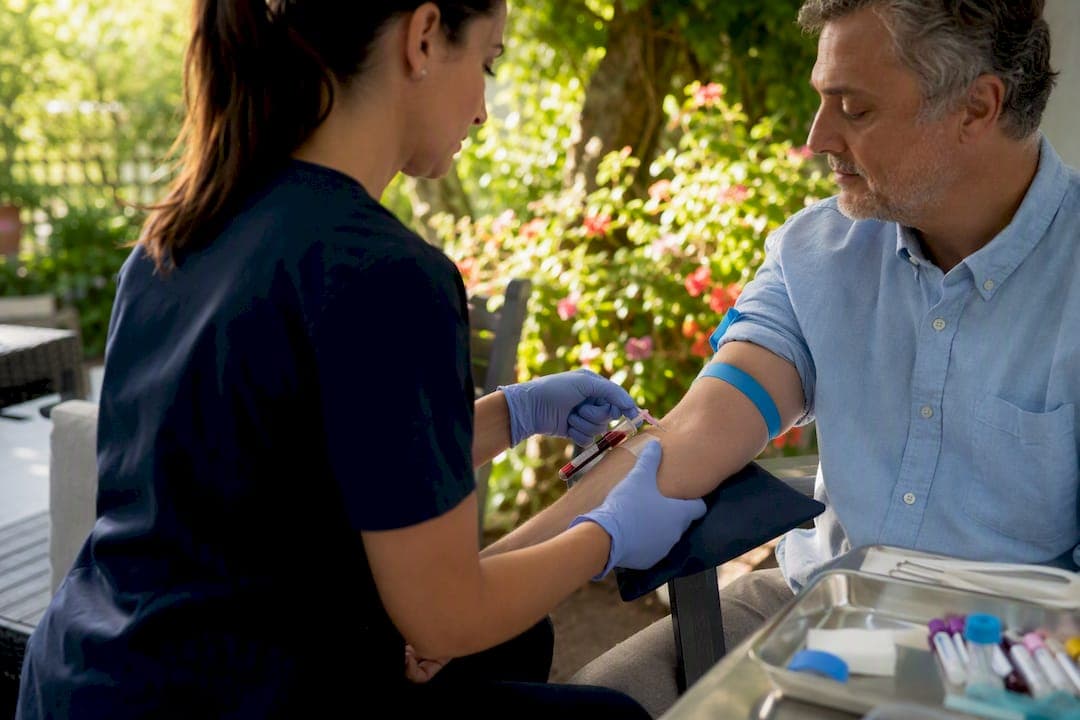
Get your blood drawn in the early morning, ideally between 6 and 10 AM, for the most accurate testosterone result. That window catches your body near its daily peak, which is how labs built their reference ranges in the first place.
One rule applies to everyone regardless of age: never act on a single low result. Guideline bodies including the Endocrine Society and the American Urological Association require confirmation with at least one repeat morning test before diagnosing low testosterone.
- Draw blood between 6 and 10 AM for men under 45
- Men 45 and older can often test until 2 PM with minimal accuracy loss
- Confirm any low reading with a second morning draw
- Use the same lab and, when possible, the same assay method for repeat tests
- EIV Diagnostics offers mobile phlebotomy and consistent lab methodology to support this exact protocol
Key Takeaways
Accurate testosterone testing depends on drawing blood in the early morning, confirming any low result with a repeat morning test, and using consistent lab methodology throughout.
| Point | Details |
|---|---|
| Test in the morning | Draw blood between 6 and 10 AM to match how lab reference ranges were calibrated. |
| Age changes flexibility | Men 45 and older can often test until 2 PM with minimal accuracy loss. |
| Never trust one low result | Confirm with a second morning draw since about 30% of low readings normalize on retest. |
| Ask about assay method | Request LC‑MS/MS testing when results are low or borderline, since it outperforms standard immunoassays at low concentrations. |
| Use a lab built for timing precision | EIV Diagnostics offers mobile phlebotomy for properly timed morning draws and same-lab repeat testing for consistent, comparable results. |
Table of Contents
- Why Testosterone Test Timing Matters So Much
- Age Changes the Rules: Under 45 vs. 45 and Older
- How to Prepare: Sleep, Fasting, Exercise, and Timing
- Confirming a Low Result: What Happens Next
- Special Situations: Shift Work, Illness, and Chronic Conditions
- Timing Blood Draws While on Testosterone Therapy
- Immunoassay vs. LC‑MS/MS: Why the Lab Method Matters
- How EIV Diagnostics Supports Accurate Testosterone Testing
- Do Testosterone Levels Change by Season?
- Testing Guidelines for Women and Adolescents
- Can Exercise or Stress Skew Your Results?
- Supplements and Herbs That Can Distort Your Results
- The Overlooked Problem With How Men Get Tested
- Get Testosterone Testing Timed the Right Way
- Sources
- FAQ
Why Testosterone Test Timing Matters So Much
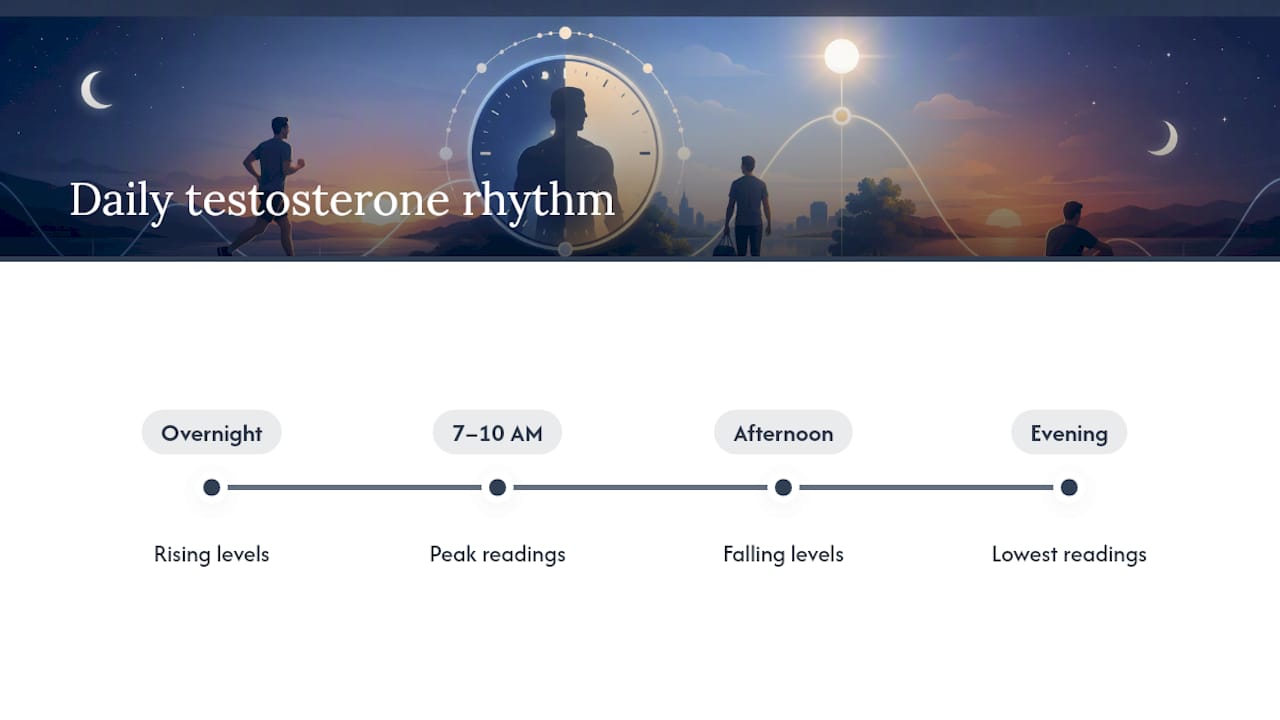
Testosterone follows a daily rhythm, not a flat line. Levels climb overnight, peak shortly after waking, and drift downward through the afternoon and evening. That’s why labs calibrate their normal ranges specifically around blood drawn between 7 AM and 10 AM. Draw the same man’s blood at 4 PM and the number can look meaningfully lower, not because his hormone production changed, but because you caught him on the downslope of a curve his lab never accounted for.
This isn’t a minor technicality. It’s the difference between an accurate diagnosis and a false alarm.
Here’s the number that should make every man pause before trusting one test result: as many as 30% of men with a single low testosterone reading turn out normal on retest, according to Harvard Health’s review of testosterone testing. Nearly a third of “low T” flags are statistical noise or bad timing, not a real hormonal problem.
That variability is exactly why a single afternoon draw showing borderline results shouldn’t trigger a prescription. Clinicians pair biochemical numbers with symptoms and repeat testing before making a call, as noted in Harvard’s own analysis of testing practice. Skip that step and you risk starting testosterone therapy, with its own costs and monitoring requirements, on a man whose “deficiency” was really just an afternoon blood draw. Get the timing right the first time, and you avoid the whole mess.
Age Changes the Rules: Under 45 vs. 45 and Older
Your age determines how strict your testing window needs to be, and this is one of the more overlooked pieces of testosterone testing schedule guidance.
Men under 45 should stick to the traditional early-morning window without exception. Diurnal variation is strongest in this group, meaning the gap between a 7 AM reading and a 3 PM reading can be substantial enough to change a clinical interpretation.
- Draw blood between 6 and 10 AM, no later
- Reschedule rather than accept a midday or afternoon slot
- Treat this window as non-negotiable if you’re being evaluated for symptoms
Men 45 and older get more room to work with. Research on diurnal patterns found that because the morning peak blunts with age, testing up to 2 PM produces results close enough to morning values to be clinically usable. That’s a meaningful convenience for men juggling work schedules who can’t always make a 7 AM lab appointment.
- Testing up to 2 PM is generally acceptable
- Morning draws are still preferred when results will guide a treatment decision
- Borderline cases, especially with symptoms of low testosterone, should still default to morning testing and clinician judgment rather than convenience
How to Prepare: Sleep, Fasting, Exercise, and Timing
Getting the time slot right is half the job. What you do in the 24 hours before your draw matters almost as much.
-
Sleep normally the night before. Testosterone production depends on sleep quality, and a short or disrupted night can suppress your morning reading independent of any underlying issue. Test within roughly three hours of waking, after a typical night’s sleep, not after an all-nighter or a red-eye flight.
-
Fasting is a judgment call, not a hard rule. A controlled study comparing fasting and non-fasting samples found no significant difference in total testosterone, though the researchers noted larger studies are still needed. Most clinical guidelines still recommend a fasting morning sample when it’s practical, mainly to keep other panel results (glucose, lipids) clean if you’re drawing multiple tests at once.
-
Skip the gym and the bar beforehand. Heavy exercise and alcohol both cause short-term hormonal swings that can distort a single reading. Give yourself at least a day of normal, unremarkable activity before the draw.
-
Postpone testing if you’re acutely ill. Fever, infection, and hospitalization all suppress testosterone temporarily. That’s not your baseline; it’s your immune system commandeering resources.
-
Ejaculation timing is a minor factor at most. The evidence here is thin and mixed, and no major guideline requires abstinence before a testosterone test. If you want to control every variable, avoiding ejaculation the night before is reasonable, but it’s not the difference-maker that some circulating claims about seven-day abstinence suggest.
-
Disclose every medication and supplement. Opioids, corticosteroids, and some psychiatric medications can lower testosterone. Herbal testosterone “boosters” can do the opposite, artificially inflating a number that doesn’t reflect your baseline.
Pro Tip: Write down everything you took in the 48 hours before your draw, including over-the-counter supplements, and hand that list to whoever orders your test. A number without context is just a number.
Confirming a Low Result: What Happens Next
One low reading is a data point, not a diagnosis. Guideline-level recommendations, including those referenced in VA clinical guidance on testosterone evaluation, call for confirming low total testosterone on at least two separate early-morning draws before diagnosing deficiency.
The commonly cited threshold for low testosterone is below 300 ng/dL, a cutoff referenced in the AUA’s guideline on testosterone deficiency. But treat that number as a starting point, not gospel: reference ranges vary by lab, by assay method, and sometimes by the population the lab used to establish “normal” in the first place.
- Confirm any low result with a second morning draw, ideally at the same lab
- Use the same assay method both times to avoid comparing apples to oranges
- Pair the number with symptoms (low energy, reduced libido, mood changes) rather than treating the lab value alone as diagnostic
- Ask for free testosterone testing if total testosterone is borderline and sex hormone binding globulin might be skewing the picture
- Get an endocrinology referral if results stay inconsistent across repeat testing
Many initial low readings normalize on retest, reinforcing the recommendation to confirm low testosterone on at least two separate morning tests. That statistic alone justifies the extra blood draw before anyone commits to therapy.
Special Situations: Shift Work, Illness, and Chronic Conditions
Standard timing rules assume a standard life. Shift workers, sick patients, and men with chronic conditions need adjustments.
If you work nights, your “morning” isn’t 7 AM, it’s whenever you wake up after your primary sleep period. Testing should track your personal circadian rhythm, not the clock on the wall. Provincial testing guidance from British Columbia notes that unstable sleep-wake patterns can invalidate standard timing assumptions entirely, and shift workers with persistent symptoms often need specialist referral to sort out what a “normal” reading even looks like for them.
- Shift workers: test within a few hours of waking from your main sleep period, and consider a specialist referral if timing can’t be standardized
- Acute illness or recent hospitalization: postpone testing until you’ve recovered
- Obesity and chronic disease: both can lower testosterone independent of true hypogonadism, so results need to be interpreted in that context, not treated as automatic evidence of deficiency
- Chronic medications (opioids, steroids): flag these for whoever orders your test, since they can suppress readings regardless of timing precision
- Persistent, unexplained low results despite correct timing: this is when an endocrinologist adds real value
Timing Blood Draws While on Testosterone Therapy
Once you start testosterone therapy, the timing question changes completely. Now you’re not chasing a natural peak, you’re checking whether your dose is landing in a therapeutic range.
-
Injectable testosterone: draw blood midway between doses. If you’re on a weekly injection, that’s roughly day three or four. For biweekly dosing, aim for the midpoint of that cycle. This captures your average exposure rather than the artificial spike right after an injection or the trough right before the next one.
-
Topical gels and patches: draw 2 to 8 hours after application, but only once you’ve been on a consistent daily routine for at least a week. Testing too early in treatment, before steady state is reached, gives your clinician a number that doesn’t reflect your real equilibrium.
-
Pellets and other long-acting formulations: follow the specific timing your prescribing clinician recommends, since release patterns vary by product and implantation schedule.
-
Monitoring cadence: most men get an initial follow-up test at three to six months after starting or adjusting therapy, then settle into testing every six to twelve months once dosing is stable. This cadence, drawn from VA clinical recommendations on testosterone replacement therapy, lets clinicians catch dose drift before it becomes a symptom problem.
Get this wrong and you risk chasing a phantom trough or peak instead of your actual treatment response, which leads to dose changes that were never needed.
Immunoassay vs. LC‑MS/MS: Why the Lab Method Matters
Not all testosterone tests are created equal, and this is the part most men never think to ask about.
Standard immunoassays are fast and cheap, which is why most routine labs use them. The problem: they lose precision at low concentrations, exactly the range where a diagnosis of testosterone deficiency actually lives. A review of assay accuracy found that liquid chromatography tandem mass spectrometry, known as LC‑MS/MS, delivers meaningfully better precision in that low or borderline range.
- Immunoassays work fine for clearly normal or clearly high results
- LC‑MS/MS is the preferred method when a result is low, borderline, or will drive a treatment decision
- Repeat testing should use the same lab and, ideally, the same method both times to keep comparisons valid
- Pre-analytical handling (how fast the sample is processed, storage temperature) also affects accuracy, which is another reason consistency between draws matters
Pro Tip: When you schedule a test, ask directly: “Does this lab use LC‑MS/MS for testosterone, or a standard immunoassay?” It’s a simple question that tells you a lot about how much you should trust a borderline number.
How EIV Diagnostics Supports Accurate Testosterone Testing
Getting the timing right on paper doesn’t help if the actual blood draw happens whenever a clinic can fit you in. EIV Diagnostics built its testing model around solving exactly that gap.
- Mobile phlebotomy brings a phlebotomist to your home or office, which means you can actually hit that 6 to 10 AM window instead of working around a lab’s front-desk hours
- Board-certified pathologists oversee result interpretation, which matters most on borderline or discordant readings
- Same-lab repeat testing eliminates a major source of inter-assay variability, directly addressing the guideline requirement to confirm low results on a second morning draw
- Consistent methodology across visits means your first test and your confirmation test are actually comparable, not two different snapshots taken with two different rulers
If you’re managing a timing-sensitive draw, whether that’s a first diagnostic test or a confirmation after a low reading, working with a lab that controls for these variables removes one more excuse for an inaccurate result.
Do Testosterone Levels Change by Season?
Testosterone doesn’t just move throughout the day, it shifts across the calendar too. Several population studies have observed that testosterone levels tend to run somewhat higher in late fall and winter and dip during summer months in some populations, a pattern researchers have tied loosely to seasonal changes in daylight exposure and activity levels.
The practical impact on testing schedule for testosterone levels is smaller than the daily swing but still worth knowing about, especially if you’re comparing results drawn months apart. A man tested in January and again in July might see a modest difference that has nothing to do with his actual hormonal trajectory and everything to do with the season.
This matters most for two groups: men tracking testosterone therapy over a full year, and men comparing a “before and after” pair of tests separated by several months. If you’re monitoring a trend rather than a single snapshot, try to schedule your annual or semi-annual follow-up tests around the same time of year whenever your treatment plan allows it. That keeps seasonal variation from masquerading as a real change in your levels.
None of this changes the core rule. Time of day remains the dominant factor by a wide margin, and no seasonal pattern justifies testing outside the 6 to 10 AM window, or the extended window for men 45 and older. Think of season as a secondary variable worth noting in your chart, not something that should reshape when you book your draw.
Testing Guidelines for Women and Adolescents
Everything above focuses on adult men, which is where the bulk of clinical guidance and public interest concentrates. But testosterone testing does happen in other populations, and the timing considerations shift.
For women, testosterone is produced at much lower baseline levels, largely by the ovaries and adrenal glands, and the clinical reasons for testing differ substantially, ranging from evaluating symptoms of androgen excess to investigating certain fertility or menstrual irregularities. Morning testing is still generally preferred for women for the same physiological reason it matters for men: hormone levels follow a daily rhythm, and labs typically calibrate reference ranges around a morning draw.
In adolescents, testosterone testing is usually tied to evaluating puberty timing, either delayed or precocious puberty, rather than the “low T” concerns that drive most adult male testing. Because puberty itself involves rapidly shifting hormone levels, pediatric endocrinologists typically interpret results alongside physical development staging rather than relying on a single number in isolation, and timing protocols are generally set by the ordering pediatric specialist based on the specific concern being evaluated.
If you’re scheduling a test for a female family member or an adolescent, the safest move is to ask the ordering clinician directly about timing rather than applying the adult male morning-window rule by default. The underlying biology, and the clinical question being asked, are different enough that a one-size-fits-all timing rule doesn’t hold up.
Can Exercise or Stress Skew Your Results?
Yes, and the direction of the effect depends on what kind of exercise or stress you’re talking about.

Acute, intense exercise, think a hard weightlifting session or a competitive sprint, can cause a temporary spike in testosterone that fades within hours. Test right after a heavy gym session and you might see an artificially elevated number that doesn’t reflect your actual baseline. That’s one reason the general prep advice includes avoiding heavy exercise in the day or so before your draw.
Chronic stress works in the opposite direction. Sustained psychological or physical stress elevates cortisol, and cortisol and testosterone have an inverse relationship in the body. Men going through a genuinely stressful stretch, a major life event, an illness, sustained sleep deprivation from a demanding work period, may see testosterone readings that reflect that temporary state rather than their stable baseline.
The practical takeaway: schedule your test during a reasonably typical stretch of life. Not the week of a marathon, not the week after a family crisis, not during finals week if you’re a student. If your life genuinely doesn’t have a “typical” week right now, mention that context to whoever is interpreting your results, since a number drawn during an unusually stressful period deserves more skepticism before it gets treated as your true baseline.
This is also part of why a single test result carries less weight than a pattern. A clinician looking at one low number drawn during a stressful month, paired with a normal repeat test drawn later, gets a much more accurate picture than either test alone.
Supplements and Herbs That Can Distort Your Results
Walk into any supplement store and you’ll find a wall of products promising to “boost testosterone naturally.” Some of these can genuinely interfere with your test results, either inflating or suppressing what your blood actually shows.
Ashwagandha, fenugreek, and DHEA are among the more commonly used supplements marketed for testosterone support, and each has some evidence of actually shifting hormone levels rather than being inert. Take one of these regularly and your test result may reflect the supplement’s effect rather than your unassisted baseline, which is a problem if your clinician is trying to assess your natural hormonal status.
The safest approach is straightforward:
- Stop any testosterone-marketed supplement at least a week before testing if your goal is an accurate baseline reading, and confirm the timing with your clinician since some supplements clear the body faster or slower than others
- Bring a full list of everything you’re taking, including “natural” products, to your test appointment rather than assuming herbal means irrelevant
- If you’re testing specifically to see whether a supplement works, keep taking it and say so explicitly, since that’s a different question than establishing your baseline
- Be equally transparent about prescription medications, since some, particularly opioids and corticosteroids, suppress testosterone independent of any supplement use
The general principle mirrors the medication disclosure advice earlier: your clinician can only account for a variable they know about. A supplement you didn’t mention is a variable working against your result whether you realize it or not.
The Overlooked Problem With How Men Get Tested
Most of the confusion around testosterone testing has nothing to do with the science, which is actually well established. It has to do with logistics. Guidelines have said for years that morning draws and repeat confirmation are the standard. The gap is that most men get tested whenever a lab can fit them in, often mid-afternoon after work, and most never get a confirmation draw at all because scheduling a second appointment feels like a hassle.
That’s the part conventional advice underplays. Everyone talks about the 6 to 10 AM window like it’s obvious, but almost nobody talks about how hard that window actually is to hit if you have a normal job and a lab with 9 to 5 hours. The evidence-based recommendation and the logistical reality are often working against each other, and the reader ends up with a technically correct rule they can’t actually follow.
The fix isn’t more awareness of the science. It’s removing the friction that makes men skip the confirmation test or accept whatever appointment slot is available. If you take one thing from this article, prioritize the mechanics of getting tested correctly over memorizing another statistic about diurnal variation. You already know the target window. What matters now is whether your testing setup can actually hit it twice.
— EIV Diagnostics
Get Testosterone Testing Timed the Right Way
Reading about the ideal testing window doesn’t help if your only option is whatever slot your local lab has open at noon. EIV Diagnostics solves that specific problem: mobile phlebotomy that comes to your home or office during your actual 6 to 10 AM window, plus consistent lab methodology so your confirmation test is genuinely comparable to your first one.

That combination, timed draws plus same-lab consistency, addresses the two biggest sources of testing error covered in this article: bad timing and inconsistent methodology between repeat tests. EIV Diagnostics also supports broader diagnostic needs beyond testosterone through its clinical pathology services, for men who need a fuller hormonal or metabolic workup alongside their testosterone panel.
If you’re due for a testosterone test, or you got a low result and need a proper confirmation draw, schedule a mobile phlebotomy visit with EIV Diagnostics and get your blood drawn at the right hour, at your own address.
This article is general information, not a substitute for advice from a qualified doctor. Consult a qualified healthcare professional about your own circumstances before acting on anything here.
Sources
For deeper reading, the PMC review on reconsidering morning-only testosterone testing covers the age-related evidence in detail. Harvard Health’s guide to low testosterone testing explains confirmation testing clearly. The AUA guideline on testosterone deficiency sets out diagnostic thresholds. For services and scheduling, visit EIV Diagnostics.
- PURLs: It’s time to reconsider early-morning testosterone tests — PMC
- What’s the best way to test for low testosterone? — Harvard Health Publishing
- Evaluation for and Management of Males with Low Testosterone Recommendations for Use — VA (Jan 2026)
- Study examining fasting vs non-fasting testosterone levels — PubMed
FAQ
When Is the Best Time to Get a Testosterone Test?
Early morning, between 6 and 10 AM, when testosterone naturally peaks and lab reference ranges are calibrated. Men 45 and older can often test up to 2 PM without a meaningful accuracy loss.
Does Not Ejaculating for Seven Days Increase Testosterone?
The evidence for a meaningful, sustained increase from a week of abstinence is thin, and no major testing guideline requires it. Ejaculation timing has a far smaller effect on your result than the hour of day you get tested.
What Should You Avoid Before a Testosterone Test?
Avoid heavy exercise, alcohol, and testing during acute illness, and disclose any supplements or medications, since certain herbs and drug classes can shift results in either direction. Getting normal sleep the night before also matters.
Why Do I Need a Second Test if My First Result Was Low?
Guidelines require confirming low total testosterone on at least two separate morning tests before diagnosing deficiency.
How Does EIV Diagnostics Help With Testosterone Test Timing?
EIV Diagnostics offers mobile phlebotomy so you can get blood drawn during the correct early-morning window at home or work, plus consistent lab methodology for accurate repeat and confirmation testing.