
By EIV Diagnostics · September 7, 2026
95% Have Actionable Genes: Pharmacogenomic Testing for Patients
Learn how pharmacogenomic testing tailors safer prescriptions, why >95% carry actionable variants, what reports mean, and how to get tested.

Pharmacogenomic testing looks at specific genes that control how your body processes medications, then matches that information to drug choices and doses more likely to work without causing harm. The main benefit for patients is fewer trial-and-error prescriptions, since a lab can flag ahead of time whether a drug is likely to work poorly, work too aggressively, or cause a bad reaction in your body. Results guide a clinician’s decision; they don’t replace it. This testing is offered along with sample collection support to help patients get answers more conveniently.
TL;DR:
- Over 95% of people carry at least one actionable genetic variant that can influence how they respond to medication, making genetic screening broadly relevant.
- Results from pharmacogenomic tests guide medication choices by categorizing individuals as poor, intermediate, normal, or ultrarapid metabolizers, affecting drug effectiveness and safety.
- Testing can be done via blood, saliva, or cheek swab, often with mobile services, but interpretation requires clinical guidance to ensure results inform treatment properly.
- Insurance coverage varies, with many plans covering testing for specific clinical indications, while broader panels may require out-of-pocket payment.
- The true benefit of pharmacogenomic testing lies in ongoing conversations between patients and clinicians, leveraging stored results for future prescribing decisions rather than a single test outcome.
Table of Contents
- What Pharmacogenomic Testing Actually Measures
- How Does Pharmacogenomic Testing Work at the Cellular Level?
- What Sample Do You Need and How Long Does It Take?
- Who Actually Needs This Test?
- How Reliable Is the Evidence Behind PGx Testing?
- How Clinicians Turn Genotype Into a Prescription
- Privacy, Insurance, and Physical Risk: What to Know Before Testing
- Questions Worth Asking Before You Test
- What EIV Diagnostics Offers Patients Who Want PGx Testing
- Our Take: The Real Value Isn’t the Test, It’s the Conversation After It
- Get Pharmacogenomic Testing Without the Extra Trip to a Lab
- Sources
- FAQ
What Pharmacogenomic Testing Actually Measures
Pharmacogenomics is a narrower, more targeted cousin of general genetic testing. Where broader genetic testing might look for disease risk or ancestry markers, pharmacogenomic testing zeroes in on genes known to affect how your body absorbs, activates, or clears specific drugs.
Labs run two basic formats:
- Single-gene tests check one gene tied to one drug or drug class, often ordered after a specific problem arises.
- Panel tests check dozens of genes at once, covering multiple drug categories including antidepressants, blood thinners, and pain medications.
Three genes show up constantly in these reports: CYP2D6, CYP2C19, and TPMT, each involved in breaking down or activating a wide swath of common prescriptions. A typical pharmacogenomic testing report shows two things: your genotype, which is the raw genetic variant detected, and your phenotype, which is the clinical translation of that variant (for instance, “poor metabolizer”). Clinicians act on the phenotype label, not the raw genetic code.
How Does Pharmacogenomic Testing Work at the Cellular Level?
Your genes control how much of a given enzyme your liver produces, and enzyme levels determine how fast a drug gets broken down or activated. Clinicians sort patients into four broad metabolizer categories: poor, intermediate, normal, and ultrarapid. A poor metabolizer clears a drug slowly, so standard doses can build up and cause side effects. An ultrarapid metabolizer clears it so fast the drug may never reach an effective level.
Two examples make this concrete. Codeine only works because an enzyme (CYP2D6) converts it into morphine inside your body. Poor metabolizers get little pain relief because that conversion barely happens, while ultrarapid metabolizers can convert too much, too fast. Clopidogrel, a common blood thinner, works the same way through CYP2C19. Some people’s genes never activate it properly, leaving them at risk despite taking the pill exactly as prescribed.
Genetics is one variable among several. Age, kidney and liver function, other medications, diet, and even smoking status all shift how a drug behaves, which is exactly why the CDC frames pharmacogenomics as one piece of a larger prescribing puzzle, not the whole picture.
What Sample Do You Need and How Long Does It Take?
Getting tested is more straightforward than most patients expect. Sample collection typically follows one of these paths:
- Blood draw at a lab, clinic, or through a mobile phlebotomy visit at home or work.
- Saliva sample, collected in a tube and mailed to the lab.
- Cheek swab, a quick, painless option sometimes used for pediatric patients.
At-home saliva kits exist for direct purchase, but clinicians generally caution against using unsupervised direct-to-consumer results to change medications without a professional reviewing the findings, a point echoed in MedlinePlus guidance on pharmacogenetic testing.
Turnaround depends on scope. A single-gene test usually reports faster than a full panel, since panels process more genetic markers and require broader interpretation. Once processed, results arrive as a written report translating your genotype into a phenotype label, alongside plain-language notes on what that means for specific drug classes.
Who Actually Needs This Test?
Pharmacogenomic testing isn’t for everyone at every visit, but certain situations push clinicians to order it. Common triggers include:
- Depression or anxiety that hasn’t responded to two or more medication trials.
- Starting anticoagulants, where the wrong dose carries real bleeding or clotting risk.
- Polypharmacy, meaning five or more regular medications, where interaction risk climbs.
- A prior unexplained adverse reaction to a standard-dose drug.
There are two strategic approaches here. Reactive testing happens after a problem shows up, useful but reactive by definition. Preemptive testing happens before a prescription is even written, banking genetic information for future use across many drug classes at once. Older adults on multiple prescriptions and children starting long-term medications are two groups where clinicians increasingly favor the preemptive route, since one test can inform years of future prescribing decisions.
How Reliable Is the Evidence Behind PGx Testing?
The strongest number in this field is also the most persuasive: more than 95% of people carry at least one actionable pharmacogenomic variant that could affect how they respond to commonly prescribed drugs. That means genetic screening isn’t a niche concern for a small subset of patients. It applies to nearly everyone who takes medication regularly.
The evidence isn’t theoretical. The PREPARE trial, a multi-country study using a 12-gene panel, found a 25% reduction in adverse drug reactions among patients whose treatment was guided by pharmacogenomic results compared to those treated with standard prescribing, as detailed in this review of clinical pharmacogenetic testing.
That said, testing has real limits. Not every drug has a well-established genetic marker tied to its effectiveness, and a test result cannot predict every possible side effect or forecast unrelated disease risk. A normal metabolizer result doesn’t guarantee a smooth reaction. It only rules out one variable among several.
How Clinicians Turn Genotype Into a Prescription
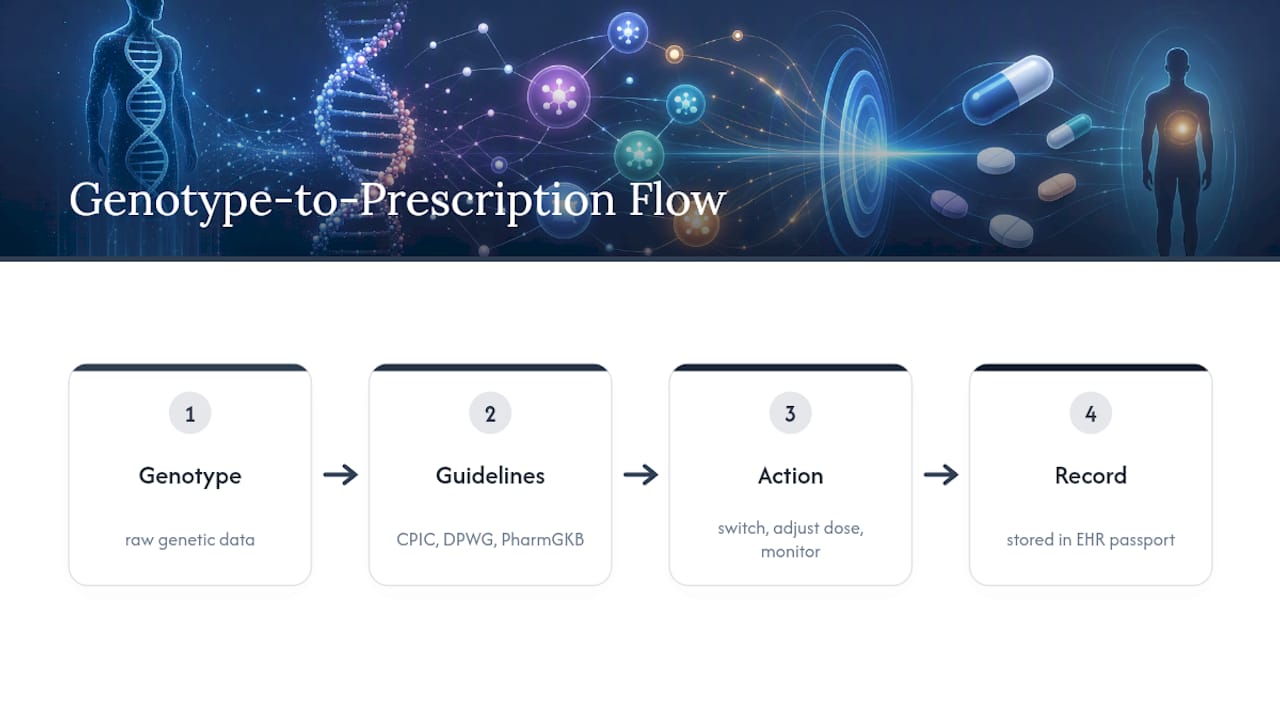
Raw genetic data means little without a translation layer, and that’s where clinical guideline groups come in. The Clinical Pharmacogenetics Implementation Consortium (CPIC) and the Dutch Pharmacogenetics Working Group (DPWG) publish peer-reviewed, drug-specific recommendations tied to genotype results. PharmGKB compiles these guidelines alongside regulatory label annotations, giving prescribers one place to check what a given phenotype means for a given drug.
In practice, a phenotype result like “CYP2C19 poor metabolizer” maps to a specific action: switch to an alternate drug, adjust the dose, or monitor more closely. These aren’t guesses. They’re standardized, evidence-backed recommendations drawn from accumulated trial and registry data.
Because your genetic variants don’t change over your lifetime, some health systems store PGx results directly in electronic health records, sometimes called a pharmacogenetic passport, so any future prescriber can check them instantly rather than ordering a new test. Good record-keeping around this kind of clinical data matters just as much as the testing itself, a point health information management specialists raise often when discussing long-term patient record integrity.
Privacy, Insurance, and Physical Risk: What to Know Before Testing
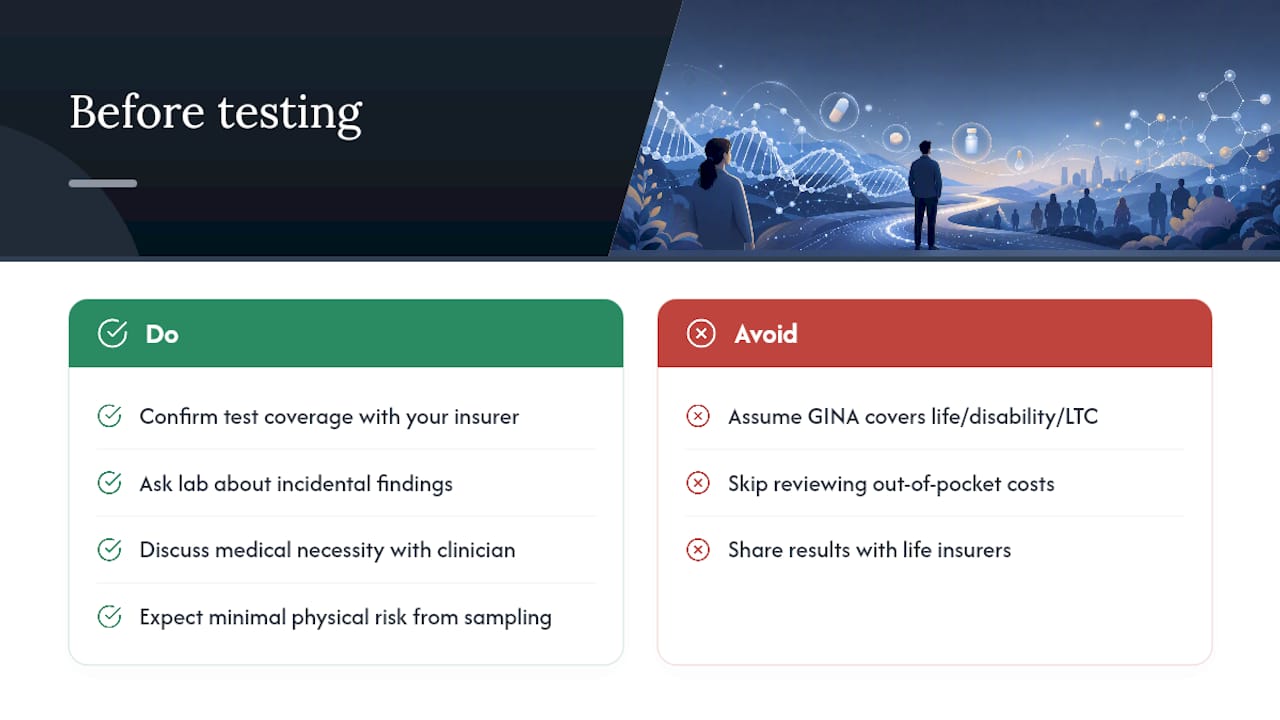
Physically, this test carries minimal risk. A blood draw, saliva sample, or cheek swab carries no more risk than routine lab work.
Legally, the Genetic Information Nondiscrimination Act (GINA) stops health insurers and employers from using your genetic results against you. That protection has a real gap: GINA does not cover life insurance, disability insurance, or long-term care insurance, so those companies could theoretically factor in genetic findings if they obtained them.
Insurance coverage for the test itself varies by plan and by medical necessity. Some insurers cover pharmacogenomic testing when it’s tied to a specific clinical indication, like starting a high-risk medication, while elective or preventive panels may fall to the patient. Costs and coverage details are worth reviewing directly, and a breakdown of typical PGx testing costs can help set expectations before you order anything.
One more thing worth knowing: because panel tests screen many genes at once, there’s a small chance of picking up incidental findings with broader health implications beyond medication response. A good lab will flag this possibility before you test, not after.
Questions Worth Asking Before You Test
A short conversation with your clinician before ordering the test saves confusion later. Bring these questions to that appointment:
- Which specific genes or drug classes will this panel cover?
- How exactly will the results change my current or future prescriptions?
- Who reviews and interprets the report, a pathologist, pharmacist, or my prescribing doctor?
- Will this result apply to future medications too, or just what I’m on now?
Once you have results, share copies with every prescriber you see, not just the one who ordered the test. A pharmacogenomic report from three years ago is still genetically accurate today, but the clinical guidelines built on top of it evolve, so it’s worth asking your clinician to double check the interpretation against current recommendations rather than assuming last year’s advice still holds.
What EIV Diagnostics Offers Patients Who Want PGx Testing
Pharmacogenomic testing is available as part of molecular pathology services for patients with prescriptions, provider referrals, or direct interest in their genetic profile before starting medications.
The process is designed to remove friction from an already complicated topic:
- Sample collection happens through standard lab visits or mobile phlebotomy, where a technician draws your sample at home or your workplace.
- Lab processing and interpretation is handled by board-certified pathologists, who translate raw genetic data into the genotype and phenotype findings your clinician needs.
- Report delivery goes to you and your ordering provider, formatted for a clear clinical conversation rather than a page of unreadable genetic code.
Results should always be reviewed with your prescribing clinician, who can weigh your genetic profile against your full medical history. The service supports clinical conversations with clear reporting, without replacing clinical decision-making.
Our Take: The Real Value Isn’t the Test, It’s the Conversation After It
The conventional pitch around pharmacogenomic testing treats the report itself as the finish line, as if a page of genotype results automatically produces better prescribing. It doesn’t. The research on implementation trials is fairly consistent on this: outcomes improve most when clinicians actually know how to apply the results, not simply when the test gets ordered.
That distinction should change how patients approach this. The statistic that over 95% of people carry an actionable variant is genuinely striking, but it’s easy to overstate what it means day to day. It doesn’t mean everyone needs urgent testing tomorrow. It means genetic variation in drug response is close to universal, which argues for preemptive panel testing over waiting for a bad reaction to force the issue.
Where most explainers fall short is treating this as a one-time event. Your genes don’t change, but the guidelines interpreting them do. The patients who get the most value are the ones who keep a copy of their results, bring them to every new prescriber, and ask, every few years, whether anything in the interpretation has shifted.
— EIV Diagnostics
Get Pharmacogenomic Testing Without the Extra Trip to a Lab
Most patients hit the same wall with pharmacogenomic testing: they know it could help, but scheduling a lab visit around a full-time job or a hard-to-move family schedule kills the plan before it starts. This barrier can be addressed with mobile phlebotomy services sending a technician to a patient’s home or office for blood draws, with qualified pathologists handling genetic interpretation behind the scenes.
If your clinician has recommended pharmacogenomic testing, or you’re managing multiple prescriptions and want clearer answers before your next appointment, Both provider-ordered and self-pay requests are processed by the laboratory. Start by reviewing the molecular pathology testing options available and schedule a sample collection at a time that actually fits your week.
This article is general information, not a substitute for advice from a qualified doctor. Consult a qualified healthcare professional about your own circumstances before acting on anything here.
Sources
- PubMed: prevalence of actionable pharmacogenomic variants
- Preventing adverse drug reactions and more: current clinical use of pharmacogenetic testing (PMC)
- CDC: Pharmacogenomics
FAQ
What Does Pharmacogenomic Testing Tell You?
It tells you and your clinician how your specific genetic variants are likely to affect the way your body processes certain medications, including whether a standard dose is likely to work, need adjustment, or trigger side effects.
Does Insurance Pay for Pharmacogenetic Testing?
Coverage varies by insurer and by medical necessity. Many plans cover it when tied to a specific clinical indication, such as starting a high-risk medication, while elective panels may require self-pay.
How Accurate Is Pharmacogenetic Testing?
The genetic detection itself is highly reliable, but accuracy in practice depends on how well the result gets translated into a prescribing decision. Guidelines from groups like CPIC exist specifically to standardize that translation.
Are There Any Risks With Pharmacogenetic Testing?
Physical risk is minimal since samples come from blood, saliva, or a cheek swab. The main considerations are privacy related: GINA protects against genetic discrimination by health insurers and employers but doesn’t extend to life, disability, or long-term care insurance.