
By EIV Diagnostics · September 14, 2026
U.S. Lab Managers: Pathology Lab Accreditation and Inspection Readiness
Practical U.S. roadmap for lab managers to achieve pathology lab accreditation: standards, step-by-step process, costs, common gaps, inspection readiness,...

Pathology lab accreditation is a formal, third-party verification that a laboratory’s testing quality, staff competence, and management systems meet recognized standards. The main routes are the College of American Pathologists (CAP), ISO 15189, the Clinical Laboratory Improvement Amendments (CLIA), A2LA, the Joint Commission, ACHC, and COLA. CLIA certification is the federal baseline every U.S. lab needs; the rest are accreditation programs labs pursue voluntarily, often to satisfy CLIA through “deemed status.”
TL;DR:
- Accreditation provides ongoing quality assurance beyond CLIA certification, requiring rigorous documentation, internal audits, proficiency testing, and corrective action systems.
- Most labs pursuing accreditation face common gaps in management systems, internal audit thoroughness, staff competency records, and consistent document control practices.
- Digital systems like LIS and digital pathology platforms significantly streamline compliance tasks such as document management, staff competency tracking, and audit trail creation.
- Accreditation costs depend on test menu complexity and include application fees, periodic assessments, and proficiency testing, with early checklist purchases sometimes reducing expenses.
- Maintaining accreditation requires continuous effort through regular internal audits, proficiency testing enrollment, document updates, and keeping track of assessment anniversaries to avoid unpreparedness.
Table of Contents
- What Pathology Lab Accreditation Means and Why It Matters
- Core Standards Explained: CLIA, ISO 15189, ISO/IEC 17025
- Major Accreditation Programs for Pathology Labs
- The Step-by-Step Pathology Lab Accreditation Process
- Preparing Your Lab: QMS Tasks, Internal Audits, and Common Gaps
- Costs, Fees, and Common Pitfalls to Plan For
- Benefits and Outcomes of Accreditation
- Differences Between Accreditation and Certification
- Maintaining Accreditation After You Get It
- Technology’s Role in Supporting Accreditation Standards
- EIV Diagnostics’ Perspective on Accreditation Readiness
- Sources
- FAQ
What Pathology Lab Accreditation Means and Why It Matters
Accreditation is a voluntary process where an outside organization audits a lab against a published set of standards and confirms, on paper and in person, that the lab actually does what it says it does. That’s different from licensure, which is a state’s legal permission to operate, and different from CLIA certification, which is the federal government’s minimum bar for running any clinical test. A lab can be CLIA certified and state licensed without ever being accredited. Accreditation goes further: it verifies the quality management system (QMS), not just the equipment and paperwork, and it does this through periodic audits, proficiency testing, and documented corrective action systems.
The practical consequences show up in daily operations, not just on a wall certificate. Labs that pursue accreditation typically see:
- Better inspection readiness, since internal audits mirror what an external assessor will check
- Mandatory participation in proficiency testing (PT), catching calibration drift before it becomes a patient safety issue
- Tighter documentation habits, because assessors expect a paper trail for every corrective action
- Fewer surprises during CMS or state inspections, since accreditation bodies often hold deeming authority
That last point matters more than most lab managers realize until they’re staring down two separate inspection regimes.
Core Standards Explained: CLIA, ISO 15189, ISO/IEC 17025
CLIA sets the federal regulatory floor for any U.S. lab performing testing on human specimens for diagnosis or treatment. It’s not optional. What is optional is how a lab demonstrates it meets CLIA’s requirements: either through direct CMS inspection, or through an accrediting organization with deeming authority, meaning CMS accepts that organization’s inspection in place of its own.
ISO 15189 is the international standard built specifically for medical laboratories, covering both quality management and technical competence. In the U.S., accreditation to ISO 15189 is voluntary and does not replace CLIA; labs pursuing it are layering a more rigorous, internationally recognized QMS on top of the CLIA baseline. Many other countries mandate ISO 15189 outright, which is why labs doing international reference work often pursue it for recognition abroad.
ISO/IEC 17025 is a different animal. It’s the general standard for testing and calibration laboratories, and it applies where pathology labs run reference or specialized analytical testing that falls outside clinical patient care. Quick reference:
- CLIA: federal, mandatory, minimum competency baseline
- ISO 15189: medical labs specifically, voluntary in the U.S., QMS plus technical competence
- ISO/IEC 17025: general testing/calibration labs, relevant mainly for reference or research testing operations
Pro Tip: Don’t assume ISO 15189 status automatically satisfies every CLIA requirement for your specialty. Cross-check your accreditor’s scope of accreditation document against your actual test menu before you file anything.
Major Accreditation Programs for Pathology Labs
Five names come up constantly in accreditation conversations, and each serves a slightly different lab profile.
- CAP (Laboratory Accreditation Program and CAP 15189): CAP uses discipline-specific checklists and peer inspectors, meaning the people auditing your molecular pathology bench have actually run one. CAP also holds CMS deeming authority. CAP 15189 layers ISO 15189 requirements on top, but a lab must already hold CAP LAP accreditation first.
- Joint Commission: Built around hospital and health system labs, with comprehensive standards that extend beyond the bench into broader patient safety systems. It requires a non-waived CLIA certificate for eligibility and awards accreditation after an onsite survey.
- A2LA: Offers both CLIA and ISO 15189 accreditation programs and holds international recognition, making it a common pick for labs with cross-border reference work.
- ACHC: Positioned as an alternative accreditor with a broader healthcare footprint, often chosen by labs already accredited by ACHC for other service lines.
- COLA: Historically focused on physician office labs and smaller independent operations that want a CLIA-deemed pathway without the scale of CAP’s checklist system.
The Step-by-Step Pathology Lab Accreditation Process
Getting accredited follows a fairly consistent sequence across programs, though timelines vary by accreditor and lab complexity.
- Run a gap assessment. Compare current practices against the target standard’s checklist before applying. Most labs buy the relevant master checklist at this stage.
- Submit the application and documentation. This includes online forms, fee payment, and an inventory of your test menu, staff credentials, and QMS documents.
- Off-site document review. The accreditor reviews your submitted QMS records, competency files, and PT enrollment before ever setting foot in the building.
- Internal audit. Programs like CAP 15189 require a documented internal audit before the on-site visit, not after.
- On-site assessment. Inspectors walk the bench, interview staff, and flag nonconformities against the checklist.
- Corrective action and root cause analysis (RCA). The lab responds to each nonconformity with a documented fix and the underlying cause, not just a patch.
- Committee review and decision. A review committee evaluates the corrective actions and issues (or withholds) accreditation.
- Ongoing cycle. Accreditation typically runs on a multi-year cycle, with CAP 15189 issuing a three-year term. The initial inspection date becomes your anniversary date, which sets the window for future unannounced inspections.
Pro Tip: Mark your anniversary date the moment you receive it and build a 90 day “always ready” staffing plan around it. Labs that treat readiness as a once-a-cycle scramble are the ones caught flat-footed by unannounced visits.
Preparing Your Lab: QMS Tasks, Internal Audits, and Common Gaps
Most accreditation failures aren’t about equipment. They’re about the management system around the equipment. Document control, management review meetings, risk management processes, and staff competency records are the pieces assessors dig into hardest, and they’re often the least mature part of a lab’s operation, since implementing them is harder than the technical work but delivers more long-term value.
Before your on-site visit, work through these tasks:
- Run a full internal audit against your target checklist, not a generic quality review
- Practice root cause analysis on a real nonconformity, not a hypothetical one, so staff know the documentation standard
- Simulate the inspection: pull random staff competency files and see if you can produce them in under two minutes
- Review CLIA certification requirements alongside your target accreditation standard so you’re not solving the same gap twice
The weak spots that show up again and again: thin internal audit programs, inconsistent management review documentation, missed PT events, and competency assessments that exist on paper but weren’t actually completed on schedule.
Pro Tip: Assign one person to own the internal audit calendar year-round, not just in the months before your assessment. Audit programs that only run pre-inspection look exactly like what they are to an assessor.
Costs, Fees, and Common Pitfalls to Plan For
Accreditation costs break into a few predictable buckets: an application fee, an annual base fee, assessor time and travel for on-site visits, and ongoing proficiency testing costs per test category. Larger labs with more test menus and more specialties pay more, both in fees and in the staff hours needed to prepare documentation.
A few tactics reduce the financial and operational strain:
- Purchase master checklists early. CAP will sometimes waive the initial application fee for labs that buy checklists and apply within six months.
- Schedule a gap assessment months ahead of your target application date, not weeks.
- Build staff schedules around your PT deadlines so results aren’t rushed or missed.
The most common pitfall isn’t a technical failure. It’s losing track of the inspection anniversary window and getting caught unprepared for an unannounced visit that lands exactly when staffing is thin.
Benefits and Outcomes of Accreditation
The payoff for accreditation shows up clinically, operationally, and commercially. Stronger QMS discipline tends to produce fewer testing errors and faster corrective action when something does go wrong, which directly supports patient safety. On the business side, accreditation often opens doors:
- Improved diagnostic accuracy through standardized, audited processes
- Fewer repeat errors, since RCA requirements force labs to fix root causes, not symptoms
- Stronger positioning with payers and referring providers who screen for accreditation status
- Real staff development, since peer inspectors and discipline-specific checklists expose teams to practices beyond their own walls
Differences Between Accreditation and Certification
These two terms get used interchangeably, and that’s a mistake worth correcting. Certification usually refers to a credential granted to an individual (a certified medical technologist) or, in CLIA’s case, a status granted to a facility confirming it meets a defined regulatory requirement. CLIA certification, for example, is a facility-level credential issued by CMS or its agents, confirming the lab meets the federal minimum for the complexity of testing it performs.
Accreditation, by contrast, evaluates a laboratory’s entire quality management system against a broader, more detailed standard, usually through recurring audits rather than a one-time check. A lab holds CLIA certification as a baseline requirement, then layers accreditation on top through CAP, A2LA, the Joint Commission, or another body to demonstrate a deeper, ongoing commitment to quality beyond the federal floor.
The distinction matters practically when you’re building a compliance roadmap. Certification tells a regulator “we meet the minimum.” Accreditation tells referring physicians, payers, and patients “an independent body actively verifies our quality year over year, not just once.” Some accreditors, through deeming authority, let their accreditation stand in for the CLIA inspection entirely, which is where the two concepts blend administratively even though they remain conceptually distinct.
Maintaining Accreditation After You Get It
Accreditation isn’t a plaque you hang and forget. Every program requires ongoing proof that your QMS keeps functioning between assessments, not just on inspection day.
That means keeping proficiency testing enrollment current across every applicable test category, running internal audits on a fixed schedule rather than reactively, and holding management review meetings that actually generate documented action items. Competency assessments for staff need refreshing on the cycle your accreditor specifies, typically annually for new staff and periodically thereafter. Document control has to stay live: procedure updates, equipment validation records, and corrective action logs all need version control that an assessor could review at any point, not just right before your renewal date.
The lab that treats the interval between assessments as a preparation period rather than a maintenance period is the lab that scrambles every cycle. Building a standing internal audit calendar, assigning clear ownership for PT tracking, and reviewing your QMS documentation quarterly instead of annually turns re-accreditation into a formality instead of a fire drill.
Technology’s Role in Supporting Accreditation Standards
Laboratory information systems (LIS) and digital pathology platforms have become quiet workhorses in accreditation readiness. Document control, one of the hardest QMS requirements to manage on paper, becomes far more auditable when procedure versions, competency records, and corrective action logs live in a searchable digital system rather than a filing cabinet.
Digital pathology tools add another layer of traceability specifically valuable for anatomic pathology accreditation. Slide-level audit trails, digital case sign-off records, and automated turnaround-time tracking give assessors exactly the kind of documented evidence checklists ask for, without a technician manually compiling it under deadline pressure. A digital pathology workflow that logs every step from accessioning to sign-off does double duty: it speeds up diagnosis and it builds the audit trail an accreditor wants to see.
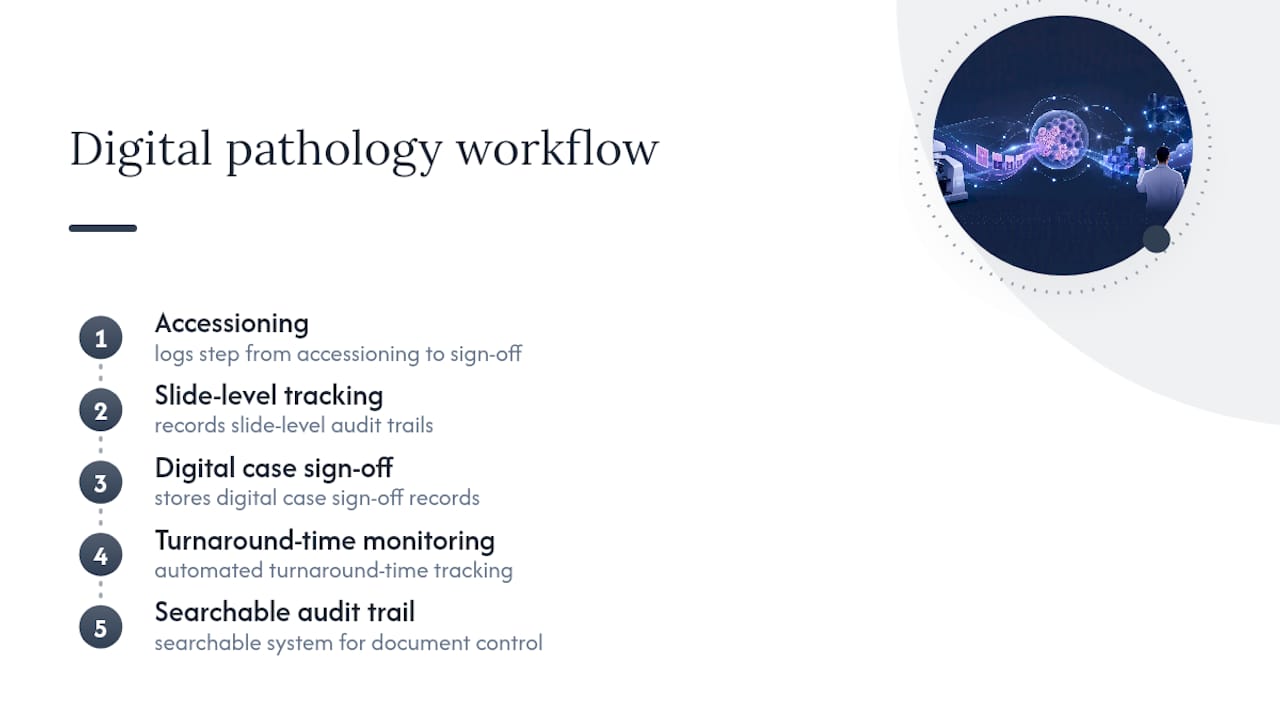
LIS platforms also make proficiency testing tracking and staff competency scheduling far less error-prone than spreadsheet-based systems, which is exactly where many labs lose points during document review.
EIV Diagnostics’ Perspective on Accreditation Readiness
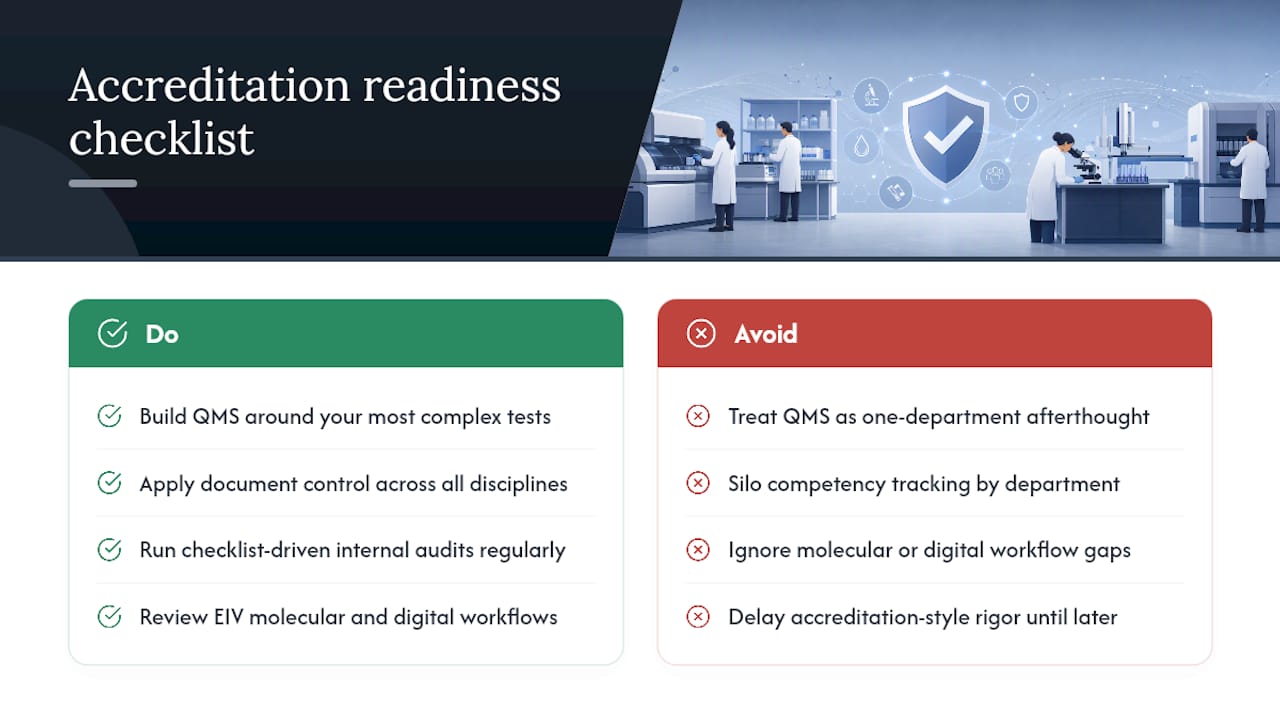
An independent pathology laboratory offers molecular pathology, dermatopathology, clinical pathology, histopathology, and digital pathology services, alongside mobile phlebotomy for patients who need testing outside a traditional draw site. Running molecular and digital pathology workflows side by side means quality management can’t be an afterthought bolted onto one department. Document control, competency tracking, and internal audit discipline have to work the same way across every discipline, or gaps show up exactly where inspectors look hardest.
The practical lesson for other labs: build your QMS around your most complex test menu, not your simplest one, and let that standard cascade down. A checklist-driven internal audit that treats molecular pathology with the same rigor as routine clinical chemistry catches problems before an assessor ever does.
— EIV Diagnostics
For labs ready to move on accreditation or looking for a working example of accredited-style rigor in molecular diagnostics, EIV Diagnostics’ molecular pathology services reflect the same QMS discipline covered throughout this guide, from PCR-based testing accuracy to documented turnaround reporting. Labs weighing digital workflow investments as part of their accreditation prep can also review EIV’s digital pathology capabilities for a sense of how confocal microscopy and slide-level tracking fit into a modern QMS. For a broader look at how labs communicate accreditation and quality credentials to referring providers and patients, the diagnostics and pathology marketing playbook from 121 Group covers positioning strategies worth reviewing alongside your compliance roadmap.
Sources
For program rules, checklists, and application forms, go straight to the source rather than secondhand summaries. CAP’s Laboratory Accreditation Program page covers checklist access and peer inspection details. The PMC overview of medical laboratory accreditation explains ISO 15189’s scope and voluntary U.S. status in depth. A2LA’s clinical testing accreditation page details CLIA and ISO 15189 program specifics, and the Joint Commission’s laboratory services page outlines survey requirements for hospital-based labs.
This article is general information, not a substitute for advice from a qualified doctor. Consult a qualified healthcare professional about your own circumstances before acting on anything here.
- Laboratory Accreditation Program - CAP
- CAP 15189 Accreditation Program - CAP
- Joint Commission - Laboratory services accreditation
FAQ
Does ISO 15189 Apply to All Labs?
No. ISO 15189 applies specifically to medical laboratories, and in the U.S. it’s voluntary rather than mandatory, unlike in many other countries where it’s a legal requirement.
What Are the Requirements for a Laboratory to Be Accredited?
Requirements vary by program, but generally include a functioning QMS, documented staff competency records, proficiency testing enrollment, internal audits, and passing an on-site or off-site assessment against the accreditor’s checklist, such as CAP’s discipline-specific checklists.
What Does ISO 17025 Accreditation Mean?
ISO/IEC 17025 accreditation confirms a testing or calibration laboratory’s competence for general testing work; it’s less common in clinical pathology and more relevant to reference or specialized analytical labs than to routine patient-testing operations.
How Does a Lab Become Accredited?
A lab applies to an accrediting body, submits documentation for review, undergoes an on-site assessment, resolves any nonconformities through corrective action and root cause analysis, and receives accreditation after committee review, typically valid for a multi-year cycle before renewal.
What’s the Difference Between CLIA Certification and Accreditation?
CLIA certification is the federal minimum every U.S. lab needs to legally operate; accreditation from bodies like CAP, A2LA, or the Joint Commission is a voluntary, more rigorous quality review that some programs can use to satisfy CLIA through deeming authority.