
By EIV Diagnostics · July 30, 2026
ICD-10 for CBC with Diff: Medicare Guide for Providers
Discover the ICD 10 code for CBC with diff for Medicare. Ensure your claims meet requirements for accurate reimbursement and compliance.

There is no single ICD-10 code for a CBC with differential. Medicare covers CPT 85025 only when you link it to a diagnosis code that documents medical necessity under CMS NCD 190.15. The diagnosis must reflect an active clinical problem — a sign, symptom, or confirmed condition — not a routine screening or historical finding.
Here is what every claim requires at minimum:
- CPT code: 85025 (automated CBC with automated 5-part differential — Hgb, Hct, RBC, WBC, platelet count, and differential WBC count)
- ICD-10 diagnosis: Must reflect the clinical reason the test was ordered (e.g., new-onset anemia, neutropenia, fever with leukocytosis)
- Ordering provider NPI: Required on the claim
- CLIA-certified performing lab: The lab processing the specimen must hold an active CLIA certificate
- Order language: The physician’s order must explicitly request “CBC with differential” — an order that says only “CBC” maps to CPT 85027, not 85025
Key compliance fact: CMS CERT data shows that 92.2% of improper payments for blood tests stem from insufficient documentation — not wrong codes. Getting the diagnosis and chart note right matters far more than memorizing code lists.
Table of Contents
- What does CMS NCD 190.15 require for Medicare to cover a CBC?
- Which ICD-10 diagnosis categories support medical necessity for CPT 85025?
- How does order wording affect which CPT code gets billed?
- What documentation does Medicare expect on the claim and in the chart?
- Why does Medicare deny CBC with differential claims, and how do you fix it?
- How to confirm Medicare will cover a CBC with differential before you submit
- Key Takeaways
- The documentation gap no one talks about
- Eivdiagnostics supports providers with CLIA-certified CBC testing
- Useful sources and where to verify coverage
- FAQ
What does CMS NCD 190.15 require for Medicare to cover a CBC?
NCD 190.15 is the national policy that governs Medicare coverage of blood counts, including CBC with differential. It applies to every Medicare Administrative Contractor (MAC) jurisdiction in the country, which means it is the baseline before any local rules come into play.
The core standard is “reasonable and necessary.” A CBC with differential meets that standard when the ordering provider can show the test was needed to evaluate or manage an active clinical problem. Coverage is diagnosis-driven, not screening-driven. Ordering a CBC because a patient is elderly or because it is part of an annual wellness visit does not satisfy NCD 190.15.
Required claim elements under NCD 190.15:
- A supported ICD-10 diagnosis code tied to the clinical problem being evaluated
- Ordering provider’s name and NPI
- CLIA number of the performing laboratory
- Explicit order language when a differential is needed (not just “CBC”)
When an ABN is required: If the ICD-10 code on the requisition is not supported by NCD 190.15 or the local MAC’s LCD, the performing lab must issue an Advance Beneficiary Notice of Noncoverage (ABN) before the service. The ABN shifts financial liability to the patient if Medicare denies the claim. Skipping this step when coverage is uncertain leaves the lab holding the cost.
Pro Tip: Download the current NCD 190.15 PDF directly from the CMS Medicare Coverage Database, then pull your MAC’s LCD for blood counts. MACs can narrow or expand the supported ICD-10 list beyond the national policy. If you are in California, check Noridian’s LCD; if you are in the Southeast, check Palmetto GBA. The MAC’s list is the practical last mile for coverage decisions.
Which ICD-10 diagnosis categories support medical necessity for CPT 85025?
No single code covers all situations. Instead, the diagnosis must fall into a category that NCD 190.15 recognizes as a valid indication for a CBC with differential. The table below maps the most common categories to example ICD-10 ranges and the clinical situations where billing CPT 85025 is appropriate.
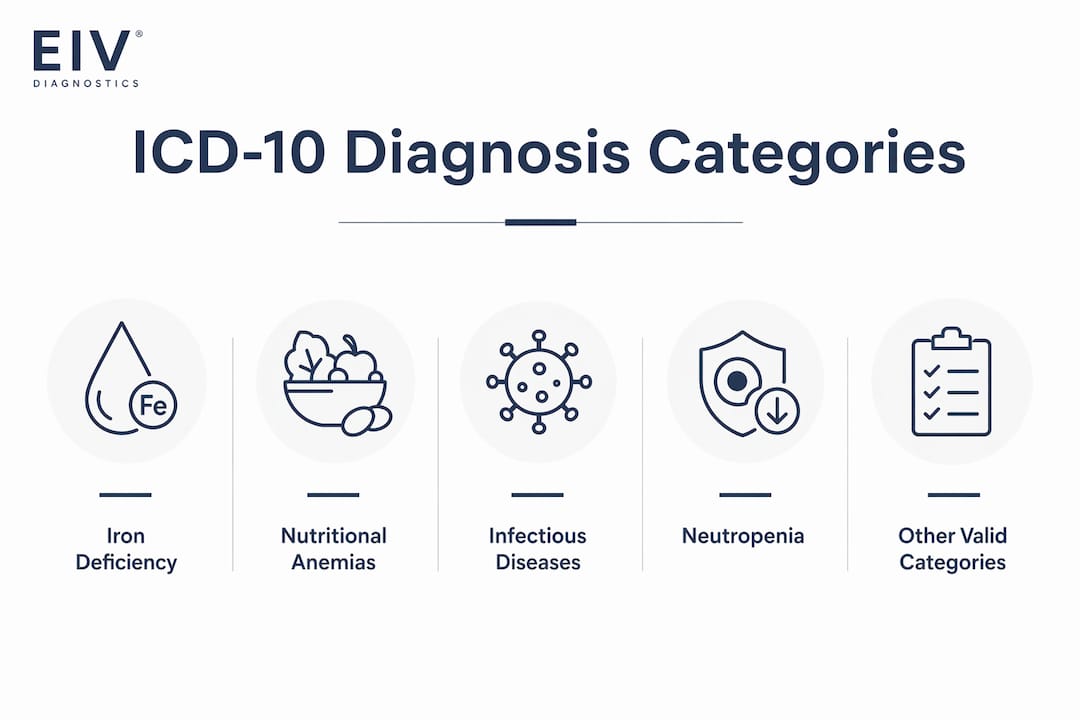
| Diagnosis Category | Example ICD-10 Range | When to Use |
|---|---|---|
| Iron deficiency and nutritional anemias | D50.x | Evaluation of fatigue, pallor, low Hgb on prior labs |
| Aplastic and other anemias | D61.x | Bone marrow suppression, unexplained pancytopenia |
| Leukemias and lymphomas | C91–C96 | Active hematologic malignancy, monitoring during treatment |
| Myelodysplastic syndromes | D46.x | Cytopenias under evaluation or active MDS management |
| Neutropenia | D70.x | Monitoring during chemotherapy, recurrent infections |
| Thrombocytopenia | D69.x | Low platelet count evaluation, bleeding risk assessment |
| Infection / fever with leukocytosis | R50.9, A41.9 | New fever, suspected sepsis, acute bacterial infection |
| Chemotherapy monitoring | Z51 + active disease code | Ongoing cytotoxic therapy requiring CBC surveillance |
These ICD-10 categories for CBC are the ones most consistently supported across MAC jurisdictions, but always verify against your specific contractor’s LCD.
Do this when selecting the primary diagnosis:
- Use the acute sign, symptom, or active disease code that prompted the order — not a historical or resolved condition
- When monitoring a known diagnosis (e.g., neutropenia during chemotherapy), pair the monitoring code with the active disease code
- Match the ICD-10 to the clinical language in the progress note; if the note says “new onset leukocytosis,” the code should reflect that
Avoid these common mistakes:
- Do not use preventive or screening codes (Z00.x) as the primary diagnosis — these do not support medical necessity for 85025
- Do not list a chronic condition that is stable and unrelated to the current encounter as the justification
- Do not leave the diagnosis field blank or use an unspecified code when a more specific one is documented
Sample clinical phrases that align the ICD-10 to the test:
- “New onset fever and leukocytosis; CBC with differential ordered to evaluate suspected bacterial infection” → R50.9 or A41.9
- “Monitoring neutropenia during chemotherapy for AML” → D70.1 + C92.00
- “Fatigue and pallor; evaluating for iron deficiency anemia” → D50.9
How does order wording affect which CPT code gets billed?
CPT 85025 is the code for an automated CBC with a complete automated differential — it includes hemoglobin, hematocrit, RBC indices, platelet count, and a 5-part automated WBC differential. That last element is what separates it from CPT 85027.
The three codes billing teams need to know:
- CPT 85025: Automated CBC with automated differential WBC count — requires the order to explicitly request a differential
- CPT 85027: Automated CBC without differential — use when the order says only “CBC”
- CPT 85007: Manual differential (blood smear, microscopic examination) — used when a pathologist or technologist manually reviews the smear
The order wording is the trigger. If a physician writes “CBC” without specifying a differential, the lab should bill 85027, not 85025 — even if the analyzer runs a differential automatically. Billing 85025 on an order that only requested a CBC is a mismatch that invites a denial or an audit finding.
NCCI rules on combining codes: CMS/NCCI policy prohibits billing CPT 85025 together with CPT 85007 for the same patient on the same date of service. If a manual review is clinically warranted, labs generally bill either 85025 alone or the combination of 85027 plus 85007, depending on what was actually ordered and performed.

Pro Tip: Train ordering providers to write “CBC with automated differential” rather than just “CBC with diff.” The word “automated” removes ambiguity for the lab and aligns the order language directly with CPT 85025’s descriptor. One phrase change prevents a category of mismatches.
Confirm with your performing lab how they interpret order language before assuming a test will be billed as 85025. Labs that proactively flag ambiguous orders and request clarification before processing cut claim denials by reducing order-to-billed-test mismatches.
What documentation does Medicare expect on the claim and in the chart?
CMS MLN guidance is direct: 92.2% of improper payments for blood tests trace back to insufficient documentation. The fix is not a new code — it is a better chart note.
Required documentation elements:
- Clinical indication: the specific sign, symptom, or diagnosis that prompted the order
- Date and time of the encounter or order
- Explicit connection between the test and the clinical problem documented that day
- Ordering provider’s signature and NPI
- Physician order that specifies “CBC with differential” (or equivalent)
- CLIA number and NPI of the performing laboratory on the claim
ABN documentation: When coverage is uncertain, the performing lab is responsible for issuing the ABN before the service. The signed ABN must be retained in the patient’s record and the appropriate modifier (GA) must appear on the claim. The ordering provider should be notified when an ABN is issued so the clinical team can document the patient’s acknowledgment.
Pro Tip: Write the clinical indication directly into the order, not just the progress note. An order that reads “CBC with automated differential — evaluating new leukocytosis and fever” gives the lab, the biller, and the auditor everything they need in one place. Progress notes buried in an EHR are harder to retrieve during a post-payment review.
For long-term care settings, where lab ordering workflows can involve multiple handoffs, tools that track MAC/LCD variability across jurisdictions help billing teams stay current without manually checking each contractor.
Why does Medicare deny CBC with differential claims, and how do you fix it?
Most common denial reasons:
- Insufficient documentation (no clinical indication in the chart or on the order)
- Order/billed-test mismatch (85027 ordered, 85025 billed — or vice versa)
- Non-supporting diagnosis code (preventive/screening code used as primary)
- Missing ordering provider NPI on the claim
- Non-CLIA-certified performing lab
- Duplicate billing (same test, same date, same patient)
- ICD-10 code not supported by the MAC’s LCD for the patient’s jurisdiction
Understanding a CO-50 denial: A CO-50 denial means Medicare determined the service was not medically necessary based on the information submitted. The denial is not final. The documentation submitted with the original claim was insufficient — the fix is to supply what was missing.
Practical appeal steps:
- Pull the complete chart note from the date of service.
- Obtain a physician attestation that ties the test date to the documented clinical problem (e.g., “On [date], patient presented with fever and leukocytosis; CBC with differential ordered to evaluate suspected bacterial infection”).
- Resubmit the corrected claim with the attestation and supporting chart notes attached.
- If an ABN was required but not obtained, document the circumstances and consult your MAC’s redetermination process.
Pre-submission error checklist:
- ICD-10 matches the acute sign/symptom or active diagnosis in the chart
- Order explicitly requests “CBC with differential”
- CPT 85025 is used (not 85027) when differential was ordered and performed
- Ordering provider NPI is on the claim
- Performing lab CLIA number is on the claim
- MAC LCD has been checked for the patient’s jurisdiction
- ABN obtained and documented if coverage is uncertain
How to confirm Medicare will cover a CBC with differential before you submit
Run through these steps before the claim goes out. Each one takes under a minute; skipping one can cost weeks in appeals.
- Confirm the clinical indication. Is there an active sign, symptom, or diagnosis in the chart that justifies the test? If not, the claim will likely deny.
- Select the correct ICD-10. Choose the code that reflects the acute problem being evaluated, not a historical or chronic-only condition.
- Check the physician order. Does it say “CBC with differential”? If it says only “CBC,” the lab will bill 85027, not 85025.
- Verify the performing lab’s CLIA status. Confirm the lab holds an active CLIA certificate and that the CLIA number will appear on the claim.
- Confirm the ordering provider NPI. It must be on the claim exactly as registered with CMS.
- Check your MAC’s LCD. Pull the LCD for blood counts from your Medicare Administrative Contractor. Verify the selected ICD-10 is on the supported list for your jurisdiction.
- Assess ABN need. If the ICD-10 is not clearly supported, the performing lab must issue an ABN before the service.
- Attach supporting documentation. Flag the chart note and order for the billing team so they are ready if a post-payment review is triggered.
For practices managing LTPAC patients, where lab orders often travel through multiple care settings, confirming that the ordering provider NPI and CLIA number survive the handoff to the billing system is a step worth building into the workflow explicitly.
Key Takeaways
Medicare coverage for a CBC with differential depends on documentation and a supported ICD-10 diagnosis, not on a single code — and 92.2% of improper payments for blood tests trace to insufficient documentation, not incorrect coding.
| Point | Details |
|---|---|
| No single ICD-10 code | Link CPT 85025 to the active clinical diagnosis or sign/symptom that justifies the test. |
| Order wording is the trigger | The physician’s order must say “CBC with differential” for a lab to bill 85025 instead of 85027. |
| Documentation drives coverage | Chart notes must tie the test date to the specific clinical problem; 92.2% of improper payments stem from insufficient documentation. |
| Always check your MAC’s LCD | NCD 190.15 is the national floor; your MAC’s LCD sets the practical supported ICD-10 list for your jurisdiction. |
| Eivdiagnostics supports your claims | Eivdiagnostics’ CLIA-certified lab in Fresno confirms order specifics before processing and documents CLIA and NPI on every claim. |
The documentation gap no one talks about
The billing community spends enormous energy debating which ICD-10 code to use for a CBC with differential. That is understandable — but it is also the wrong place to focus most of the effort. The CMS CERT data makes the real problem plain: 92.2% of improper payments for blood tests come from insufficient documentation. Not wrong codes. Not missing CLIA numbers. Thin chart notes.
What that means in practice is that a provider who picks the right ICD-10 but writes a vague progress note (“CBC ordered per patient request”) is far more likely to face a denial than one who picks a slightly less specific code but documents “patient presented with three-day fever, WBC 14.2 on prior draw, CBC with differential ordered to evaluate for bacterial infection.” The second note survives an audit. The first one does not.
The other thing worth saying plainly: order language is a clinical communication problem, not just a billing one. When a physician writes “CBC” and means “CBC with differential,” the lab has to make a compliance judgment call. Billing 85025 on an order that says 85027 is an audit risk. Billing 85027 when the physician wanted a differential means the clinical team may not get the white cell breakdown they needed. Training providers to write “CBC with automated differential” takes five minutes and prevents both problems.
Eivdiagnostics supports providers with CLIA-certified CBC testing
Providers in the Fresno and Reedley area who need a reliable lab partner for Medicare CBC with differential testing will find that Eivdiagnostics removes a significant layer of billing friction. The lab’s board-certified pathologists review orders before processing, and when order language is ambiguous (“CBC” without a differential specified), the lab contacts the ordering provider to clarify before running the specimen. That one step prevents the most common mismatch between what was ordered and what gets billed.

Eivdiagnostics holds an active CLIA certificate, and the lab’s NPI and CLIA number are documented on every claim. Mobile phlebotomy is available for patients who cannot come to the lab, with draws performed at home or at the provider’s office. For practices managing complex hematology cases, the lab’s clinical pathology services include the full range of CBC and differential testing with rapid turnaround. Coverage is not guaranteed — providers should verify the patient’s ICD-10 against their MAC’s LCD and obtain an ABN when indicated. Contact Eivdiagnostics to confirm order requirements and set up a provider account.
Useful sources and where to verify coverage
Before submitting any Medicare claim for a CBC with differential, check these primary sources directly. MAC LCDs change, and a code that was supported last year may have been narrowed.
- CMS NCD 190.15 — Blood Counts: The national coverage determination that governs all blood count claims. Start here.
- CMS Medicare Coverage Database: Use the LCD search to find your MAC’s local coverage determination for blood counts by jurisdiction.
- CMS MLN — Blood Count Lab Tests: Provider compliance tips and CERT data on improper payment causes.
- CMS NCD Coding Manual (ICD-10 version): The full ICD-10 code lists covered and not covered under each NCD.
- Your MAC’s website: Noridian (Jurisdiction E/F), Palmetto GBA, CGS, Novitas, WPS, and others publish updated LCD articles with supported ICD-10 lists. Always check the LCD for the patient’s state, not your practice’s state.
Reminder: The NCD sets the national floor. Your MAC’s LCD is the controlling document for which specific ICD-10 codes will actually pay in your jurisdiction. When in doubt, call your MAC’s provider relations line before submitting.
FAQ
What diagnosis will cover a CBC for Medicare?
Medicare requires a diagnosis that reflects an active clinical problem — such as iron deficiency anemia (D50.x), neutropenia (D70.x), leukemia (C91–C96), thrombocytopenia (D69.x), or fever with suspected infection (R50.9). Preventive or screening codes do not satisfy NCD 190.15’s medical necessity standard.
Is there an ICD-10 code specifically for CBC with differential screening?
No. There is no ICD-10 code that functions as a standalone “order a CBC with differential” code. The diagnosis must document why the test is clinically needed; the CPT code (85025) identifies the test itself.
What ICD-10 codes are covered for routine labs under Medicare?
Medicare does not cover routine or screening labs without a supporting clinical indication. Any ICD-10 code that reflects an active sign, symptom, or diagnosis recognized under NCD 190.15 can support coverage — but the code must match what is documented in the chart for that encounter.
What is the CPT code for CBC with differential billed to Medicare?
CPT 85025 is the standard code for an automated CBC with automated differential. The physician’s order must explicitly request a differential; an order for “CBC” alone maps to CPT 85027 (CBC without differential).
What happens if my MAC’s LCD does not list my ICD-10 code?
If the diagnosis code is not on the MAC’s supported list, the performing lab must issue an ABN before the service. Without a signed ABN, the lab cannot bill the patient if Medicare denies the claim. Check your MAC’s LCD at the CMS Medicare Coverage Database before ordering.
Recommended
- CMP Test Code 10231: What It Measures and Why It Matters | EIV Diagnostics | EIV Diagnostics
- EIV Diagnostics | Independent Pathology Laboratory | EIV Diagnostics
- EIV Diagnostics | Independent Pathology Laboratory | EIV Diagnostics
- Skin Pathology Billing: A Clear Guide for Hanford Patients | EIV Diagnostics | EIV Diagnostics