
By EIV Diagnostics · July 29, 2026
DX Code for PSA Screening: A Billing Guide for Providers
Discover the correct dx code for PSA screening and simplify your billing process. Understand key codes to ensure accurate Medicare claims.

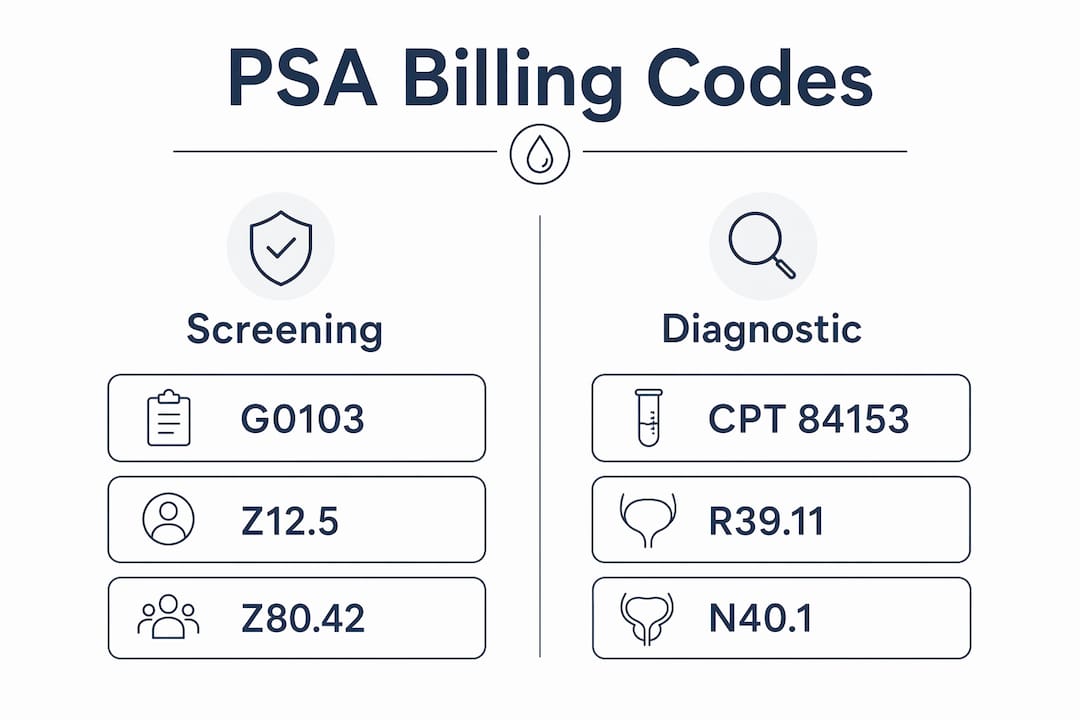
For routine PSA screening, the correct dx code for psa screening is Z12.5 (Encounter for screening for malignant neoplasm of prostate), paired with HCPCS G0103 for Medicare claims. When the patient has symptoms or prior prostate findings, switch to CPT 84153 (total PSA) with a diagnostic ICD-10-CM code. That one distinction — asymptomatic screening versus symptomatic diagnostic workup — determines everything about how the claim is built.
Quick-reference codes at a glance:
- Z12.5 — ICD-10-CM screening code for routine prostate cancer screening (valid October 1, 2025 through September 30, 2026)
- G0103 — Medicare HCPCS code for asymptomatic PSA; covered once every 12 months for men age 50 and older
- CPT 84153 — Total PSA; used when the patient is symptomatic or has prior abnormal findings; pair with a diagnostic ICD-10 code such as R39.11, N40.x, or C61
- Z80.42 — Secondary code for documented family history of prostate cancer; add alongside Z12.5 when the chart supports it
Table of Contents
- When should you use Z12.5 versus CPT 84153?
- How to bill PSA screening: code pairings, Medicare rules, and frequency limits
- What coding mistakes cause PSA claim denials?
- What should providers document to support screening or diagnostic coding?
- Coding scenarios: what do correct code combinations look like?
- Key Takeaways
- Why accurate PSA coding matters more than most providers realize
- Eivdiagnostics makes PSA testing easier for providers and patients
- Useful sources
- FAQ
When should you use Z12.5 versus CPT 84153?
Use Z12.5 plus G0103 only when the patient is asymptomatic and the visit purpose is explicitly routine prostate cancer screening. The moment any of the following appear in the chart, the test moves into the diagnostic lane and requires CPT 84153 paired with an appropriate diagnostic ICD-10-CM code:
- Lower urinary tract symptoms (urgency, hesitancy, frequency, nocturia)
- Prior elevated PSA result
- Benign prostatic hyperplasia (BPH) or abnormal digital rectal exam
- Active monitoring of known prostate pathology (e.g., C61 for prostate cancer)
Diagnostic ICD-10 codes commonly paired with CPT 84153 include R39.11 (hesitancy of micturition), N40.1 (BPH with lower urinary tract symptoms), and C61 (malignant neoplasm of prostate). Urology practices use CPT 84153 far more often than G0103 precisely because most patients presenting to a specialist already have a documented finding. G0103 is largely a primary care preventive code.
Pro Tip: Add a single line to every screening visit note — “Patient is asymptomatic; PSA ordered as routine prostate cancer screening” — before the order goes in. That one sentence is what separates a clean claim from a denial.
How to bill PSA screening: code pairings, Medicare rules, and frequency limits
The two billing lanes are mutually exclusive. Never bill G0103 and CPT 84153 on the same date of service.

| Scenario | HCPCS/CPT | ICD-10-CM | Cost-Sharing |
|---|---|---|---|
| Asymptomatic screening (Medicare) | G0103 | Z12.5 (+ Z80.42 if applicable) | Generally no deductible or coinsurance |
| Diagnostic workup (symptomatic) | CPT 84153 | R39.11, N40.x, C61, or other diagnostic code | Standard Part B: deductible + coinsurance |
| Out-of-frequency patient request | CPT 84153 + modifier GA | Diagnostic or screening ICD per clinical context | Patient financial responsibility after ABN |
Medicare specifics: G0103 is a Medicare Part B preventive benefit for men age 50 and older, payable no more than once every 12 months. CMS enforces a minimum of 11 months between covered tests. When billed correctly as G0103 with Z12.5 and the patient meets eligibility criteria, there is generally no patient deductible or coinsurance.
Out-of-frequency requests: When a patient wants a PSA test sooner than the payer allows, issue an Advance Beneficiary Notice (ABN) and append modifier GA to the lab claim. This documents that the patient accepts financial responsibility and protects the provider from liability.
Commercial payers: Coverage rules vary. Many follow Medicare’s framework, but local coverage determinations (LCDs) and plan-specific policies can differ on age thresholds, frequency, and cost-sharing. Always verify payer-specific rules before filing.
What coding mistakes cause PSA claim denials?
The most common denial pattern is a mismatch between the procedure code type and the diagnosis code type. Mixing a screening HCPCS with a diagnostic ICD, or vice versa, triggers immediate payer rejection.
- Mixing lanes: Billing G0103 alongside CPT 84153 on the same claim is the leading cause of PSA-related denials. The two code sets are mutually exclusive — pick one lane per date of service.
- Undocumented screening intent: Using Z12.5 without an explicit “asymptomatic” or “routine screening” statement in the chart. If the note is ambiguous, a payer auditor will default to diagnostic, and the claim may be recouped.
- Age or frequency violations: Submitting G0103 for a patient under 50, or within 11 months of a prior covered screening, results in automatic denial.
- Missing Z80.42: When a family history of prostate cancer is documented but the secondary code is omitted, the claim is technically incomplete and may affect clinical completeness scores.
- No ABN or modifier GA: Ordering a PSA outside insurer frequency limits without issuing an ABN leaves the provider financially exposed if the claim is denied.
Pro Tip: Build two separate order sets in your EHR — one for screening PSA (G0103 + Z12.5) and one for diagnostic PSA (CPT 84153 + relevant diagnostic ICD). Keeping them structurally separate at the point of order eliminates most downstream coding errors before they reach the biller.
What should providers document to support screening or diagnostic coding?
Correct code assignment is the ordering provider’s responsibility. The chart must make the billing intent unambiguous.
For screening (Z12.5 + G0103), confirm the note includes:
- Explicit statement that the patient is asymptomatic
- Purpose documented as “routine prostate cancer screening”
- Patient age confirmed at 50 or older
- No prior elevated PSA, BPH, or abnormal exam findings noted
For diagnostic coding (CPT 84153), document:
- Specific symptoms (urgency, hesitancy, frequency, nocturia, or pelvic pain)
- Prior abnormal PSA value with date
- Abnormal digital rectal exam findings
- Relevant history (BPH, prior biopsy, active surveillance)
When family history applies: Document the specific relative and cancer type, then add Z80.42 as a secondary code. This improves clinical completeness without changing the screening classification when the patient is otherwise asymptomatic.
That note supports G0103 + Z12.5 + Z80.42 cleanly. A coder reviewing it has everything needed to file without a call back to the provider.
Coding scenarios: what do correct code combinations look like?
| Scenario | Procedure Code | Primary ICD-10-CM | Secondary Code |
|---|---|---|---|
| Asymptomatic annual screen, age 58 | G0103 | Z12.5 | Z80.42 (if family history documented) |
| Lower urinary tract symptoms, age 62 | CPT 84153 | R39.11 or N40.1 | — |
| Family history, asymptomatic, age 52 | G0103 | Z12.5 | Z80.42 |
| Repeat test within 11 months, patient request | CPT 84153 + modifier GA | Per clinical context | — |
Scenario 1 (asymptomatic annual screen): A 58-year-old male with no symptoms presents for a preventive visit. Bill G0103 with Z12.5. If the chart documents his father’s prostate cancer diagnosis, add Z80.42. If the PSA is drawn during a comprehensive preventive exam, Z00.00 may also be appropriate depending on payer rules.
Scenario 2 (lower urinary tract symptoms): A 62-year-old reports hesitancy and nocturia. This is a diagnostic encounter. Bill CPT 84153 with R39.11 or N40.1. Do not use G0103 here regardless of the patient’s age.
Scenario 3 (family history, asymptomatic): A 52-year-old with a father who had prostate cancer, no symptoms himself. Bill G0103 + Z12.5 as primary, Z80.42 as secondary. Note that some commercial payers may not recognize Z80.42 as a standalone justification for earlier screening — verify the LCD before assuming coverage.
Scenario 4 (repeat within restricted interval): A patient requests a PSA test nine months after his last covered screening. Document the request and clinical rationale, present and have the patient sign an ABN, then bill CPT 84153 with modifier GA. The patient accepts financial responsibility for the test cost.
Key Takeaways
The single most important rule in PSA billing: Z12.5 and G0103 belong to the screening lane; CPT 84153 and diagnostic ICD codes belong to the diagnostic lane. Never cross them on the same claim.
| Point | Details |
|---|---|
| Primary screening code | Z12.5 is the ICD-10-CM code for routine prostate cancer screening; pair with G0103 for Medicare claims. |
| Medicare frequency limit | G0103 is covered once every 12 months for men age 50+; CMS enforces an 11-month minimum interval. |
| Diagnostic lane rule | Use CPT 84153 with a diagnostic ICD (R39.11, N40.x, C61) when symptoms or prior findings are present; never mix with G0103. |
| Family history documentation | Add Z80.42 as a secondary code when a family history of prostate cancer is documented in the chart. |
| Eivdiagnostics lab support | Eivdiagnostics includes test purpose on requisitions and provides provider-facing documentation guidance to reduce billing friction at the point of order. |
Why accurate PSA coding matters more than most providers realize
The coding split between screening and diagnostic PSA is one of the most consistently misapplied rules in outpatient billing, and the consequences run in both directions. When a provider bills G0103 for a patient who actually had symptoms, the claim may pay initially but creates audit exposure. When CPT 84153 is used for a true screening encounter, the patient faces a deductible and coinsurance they were not expecting — a surprise bill that damages trust and sometimes delays follow-up care.
What gets overlooked is that the documentation burden falls entirely on the ordering provider, not the coder. A coder reviewing a vague note cannot manufacture the word “asymptomatic” from context. The AAPC is explicit on this: correct code assignment is the ordering provider’s responsibility, and the chart must justify the code before the claim is filed.
The family history code Z80.42 is another underused tool. Adding it when documented does not change the screening classification, but it does create a more complete clinical picture — one that supports appropriate follow-up intervals and, in some payer contexts, earlier screening eligibility.
The practical fix is structural, not educational. Separate EHR order sets, standardized note phrases, and lab requisitions that flag test purpose (screening versus diagnostic) eliminate most errors before they reach the billing team. That is where the real leverage is.
Eivdiagnostics makes PSA testing easier for providers and patients
Providers who order PSA tests through Eivdiagnostics get more than a lab result. The clinical pathology services at Eivdiagnostics are built around reducing the friction between the order and the final report — including clear requisition forms that capture test purpose (screening versus diagnostic) at the point of order, which directly supports correct downstream coding.
Board-certified pathologists review results and reports go back to the ordering provider quickly, so clinical decisions do not wait on lab turnaround. For patients in the Sanger and Fresno area who cannot easily get to a draw site, Eivdiagnostics offers mobile phlebotomy — a phlebotomist comes to the patient’s home or office. Self-pay patients can order directly without a physician referral. Providers can set up a provider account and access requisition support at the provider portal. Contact Eivdiagnostics to discuss testing logistics, requisition templates, or billing documentation questions.
Useful sources
- CMS ICD-10-CM Coding and Billing Resources — official ICD-10-CM code set and annual updates
- Medicare NCD 210.1: PSA Screening Coverage — national coverage determination for G0103 frequency and eligibility
- CMS Medicare Coverage Database (NCDs and LCDs) — search local coverage determinations by payer and state
- AAPC Codify: Z12.5 ICD-10 Code — professional coding reference for Z12.5 with coding notes
- AAPC: 3 Tips for Proper PSA Test Coding — practical guidance on screening versus diagnostic PSA billing
- Medicare Part B coverage details — practical overview of Medicare preventive benefits and plan options
Always check your payer’s LCD for state- or plan-specific variations on age thresholds, frequency limits, and covered diagnoses. National coverage rules set the floor; LCDs can be more restrictive.
FAQ
What is the ICD-10 code for routine PSA screening?
Z12.5 (Encounter for screening for malignant neoplasm of prostate) is the correct ICD-10-CM diagnosis code for routine prostate cancer screening in asymptomatic patients. It is valid for claims submitted October 1, 2025 through September 30, 2026.
What is the difference between G0103 and CPT 84153?
G0103 is the Medicare HCPCS code for an asymptomatic screening PSA, covered once every 12 months for men age 50 and older with no patient deductible or coinsurance when billed correctly. CPT 84153 is used for diagnostic PSA testing when the patient has symptoms or prior abnormal findings, and standard Part B cost-sharing applies.
Can you bill G0103 and CPT 84153 on the same date of service?
No. The screening and diagnostic billing lanes are mutually exclusive. Billing both codes on the same date of service is a primary cause of claim denials and should never appear on the same claim.
When should Z80.42 be added to a PSA screening claim?
Add Z80.42 as a secondary code when the patient’s chart explicitly documents a family history of prostate cancer. It does not change the screening classification but improves clinical completeness and may support payer acceptance of earlier or more frequent screening in some plans.
What happens if a patient wants a PSA test before the 12-month interval is up?
Issue an Advance Beneficiary Notice (ABN), have the patient sign it acknowledging financial responsibility, and append modifier GA to the lab claim. The patient pays out of pocket for that test, and the provider is protected from liability for the non-covered service.