
By EIV Diagnostics · September 6, 2026
Pathologists Decide Your Diagnosis: What They Do and Career Steps
Explore how pathologists diagnose disease, where they work, how long training takes, subspecialties, and lab services like mobile phlebotomy.

A pathologist is a physician who diagnoses disease by examining tissue, blood, and other body fluids under a microscope or through laboratory testing, then reports findings that guide a patient’s treatment. Pathologists complete medical school, a residency of at least three years, and board certification through the American Board of Pathology. Their work touches nearly every diagnosis a patient receives, even though most patients never meet them face to face.
TL;DR:
- The typical training timeline for a pathologist spans seven to nine years, including medical school, residency, and often a subspecialty fellowship.
- Most pathology reports involve complex molecular panels or immunohistochemistry, which can take from same-day to over a week to complete depending on complexity.
- Subspecialties like hematopathology or molecular pathology focus on specific clinical questions, such as blood disorders or genetic mutations, influencing treatment choices.
- Independent labs like EIV Diagnostics utilize digital slide review and mobile phlebotomy, significantly enhancing diagnostic speed and patient convenience.
- Pathologists serve as critical quality checkpoints, validating tests, reducing diagnostic errors, and guiding treatment both behind the scenes and in real-time clinical decisions.
Table of Contents
- What Does a Pathologist Do Day to Day? Anatomic vs. Clinical Duties
- Pathology Subspecialties: What Each One Actually Covers
- Where Pathologists Work and Who Relies on Them
- How Long Does It Take to Become a Pathologist?
- What a Pathology Report Actually Looks Like
- The Pathologist’s Role in Patient Safety and Diagnostic Accuracy
- Pathology as a Career: Settings, Pay, and Growth
- EIV Diagnostics: How an Independent Lab Puts Pathology Into Practice
- Why the Pathologist’s Role Gets Underestimated
- Sources
- FAQ
What Does a Pathologist Do Day to Day? Anatomic vs. Clinical Duties
Pathology splits into two complementary branches, and most pathologists train in both. Anatomic pathology deals with the physical structure of tissue: biopsies, surgical specimens, and autopsies examined under a microscope to spot cancer, infection, or other structural disease. Clinical pathology covers everything that happens in the lab without a scalpel involved: blood chemistry, microbiology cultures, coagulation studies, and blood bank operations. The ASCP describes these as two halves of one job, with anatomic pathologists focused on histology and clinical pathologists focused on fluids and automated testing.
A typical day might include:
- Examining tissue slides under a microscope to classify disease
- Reviewing and validating lab results before they reach a treating physician
- Authoring pathology reports that name the diagnosis and stage of disease
- Consulting directly with surgeons or oncologists about ambiguous findings
- Performing or overseeing autopsies when cause of death needs clarification
Pathologists also weigh in before testing even starts. When a surgeon isn’t sure which molecular panel fits a tumor, the pathologist often makes that call.
Pro Tip: If you’ve ever wondered who actually reads your biopsy slide, it’s not your dermatologist or surgeon. It’s a pathologist who never examines you directly but decides what happens next.
Pathology Subspecialties: What Each One Actually Covers
Pathology isn’t one job. It’s a cluster of specialties, each built around a specimen type or clinical question, cataloged in detail by NCBI’s overview of pathology disciplines. Board-certified pathologists frequently add a fellowship year or two to specialize further.
- Dermatopathology examines skin biopsies to distinguish melanoma from a benign mole, or eczema from a drug reaction.
- Hematopathology studies blood and bone marrow, answering questions about leukemia, lymphoma, and clotting disorders.
- Molecular pathology runs genetic and PCR-based tests that identify mutations driving a tumor’s growth.
- Neuropathology reviews brain and nerve tissue, often for tumors or degenerative disease.
- Cytopathology analyzes individual cells, as in a Pap smear or fine needle aspiration.
- Forensic pathology determines cause and manner of death, usually working with medical examiners.
- Pediatric and perinatal pathology focuses on fetal and childhood tissue abnormalities.
- Transfusion medicine oversees blood bank safety and compatibility testing.
Each subspecialty answers a different clinical question, but all of them funnel back to the same outcome: a report a treating physician can act on.
Where Pathologists Work and Who Relies on Them
Pathologists work in hospital labs, independent diagnostic laboratories, academic medical centers, medical examiner’s offices, and increasingly in industry roles developing new diagnostic tests. Many serve as laboratory director, a role where they’re legally responsible for test accuracy and regulatory compliance.
Common roles include:
- Hospital-based anatomic or clinical pathologist
- Laboratory director overseeing quality control and staff competency
- Medical examiner or forensic pathologist
- Academic faculty training residents
- Industry consultant validating new diagnostic assays
Patients rarely meet their pathologist in person, but every clinician on their care team depends on one. Surgeons, oncologists, and primary care physicians all wait on a pathologist’s report before deciding what comes next.
How Long Does It Take to Become a Pathologist?
Becoming a board-certified pathologist follows a defined sequence, and it takes longer than most people expect.
- Medical school (4 years) resulting in an MD or DO degree.
- Pathology residency (at least 3 years for a focused anatomic or clinical pathology track, often 4 years for combined AP/CP training).
- Optional fellowship (1 to 2 years) in a subspecialty like hematopathology or molecular pathology.
- Board certification through the American Board of Pathology, which requires passing exams and maintaining certification over time.
- State medical licensure, required in every state before independent practice.
From the first day of medical school to independent practice, most pathologists spend several years in training, sometimes more with fellowship years added. That timeline matters because at least 70% of medical decisions rely on laboratory data the pathologist ultimately signs off on. That’s not a small credentialing footnote. It’s the reason a diagnosis a patient receives in an afternoon rests on nearly a decade of specialized training behind the scenes.
What a Pathology Report Actually Looks Like
Abstract descriptions of the job only go so far. A few short cases show what the work produces.
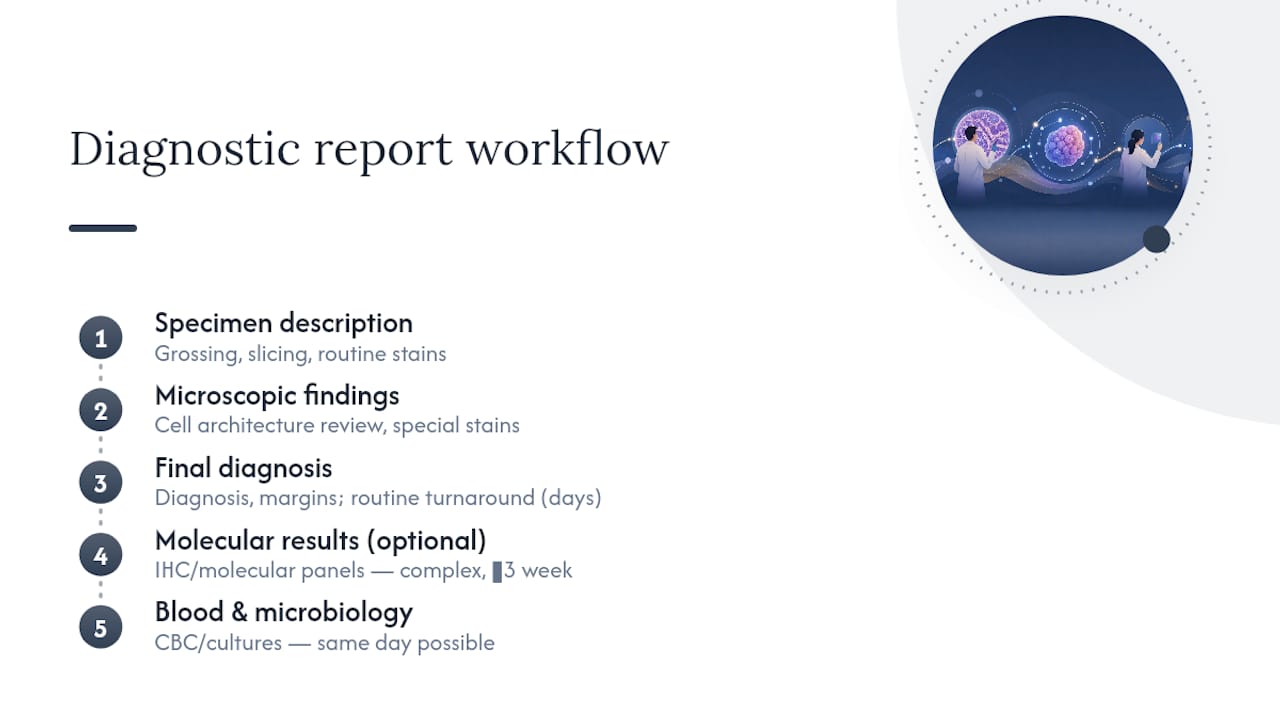
Skin biopsy: A dermatologist removes a suspicious mole and sends it to the lab. A technician grosses the specimen, slices thin sections, and stains them. A dermatopathologist examines the slide, checks cell architecture, and issues a report naming the diagnosis, whether margins are clear, and whether further excision is needed.
Tumor typing: A breast tumor sample goes through immunohistochemistry and molecular panels to check for specific receptor mutations. The pathologist’s findings determine whether a patient qualifies for targeted therapy instead of standard chemotherapy.
Blood and microbiology work: A clinical pathologist interprets a complete blood count or a culture result, flagging infection type and antibiotic sensitivity for the treating physician.
Most reports include the specimen description, microscopic findings, a final diagnosis, and sometimes molecular results. Turnaround runs anywhere from same day for a straightforward blood culture to a week or more for complex molecular panels.
The Pathologist’s Role in Patient Safety and Diagnostic Accuracy
Pathologists function as a quality checkpoint most patients never see. They validate new tests before a lab ever offers them, run inter-laboratory comparisons to catch drift in accuracy, and audit results that don’t fit a clinical picture. This work reduces diagnostic errors that would otherwise reach a treating physician unchecked.
Yale Medicine notes that pathologists provide the definitive diagnosis in cancer cases and determine whether a tumor has been fully removed, which shapes whether a patient needs more surgery or a different treatment path entirely. Oncologists and surgeons routinely call pathologists mid-case to discuss an unclear margin or an unexpected finding. Pathologists also act as stewards of testing resources, pushing back on unnecessary tests and helping hospitals use lab budgets on testing that actually changes patient management.
Pathology as a Career: Settings, Pay, and Growth
Pathologists work across academic medicine, hospital systems, independent labs, forensic offices, and biotech or pharmaceutical companies developing diagnostics. Career progression often moves from staff pathologist toward laboratory director, research leadership, or academic department chair.
O*NET’s occupational summary for pathologists lists core tasks like examining microscopic specimens, operating lab equipment, and authoring diagnostic reports, alongside broader physician compensation and employment data compiled by the Bureau of Labor Statistics. Pay varies significantly by subspecialty, geography, and practice setting, with forensic and academic roles typically trailing private-practice and industry positions. Anyone comparing numbers across sources should treat any single salary figure as a rough band rather than a fixed rate, since practice setting swings it considerably.
EIV Diagnostics: How an Independent Lab Puts Pathology Into Practice
An independent pathology laboratory offers molecular pathology testing using PCR-based methods, dermatopathology review for skin biopsies, and digital pathology workflows that let board-certified pathologists review slides faster and consult remotely with treating physicians. Clinical pathology services round out the offering for routine and specialized blood work.
One detail that sets this lab apart from a typical reference lab: mobile phlebotomy. Instead of requiring patients to travel for a blood draw, the lab sends a phlebotomist to a patient’s home or office, which matters for anyone managing a chronic condition or juggling a schedule that doesn’t allow for a lab waiting room.
- Molecular pathology and PCR-based testing for precise disease detection
- Dermatopathology review of skin biopsies
- Digital pathology for faster, remote-friendly slide review
- Mobile phlebotomy for home or office specimen collection
Pro Tip: If your provider orders a test and you want to skip the drive to a draw site, ask whether mobile phlebotomy is available. It’s one of the more overlooked conveniences in modern lab testing.
Why the Pathologist’s Role Gets Underestimated
Most explainers on this topic treat pathologists as a footnote, a name printed at the bottom of a lab report nobody reads closely. That framing misses the point. The physician ordering your test, the surgeon operating on you, and the oncologist planning your chemotherapy are all waiting on one person’s interpretation before they act. Call it what it is: the pathologist is often the actual decision maker, even though the treating doctor delivers the news.
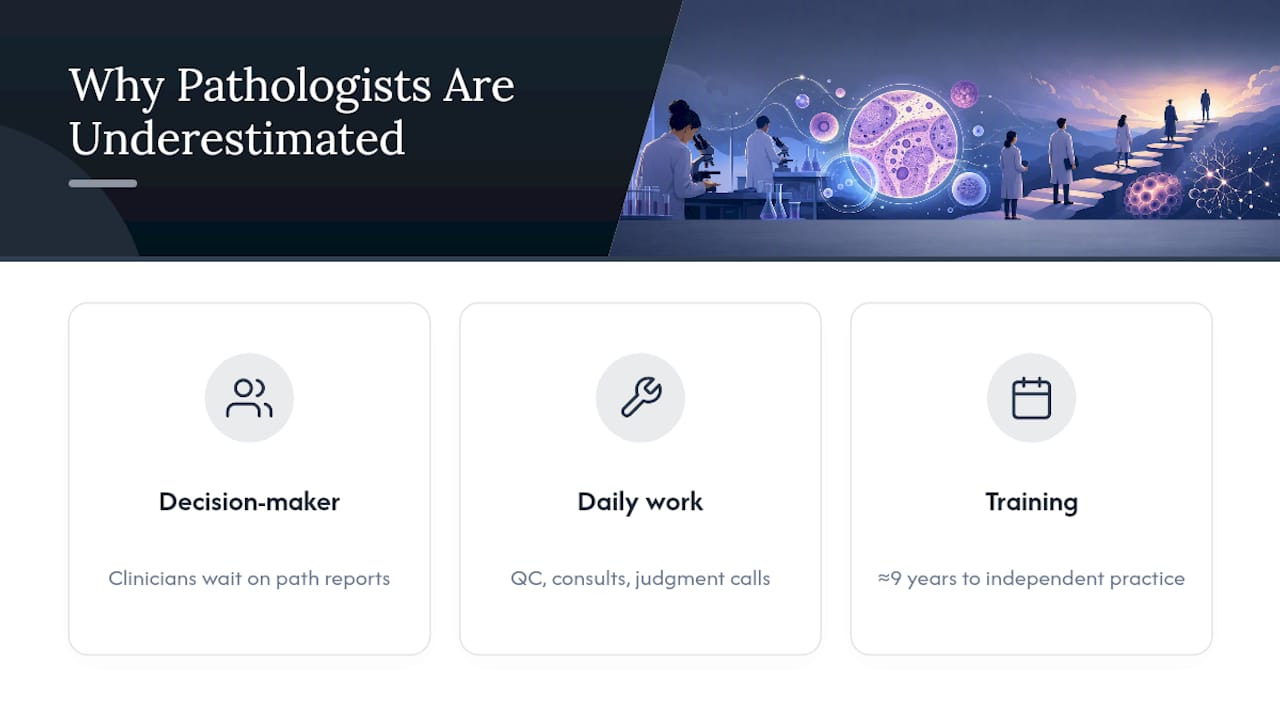
The bigger gap in conventional advice is career messaging. Most guides reduce pathology to “you look at slides all day,” which undersells how much of the job is quality control, consultation, and judgment calls under ambiguity. A tumor margin that’s borderline, a culture result that doesn’t match the clinical picture. These calls happen constantly, and they carry real consequences.
If you’re evaluating pathology as a career, weigh the training timeline honestly. Nine years from medical school to independent practice is a long runway, and subspecialty choice affects both workload and pay more than most students expect going in.
— EIV Diagnostics
This article is general information, not a substitute for advice from a qualified doctor. Consult a qualified healthcare professional about your own circumstances before acting on anything here.
Sources
Key references for this article include ASCP’s overview of the pathologist role, ABPath’s certification requirements, CDC’s laboratory data statistics, Yale Medicine’s patient-facing explainer, and NCBI’s subspecialty taxonomy. For a look at how molecular diagnostics extend into related fields, this overview of diagnostic peptide testing offers useful background.
- CDC: Laboratory education / Lab week (archive)
- American Board of Pathology (ABPath) — reporting and certification info
- ASCP: What is a Pathologist?
- Yale Medicine: Understanding a pathologist’s role
FAQ
Why Would You See a Pathologist?
Most patients never see a pathologist directly. A pathologist reviews specimens ordered by your treating physician, such as a biopsy or blood test, and issues the diagnosis that shapes your treatment plan.
How Many Years of School Does It Take to Become a Pathologist?
It typically takes four years of medical school plus a minimum of three years of pathology residency, often followed by a one to two year fellowship, putting most pathologists at seven to nine years of training before independent practice.
Which Pathology Subspecialty Pays the Most?
Pay varies by practice setting and subspecialty more than by title alone, and private-practice or industry roles generally out earn academic and forensic positions. Anyone researching a specific figure should check current Bureau of Labor Statistics data rather than relying on a single quoted number.
What’s the Difference Between a Pathologist and a Regular Doctor?
A pathologist is a physician too, but instead of examining patients directly, they diagnose disease by analyzing tissue and lab specimens and report findings to the treating doctor, who then discusses the diagnosis with the patient.