
By EIV Diagnostics · August 23, 2026
What a Strep Throat PCR Test Tells You and Why It's So Accurate
Learn how a strep throat PCR test accurately detects Group A strep DNA, providing quick results for symptomatic patients. Discover its benefits!
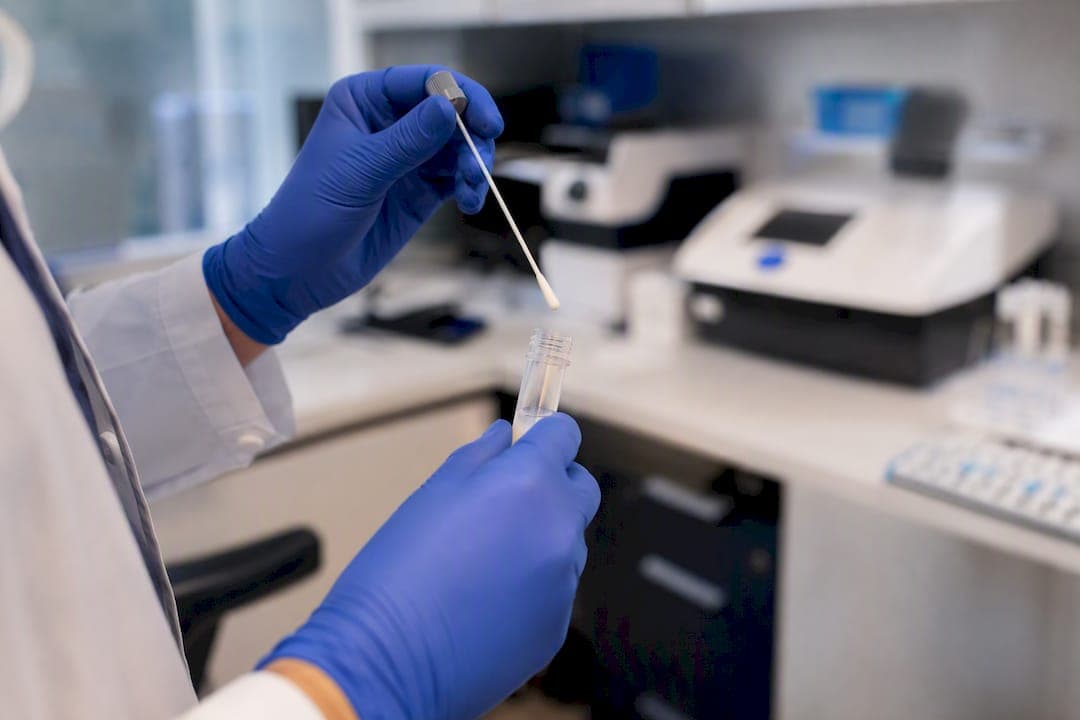
A strep throat PCR test detects the DNA of Streptococcus pyogenes (Group A Strep) from a throat swab, and it does this with a level of accuracy that rivals or beats a traditional throat culture. Clinicians order it for symptomatic patients when they need a fast, reliable answer without waiting two days for culture results. In many clinics, PCR has quietly replaced the old two-step process of a rapid antigen test followed by a backup culture.
Here’s the short version:
- What it detects: genetic material specific to Group A Strep, not the live bacteria itself
- How accurate it is: sensitivity and specificity both commonly fall in a high 90% range
- Who it’s for: people with sore throat symptoms, especially when a rapid antigen test is negative but suspicion stays high
- What it doesn’t do: distinguish an active infection from someone who’s simply carrying the bacteria without being sick
Key Takeaways
Strep throat PCR delivers sensitivity and specificity in the mid-to-high 90% range, catching more true infections than rapid antigen tests while cutting the wait time culture requires.
| Point | Details |
|---|---|
| PCR accuracy | Sensitivity of roughly 95-98% and specificity of 95-99% outperform standard rapid antigen tests. |
| Speed advantage | Point-of-care PCR can return results in under two hours versus 24-48 hours for culture. |
| Test only symptomatic people | Testing without symptoms risks flagging harmless carriage instead of active infection. |
| Positive doesn’t always mean treat | PCR can stay positive for weeks after treatment, so clinical judgment still guides antibiotic decisions. |
| Lab quality shapes reliability | EIV Diagnostics runs molecular testing through board-certified pathologists with mobile phlebotomy for sample collection. |
Table of Contents
- How PCR Detects Strep Throat and What Methods Labs Use
- How Accurate Is PCR Compared With Rapid Tests and Culture?
- When Do Doctors Order a Strep PCR Test?
- What Does a Positive or Negative Strep PCR Result Mean?
- What to Expect During Strep PCR Testing
- What Strep PCR Can’t Tell You
- Why Lab Quality Matters for Strep PCR Results
- Our Take on Strep PCR Testing
- Get Strep Testing Done Without the Clinic Wait
- Sources
- FAQ
How PCR Detects Strep Throat and What Methods Labs Use
PCR works by finding and copying a specific stretch of bacterial DNA until there’s enough of it to detect. For Group A Strep, assays typically target genes like speB or sdaB, sequences unique enough to the organism that cross reactions with other bacteria in your throat are rare. That specificity is a big part of why PCR outperforms older methods.
Collection starts with a throat swab, the same basic motion as a rapid antigen test: a swab brushed firmly across the tonsils and back of the throat. The sample then goes into a transport medium, often liquid Amies or an ESwab system, which keeps the specimen stable until it reaches the lab or the testing cartridge.
From there, testing splits into two paths:
- Lab-based PCR (NAAT): the sample travels to a laboratory where a trained technologist runs it on a molecular platform, with results typically available in hours.
- Point-of-care (POC) PCR: a sample-to-answer cartridge processes the swab right in the clinic, often producing a result in under two hours and sometimes in under an hour on certain platforms.
Several FDA-cleared assays exist across both categories, including real-time PCR and other amplification technologies, and their performance varies slightly by design and target gene, though all tend to score well against culture.
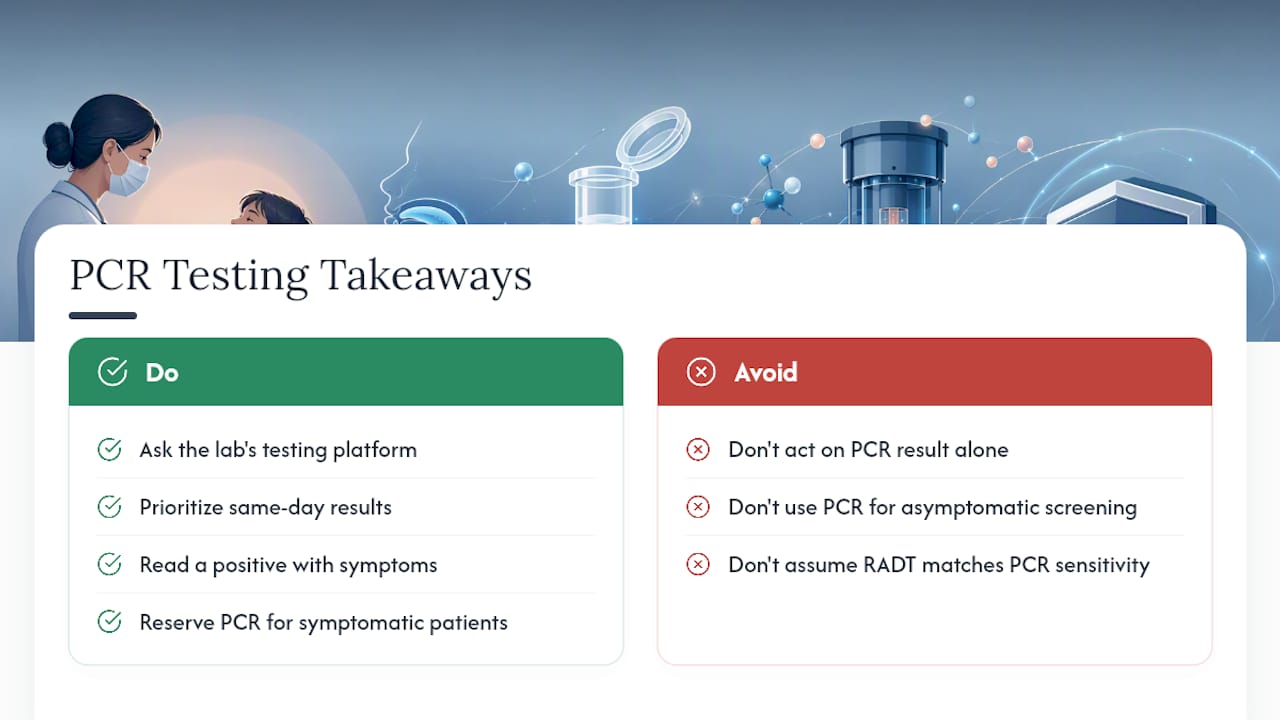
Pro Tip: If your clinic offers point-of-care PCR, ask directly, since not every office has adopted it yet, and a same-visit result can save you a follow-up call and a day of uncertainty.
How Accurate Is PCR Compared With Rapid Tests and Culture?
The numbers make the case for PCR clearly. Clinical evaluations put PCR sensitivity for Group A Strep at roughly 95.5% to 98.1%, with specificity between 94.7% and 99.3% when measured against reference culture. One multicenter study of an automated PCR assay reported 97.5% sensitivity and 97.8% specificity, numbers that hold up across different patient populations and clinical settings.
By the numbers: PCR sensitivity of ~95-98% versus rapid antigen tests at 70-90% means PCR catches meaningfully more true infections, missing far fewer cases that a rapid test would report as negative.
Rapid antigen detection tests (RADT) are faster at the point of care but less sensitive, generally landing in the 70% to 90% range, which is why a negative RADT in a child often triggers a backup culture. Throat culture itself remains reliable but slow, typically taking 24 to 48 hours to grow and identify the bacteria.
Why does the sensitivity gap matter so much in practice?
- Higher sensitivity means fewer false negatives, so fewer real infections get missed and left untreated.
- Higher specificity means fewer false positives, so fewer people get antibiotics they don’t need.
- A prospective study found point-of-care PCR increased appropriate antibiotic prescribing to 97.1%, compared with 87.5% under the standard rapid-test-plus-culture approach.
That last figure is the real-world payoff. Better test accuracy doesn’t just look good on paper. It changes how many people walk out of the clinic on the right medication.
When Do Doctors Order a Strep PCR Test?
Most clinics still run a two-step algorithm: rapid antigen test first, then reflex culture if the RADT comes back negative, particularly in children where missing a true infection carries more weight. Some practices skip straight to PCR or point-of-care PCR as a single, more definitive step, especially where speed and accuracy both matter.
PCR tends to get prioritized in a few specific situations:
- Pediatric patients, where a missed strep infection raises concern about complications like rheumatic fever
- Outbreak settings, such as a school or household cluster, where a fast, definitive answer helps guide isolation and treatment decisions quickly
- Cases needing rapid, conclusive diagnosis, where waiting 24 to 48 hours for culture isn’t practical
One point CDC testing guidance makes clear: testing should be reserved for symptomatic patients. Swabbing someone without a sore throat or other symptoms risks picking up asymptomatic carriage rather than active infection.
Pro Tip: If you don’t have a sore throat, fever, or swollen tonsils, ask your provider whether testing is even appropriate. A positive result in someone without symptoms rarely calls for antibiotics.
What Does a Positive or Negative Strep PCR Result Mean?
A positive PCR result means Group A Strep DNA was found in your throat. Combined with symptoms like sore throat, fever, and swollen tonsils, that’s usually enough for a clinician to prescribe antibiotics. A negative result makes strep unlikely, though if your symptoms are severe and classic for strep, some clinicians will still weigh that judgment against the lab result rather than dismiss it outright.
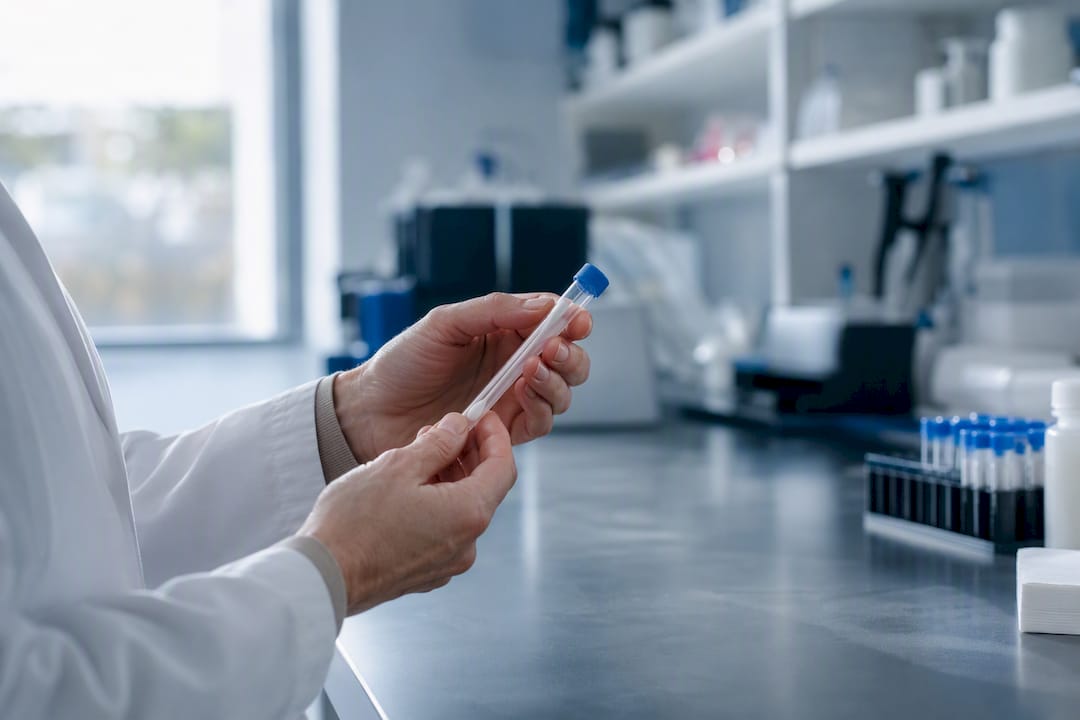
The trickier issue is carriage. Some people carry Group A Strep in their throat without being sick, and PCR’s high sensitivity means it can pick up that DNA too. A positive test doesn’t always equal an active infection needing treatment; that’s a clinical call, not just a lab result.
Timing matters too:
- PCR can stay positive for some time after a treated infection, since it detects genetic material, not necessarily live, viable bacteria.
- A positive test soon after finishing antibiotics doesn’t automatically mean treatment failed or reinfection occurred.
- Repeat testing right after treatment usually isn’t useful unless symptoms return or persist.
What to Expect During Strep PCR Testing
The process itself is quick and familiar to anyone who’s had a rapid strep test or a COVID swab.
- A clinician swabs the back of your throat and tonsils for a few seconds, which can trigger a brief gag reflex but nothing more.
- The swab goes into transport media and either gets processed on-site (point-of-care PCR) or sent to a lab.
- Turnaround depends on the method: point-of-care PCR can return results in under two hours, lab-based PCR typically same day, and traditional culture 24 to 48 hours.
- If the result is positive, most clinicians will start antibiotics the same day, often before you’ve even left the building for point-of-care testing.
What Strep PCR Can’t Tell You
PCR is powerful, but it has real limits worth understanding before you interpret a result on your own.
- It detects DNA, not living, infectious bacteria, so it can’t confirm the organism is actively causing disease versus just present.
- Asymptomatic carriage and recently treated infections can both produce a positive result well after the illness has resolved.
- Lab error, contamination, or an improperly collected swab can occasionally cause a false positive or an invalid run that needs repeating.
- A negative strep PCR only rules out Group A Strep. It says nothing about a viral sore throat or a different bacterial cause, so symptoms that persist still deserve follow-up.
Why Lab Quality Matters for Strep PCR Results
The accuracy numbers you read about only hold up if the lab running your test does its job well. EIV Diagnostics, an independent pathology laboratory, offers molecular pathology testing built around validated, sample-to-answer platforms and reviewed by board-certified pathologists, the kind of oversight that keeps invalid or discordant results rare.
Well-run assays report invalid rates around 1%, and much of that comes down to preanalytic factors: correct swab technique, proper transport media, and validated internal controls at every step.
A few things separate a dependable molecular lab from a mediocre one:
- Assays validated against culture and cross-checked when results are discordant
- Trained staff handling collection and transport to avoid contamination
- Mobile phlebotomy for patients who need testing done at home or in a provider’s office rather than a clinic waiting room
Our Take on Strep PCR Testing
The conventional advice on strep testing hasn’t caught up to what the data actually shows. Plenty of patient guides still frame rapid antigen tests as the default and culture as the fallback, treating PCR like a specialty option reserved for complicated cases. The multicenter numbers tell a different story: PCR’s sensitivity advantage over RADT is large enough that it changes real treatment outcomes, not just lab statistics.
What gets underrated is the carriage problem. Most explainers focus on accuracy and skip the nuance that a highly sensitive test will occasionally find bacteria that aren’t actually making you sick. That’s not a flaw in PCR. It’s a reason testing should stay reserved for people with actual symptoms, and it’s a reason a positive result should always get read alongside how you’re feeling, not in isolation.
If there’s one thing worth prioritizing, it’s this: ask what platform your provider or lab uses and how fast you’ll get an answer. A same-day, accurate result changes how quickly you can stop guessing and start treating, or stop worrying and move on.
Get Strep Testing Done Without the Clinic Wait
Waiting for a same-day appointment just to get swabbed adds hours to a process that shouldn’t take that long. EIV Diagnostics brings the swab to you through mobile phlebotomy, whether that’s your home, your office, or wherever you’re already stuck feeling miserable, then runs the analysis through board-certified pathologists using validated molecular platforms.
That combination matters more than it sounds: accurate PCR results depend on correct collection and a lab that catches errors before they reach you, not just a fast machine. EIV Diagnostics offers molecular pathology testing for patients with a provider’s order and for those who’d rather self-pay and skip the referral process entirely. If you’re dealing with sore throat symptoms and want a reliable answer without sitting in a waiting room, schedule a mobile phlebotomy visit and get your sample collected on your schedule.
This article is general information, not a substitute for advice from a qualified doctor. Consult a qualified healthcare professional about your own circumstances before acting on anything here.
Sources
- Multicenter clinical evaluation of the automated Aries Group A Strep PCR assay
- Testing for Strep Throat or Scarlet Fever | Group A Strep
- Strep A test - MedlinePlus
FAQ
What Does a Strep PCR Test Mean?
It means a molecular test looked for the DNA of Group A Strep bacteria in a throat swab. A positive result usually points to Group A Strep being present, though clinicians still weigh it against your symptoms before deciding on treatment.
How Long Can Strep PCR Stay Positive?
PCR can remain positive for days to a few weeks after an infection clears or after antibiotic treatment, since it detects genetic material rather than confirming live, active bacteria. That’s why repeat testing right after treatment usually isn’t recommended unless symptoms return.
What Does It Mean If My Strep A PCR Test Is Abnormal?
An abnormal or positive strep A PCR result typically indicates Group A Strep DNA was detected in your throat sample. Your clinician will factor in your symptoms, since a positive result in someone without sore throat or fever might reflect asymptomatic carriage rather than an infection needing antibiotics.
Why Would I Test Positive for Strep Without Feeling Sick?
This usually happens because of asymptomatic carriage, where the bacteria live in your throat without causing illness, or because you recently finished treatment and PCR is still picking up leftover genetic material. Neither situation typically calls for a new round of antibiotics.