
By EIV Diagnostics · November 26, 2026
STD Testing Without a Doctor: Your Options in 2026
You can get tested for STDs without a doctor's visit. Learn which tests work, how at-home and self-pay lab testing differ, and when to see a clinician.
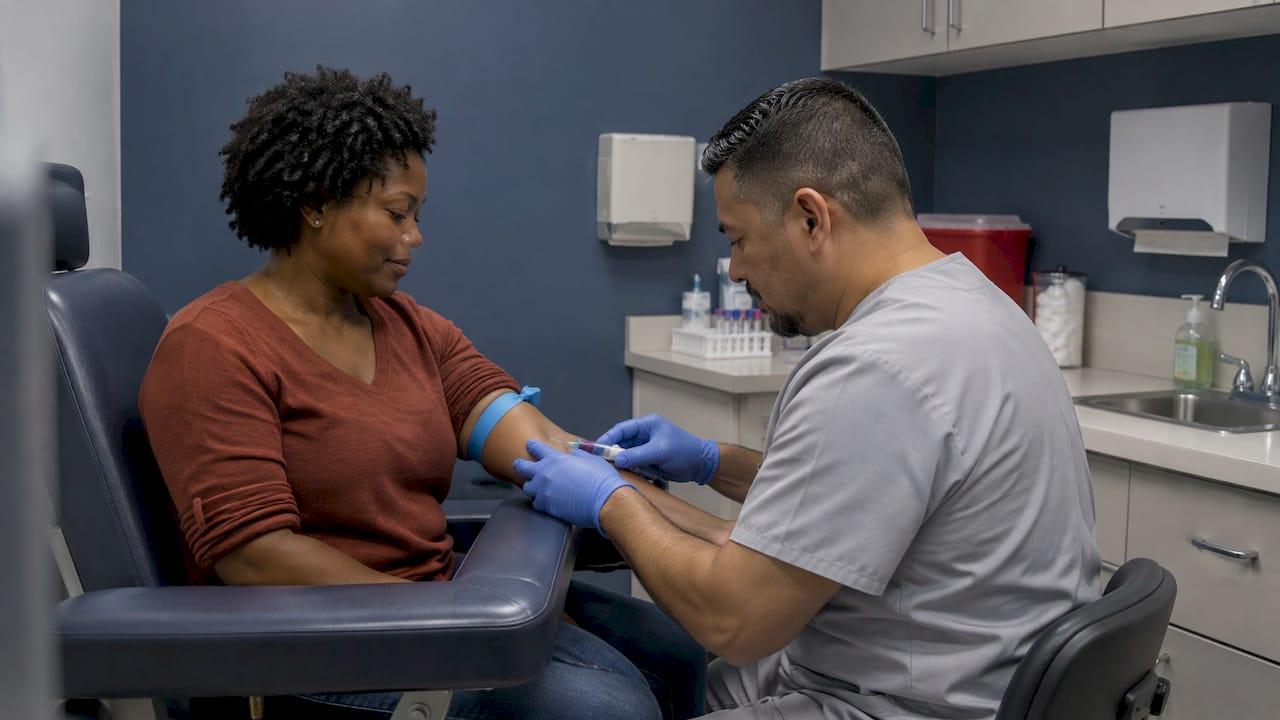
You don’t need an appointment with your own doctor to get tested for sexually transmitted infections. In the U.S., you can use a home self-test, mail a self-collected sample to a lab, or pay for lab testing yourself. At EIV Diagnostics in Fresno, we run self-pay testing, and our mobile phlebotomy service can bring the blood draw to your home or office. This guide explains which route fits which situation, what each costs you in time and money, and the situations where you should see a clinician instead.
TL;DR
- The CDC describes three ways to get tested: in a provider’s office, with an at-home self-test, or with a self-collected sample mailed to a lab.
- FDA-approved self-tests exist for HIV and syphilis, and a vaginal-swab self-test covers gonorrhea, chlamydia and trichomoniasis.
- Home kits are typically not covered by insurance. Self-pay lab testing lets you see the cost before you commit.
- If you have symptoms, sores, discharge or a known exposure, get seen by a clinician instead of relying on a kit.
- EIV Diagnostics offers self-pay testing and mobile phlebotomy from $65 per visit, so you can skip both the waiting room and the office visit.
Table of Contents
- The three legitimate ways to get tested
- What you can test for without a doctor
- Home kit, mailed sample or lab draw: how they compare
- How to get tested without a doctor, step by step
- When you should see a clinician instead
- What does it cost, and where can you find free options?
- Our perspective
- Order your test with EIV Diagnostics
- FAQ
- Sources
The three legitimate ways to get tested
The CDC’s guidance on getting tested for STIs (updated March 17, 2026) lays out three paths:
- A healthcare provider tests you in their office. This is the traditional route and the only one that includes an exam.
- You self-test at home with a device that gives results within minutes.
- You self-collect a sample (a vaginal swab, urine or blood) with a kit and mail it to a laboratory. Results can take a few days.
Paths two and three are what people usually mean by “STD testing without a doctor.” There is a fourth path the CDC page doesn’t list as such: ordering a lab test yourself and having a professional collect the sample. That is where self-pay lab testing comes in, and it is the option that combines the accuracy of a clinical lab with the convenience of skipping the office visit.
What you can test for without a doctor
Not every infection has a home option. Here is what the CDC says is available.
| Infection | At-home self-test (results in minutes) | Self-collected sample mailed to a lab |
|---|---|---|
| HIV | FDA-approved | FDA-approved options exist |
| Syphilis | FDA-approved | FDA-approved options exist |
| Gonorrhea, chlamydia, trichomoniasis | FDA-approved vaginal-swab self-test | Gonorrhea and chlamydia: FDA-approved options exist |
MedlinePlus, from the National Library of Medicine, adds useful context on how STI tests are done. Blood tests diagnose syphilis, HIV, hepatitis B and sometimes herpes. Urine tests diagnose trichomoniasis, chlamydia and sometimes gonorrhea. Swab tests diagnose HPV, chlamydia, gonorrhea and herpes. At-home kits are available for chlamydia, gonorrhea, syphilis, trichomoniasis and hepatitis C, and the results should be discussed with a provider.
The practical takeaway: a blood draw and a urine sample cover the most common infections, and neither requires you to sit in an exam room.
Home kit, mailed sample or lab draw: how they compare
Home self-tests
Speed is the appeal. You get a result within minutes, in private. The trade-off is that you are interpreting a result alone, and a self-test covers only the infection it is designed for. A review of direct-to-consumer testing in an academic journal notes that these services mainly rely on self-collection with labs that hold CLIA and CAP certification. CLIA is the federal program that sets quality standards for clinical labs, and CAP is the College of American Pathologists, whose accreditation is a further quality check. When any lab is handling your sample, whether through a kit or in person, those credentials are what you want behind the result.
Mailed self-collection kits
Public health programs use these too. Texas, for example, offers free self-collection HIV and STD kits through an online portal after a short health assessment. The kit arrives in a discreet box with a prepaid return mailer, and results are typically posted in the portal two to seven calendar days after the lab receives the sample (Texas DSHS brochure, revised May 2026). A healthcare provider contacts anyone who tests positive. Availability depends on your state, so check your own state health department.
Lab testing you order and pay for yourself
With self-pay lab testing, you choose the test, pay a posted price, and give a sample to trained staff. There is no insurance claim, and no explanation of benefits arrives in the mail, which matters to many people who want privacy. At EIV Diagnostics, our self-pay testing is open to patients with a prescription, patients without one, and anyone who prefers to pay directly. Our guide to getting blood work done without a doctor walks through the ordering process in detail.
How to get tested without a doctor, step by step
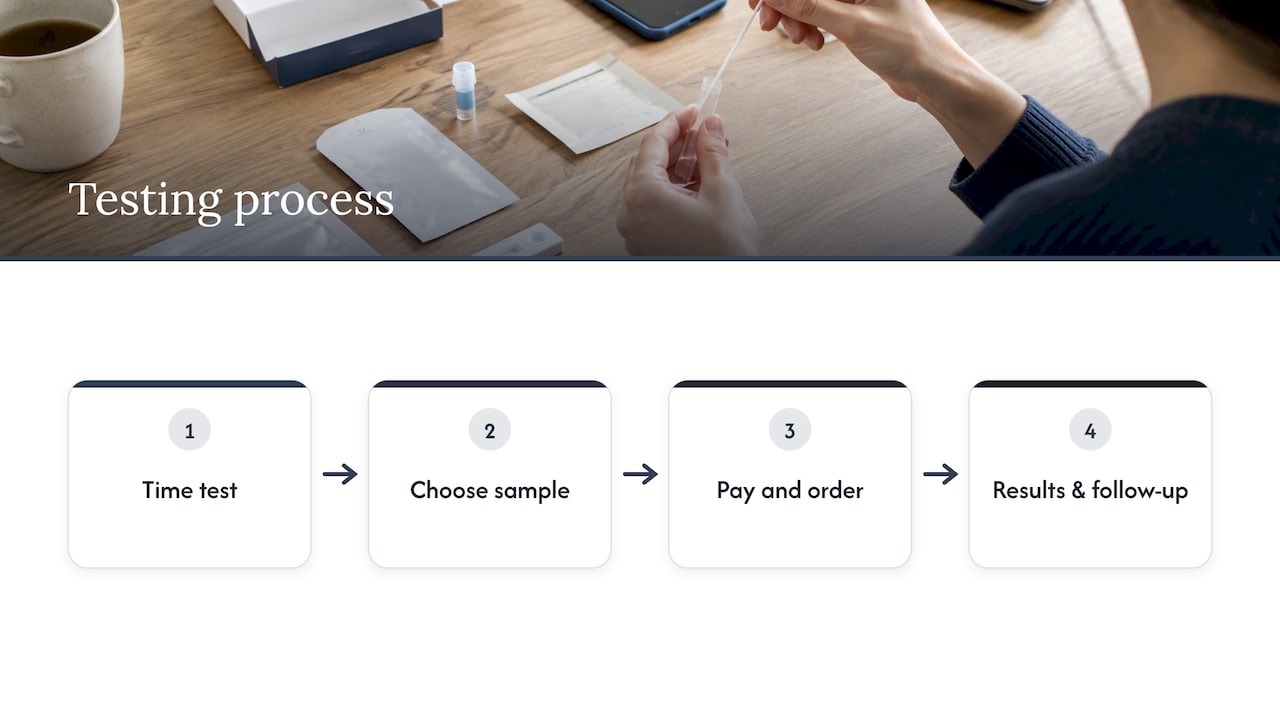
Step 1: Decide what you need to test for
Start with the CDC’s screening guidance. According to the CDC:
- Everyone ages 13 to 64 should be tested at least once for HIV.
- All sexually active women under 25 should be tested for gonorrhea and chlamydia every year.
- Sexually active gay and bisexual men and other men who have sex with men should be tested for syphilis, chlamydia and gonorrhea at least annually, and every 3 to 6 months with multiple or anonymous partners.
- Anyone who shares injection drug equipment should get an HIV test at least once a year.
If you fall into none of these groups but have had a new partner or a partner with an infection, testing still makes sense. The mistake to avoid is picking a single-infection home kit when you actually need several results. A panel that covers more than one infection answers the question in one visit.
Step 2: Time the test correctly
Testing too soon after an exposure can produce a false negative, because infections take time to become detectable. This delay is called the window period, and it differs by infection and by test type. Our page on the STD window period explains how long to wait before testing for each. If you are unsure, test now and plan a repeat test later rather than waiting and worrying.
Step 3: Choose how the sample is collected
If you are comfortable with a swab or a urine cup, a self-collected sample works. If you need a blood draw, or you simply want a trained person to collect it, mobile phlebotomy removes the trip. Our phlebotomists come to your home or office. Mobile phlebotomy starts at $65 per visit, and we serve Fresno, Clovis, Madera, Visalia, Hanford, Sanger, Reedley and the surrounding Central Valley communities.
Step 4: Pay and place the order
Self-pay means you know the cost up front. Compare it honestly with the alternatives: ASHA notes that most health insurance plans cover in-office STI testing, often with no co-pay, while home tests bought at pharmacies or online are typically not covered by insurance, though HSA funds may be usable. Our guide to lab tests without insurance explains how self-pay pricing works, and our post on ordering lab tests online covers what to check on a lab’s credentials before you order.
Step 5: Get your results and plan what comes next
Results from a lab are reviewed by pathologists and clinical staff. EIV Diagnostics works with board-certified pathologists and is CAP-accredited, and we are built for rapid turnaround. A positive result is not the end of the process: it is the start of treatment, and most common bacterial infections such as chlamydia and gonorrhea are treated with prescription antibiotics, so you will need a clinician for that step. Public programs reflect this. Rhode Island’s Testing 1-2-3 program, for example, has a staff member call to arrange treatment when a test is positive, and Texas has a provider notify and assist anyone who tests positive. Plan your follow-up before you test, and tell recent partners so they can be tested too.
When you should see a clinician instead
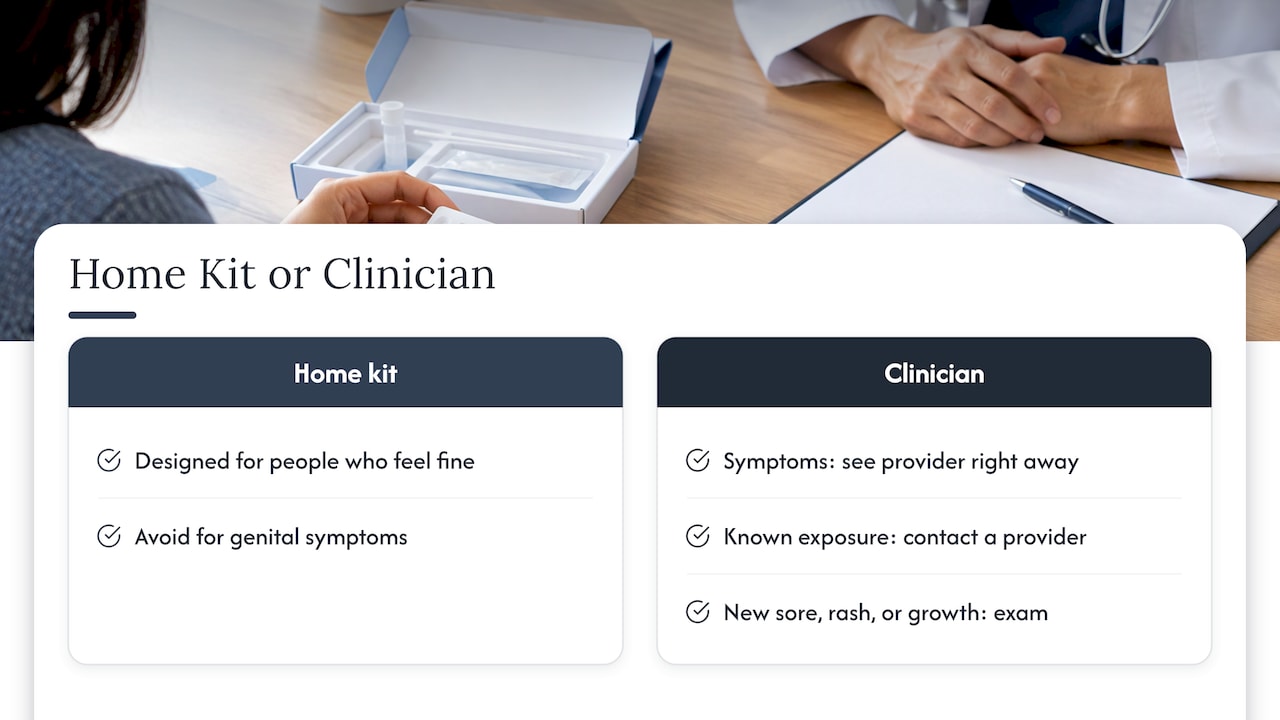
Testing without a doctor is designed for people who feel fine. ASHA advises that if you have symptoms such as genital itching, sores or discharge, you should see a health care provider right away rather than using a home kit, because symptoms can signal other conditions and testing is the first step to treatment. Rhode Island’s program makes the same distinction: it is for people without symptoms, and anyone with symptoms or a known exposure should contact a medical provider or participating clinic.
Skin changes deserve their own mention. A new sore, rash or growth in the genital area is a reason to be examined, and where a biopsy is needed, our board-certified pathologists read the tissue through our dermatopathology service for the clinician who ordered it.
What does it cost, and where can you find free options?
Price depends on the route:
- Free or low-cost clinics. Health departments and Planned Parenthood health centers offer free or low-cost testing, and the CDC’s Get Tested website finds testing centers by zip code with filters for free and low-cost options, according to ASHA. Expect walk-in lines and limited hours.
- Insurance. In-office testing is often covered, but the claim goes through your plan.
- Self-pay. You pay the lab directly. Rhode Island’s health department is candid that lab testing through its program is not free and may cost hundreds of dollars if paid out of pocket, which is why it pays to ask for a price before ordering a large bundle.
A related caution from the academic literature: some bundled kits have been criticized for overselling screening for unlikely diseases. Order the tests that match your actual risk, using the CDC guidance above, rather than the longest panel on the menu.
Our perspective
Most people who put off STD testing are not careless. They are busy, worried about privacy, or unsure what they would even ask a doctor. Our view is that the barrier should be as low as possible: a test you can order yourself, a sample collected where you are, and a result read by people who answer for its accuracy.
That is why EIV Diagnostics offers self-pay testing to patients with or without a doctor’s order, and why we built mobile phlebotomy into the service. Convenience matters, but so does what happens in the lab. Our board-certified pathologists, CAP-accredited standards and molecular technologies such as PCR are there so that a quick result is also a reliable one.
Testing without a doctor should never mean testing without a plan. We encourage everyone to decide beforehand who they will call if a result is positive, and to treat symptoms as a reason to be seen in person.
EIV Diagnostics
Order your test with EIV Diagnostics
If you live or work in Fresno, Tulare, Kings or Madera County, you can skip the waiting room entirely. EIV Diagnostics offers self-pay testing for patients with or without a doctor’s order, and a phlebotomist can collect your blood at your home or office for $65 per visit and up. Our results are reviewed by board-certified pathologists in a CAP-accredited laboratory.
Start on our self-pay page, or learn how direct access lab testing works before you order.
FAQ
Can you get an STD test without a doctor?
Yes. The CDC lists home self-tests, mailed self-collection kits and lab testing as options, and FDA-approved self-tests exist for HIV and syphilis. You can also pay for lab testing yourself and have the sample collected by a phlebotomist. Treatment of a positive result still requires a clinician.
Can you buy an over-the-counter STD test?
At-home kits are available for several infections, including chlamydia, gonorrhea, syphilis, trichomoniasis and hepatitis C, according to MedlinePlus. Each kit covers only certain infections, so match the kit to the infections you need to rule out. MedlinePlus advises discussing the results with a provider.
How long do results take?
Home self-tests give results within minutes, while mailed samples can take a few days, and the CDC says as much on its testing page. In Texas’s public kit program, results typically post two to seven days after the lab receives the sample. Turnaround at a lab depends on the test ordered.
Will my insurance cover it?
Most plans cover in-office STI testing, often without a co-pay, but home tests are typically not covered, per ASHA. Self-pay testing avoids the claim entirely, and you pay the lab’s price directly.
How often should I be tested?
It depends on your age, partners and risk. The CDC recommends one-time HIV testing for everyone ages 13 to 64, and yearly gonorrhea and chlamydia testing for sexually active women under 25. It also recommends testing at least every year, and every 3 to 6 months with multiple or anonymous partners, for sexually active gay and bisexual men and other men who have sex with men, as detailed in its screening guidance.
Sources
- Getting Tested for STIs, CDC
- Sexually Transmitted Infection (STI) Tests, MedlinePlus
- Testing 1-2-3, Rhode Island Department of Health
- Self-Testing brochure, Texas DSHS
- Getting Tested for STIs Can Be Easy and Affordable, ASHA
- Direct-to-Consumer Testing: A Game-Changer for STI Control, MDPI