
By EIV Diagnostics · November 7, 2026
Fentanyl Detection Time in Urine: How Long It Shows Up
Fentanyl is usually detectable in urine for 1 to 4 days, but regular use can stretch that to weeks. See the ranges, the reasons and how labs confirm results.
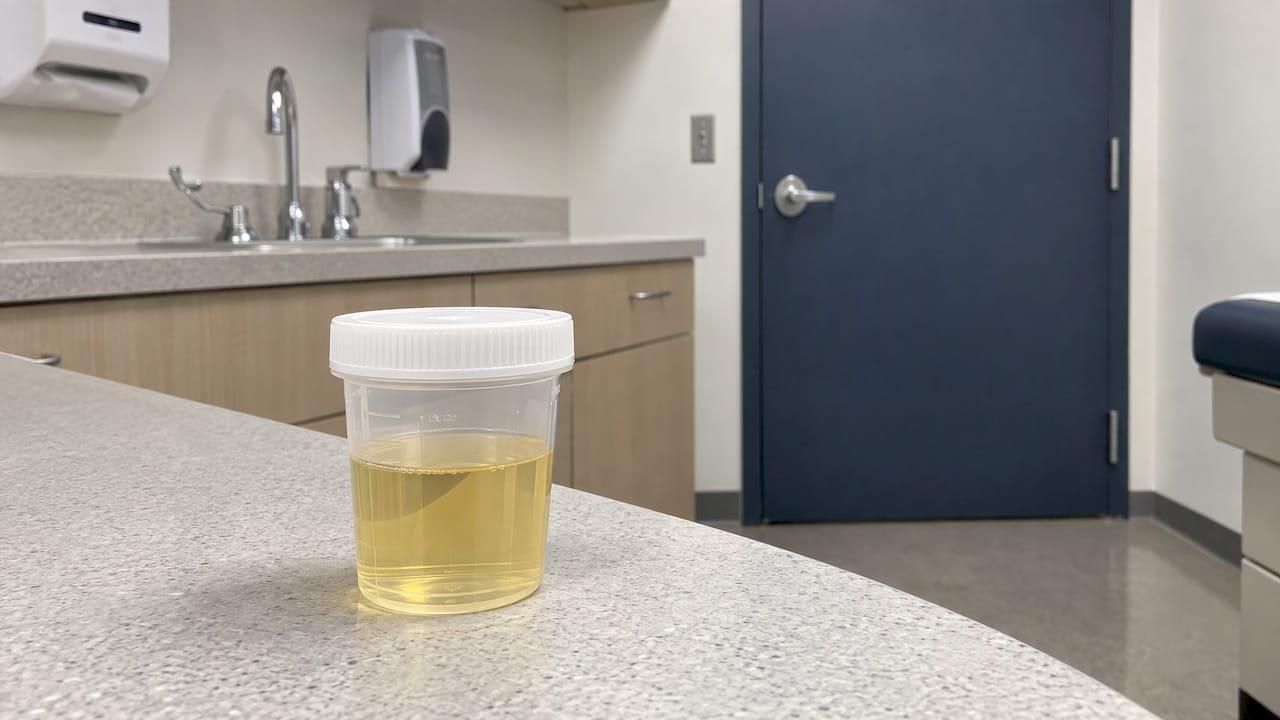
After a single use, fentanyl typically clears from urine within a few days. With regular use, it can stay detectable for a week or two, and in some people for much longer. The range is wide because fentanyl is stored in body fat and released slowly. Dose, frequency, body composition and the lab’s cutoff all change the answer.
This guide gives the numbers from published studies, explains why results differ from person to person, and shows how a positive screen is confirmed. At EIV Diagnostics, we work with patients and clinicians who need a clear answer, so we have kept the focus on what the evidence supports.
TL;DR
- After one or a few doses, fentanyl is generally cleared from the body in about 2 to 4 days, according to Boston University’s summary of the research.
- With regular use, a study of 12 people with opioid use disorder found a mean of 7 days for fentanyl and 13 days for its metabolite norfentanyl. The longest was 19 and 26 days.
- Fentanyl is fat-soluble, so repeated use builds a reservoir that releases slowly. That is why some people test positive long after stopping.
- A screening result is preliminary. A quantitative confirmation by mass spectrometry tells you far more about timing.
Table of Contents
- How long fentanyl stays in urine
- Why some people test positive for weeks
- Factors that change the window
- Cutoffs, panels and false positives
- Perspective
- Getting tested in the Fresno area
- FAQ
- Sources
How long fentanyl stays in urine
There is no single number. The window depends mostly on how much was used and how often.
| Pattern of use | Typical urine detection | Source |
|---|---|---|
| One or a few doses | About 2 to 4 days | BU AOD Health |
| One-time use | Under 96 hours | Perinatal Toxicology presentation, 2025 |
| Frequent use | About 7 days on average | ACMT, 2024 |
| Regular use, longest cases | 19 days (fentanyl), 26 days (norfentanyl) | BU AOD Health |
The often quoted “24 to 72 hours” fits occasional exposure. It does not describe people who use fentanyl heavily or daily.
Why fentanyl and norfentanyl are both measured
The body breaks fentanyl down into norfentanyl. Urine tests look for one or both. Norfentanyl usually lasts longer. In the 12-person study from Huhn and colleagues, the mean clearance was 7 days for fentanyl and 13 days for norfentanyl, with one participant positive for 19 and 26 days respectively.
A 2025 case series by Bird and colleagues estimated urinary half-lives of 1.5 to 28.7 hours for fentanyl and 5.2 to 27.4 hours for norfentanyl in people with opioid use disorder. At a 5 ng/mL threshold, the predicted detection windows were 0.5 to 5.5 days for fentanyl and 2.7 to 10.7 days for norfentanyl (PubMed). The authors note that guidelines built on medical fentanyl may underestimate how long illicit use stays detectable, because exposure is higher and the drug accumulates.

How soon it appears
Fentanyl acts within minutes, and its metabolites reach urine within hours. One consumer lab guide puts first detection at about an hour after use. We could not find a clinical study giving a precise onset, so treat the first hours as variable. The more useful question for most people is how long it stays.
Why some people test positive for weeks
Fentanyl is highly lipophilic. With regular use it can be sequestered in fat cells and other tissues, which prolongs clearance, as BU AOD Health explains. The American College of Medical Toxicology notes that fentanyl is more lipophilic than heroin and accumulates in subcutaneous fat, then leaves the body slowly.
The extreme cases are striking. A 2025 toxicology presentation describes fentanyl above the test threshold for 95 days after last use in one case, and norfentanyl for 245 days. In a series of three pregnant and postpartum patients, all three had norfentanyl-positive urine for more than four months. Levels also moved between detectable and undetectable without any new use.
That last point matters. A positive result weeks after stopping does not by itself prove recent use. The same presentation advises requesting a quantitative confirmation and watching the trend in fentanyl and norfentanyl levels.
Factors that change the window
- Dose and frequency. More exposure means more stored drug and a longer tail.
- Body composition. In a 2022 study, people classified as overweight tested positive for fentanyl for 7.46 days on average, compared with 6.40 days for those with a healthy BMI, a statistically significant difference (PMC).
- Pregnancy. The University of Washington ICTP reports norfentanyl detection up to 294 days after last use in pregnant patients.
- Metabolism and kidney function. Labs note that individual metabolism, kidney and liver function all affect urine results.
- The test’s cutoff. A lower cutoff catches smaller traces for longer.
Cutoffs, panels and false positives
Not every drug panel includes fentanyl. Standard opiate screens have essentially no cross-reactivity for it, according to the ADLM guidance, so fentanyl needs its own assay. If you are wondering whether a 12-panel test covers it, check the panel’s list of analytes rather than assuming.
For federal workplace testing, HHS added fentanyl to the urine panel effective July 7, 2025. The initial test cutoff is 1 ng/mL, and confirmatory cutoffs are 1 ng/mL for both fentanyl and norfentanyl (Federal Register notice). Cutoffs like these decide whether a trace counts as positive, which is explored further in guidance on collecting specimens for drugs of abuse testing.
Immunoassay screens can also be wrong. A 2024 study found a 38% false-positive rate for one FDA-cleared fentanyl immunoassay at a 1.0 ng/mL cutoff, falling to 17% at 1.3, with trazodone, labetalol and haloperidol accounting for 56% of false positives (ScienceDirect). The ADLM guidance also reports false positives with labetalol, particularly in pregnancy. Our overview of false positive drug test causes covers medications and other triggers.

How a positive is confirmed
Confirmation uses GC-MS or LC-MS/MS, which identify the exact molecules and measure how much is present. Military drug labs, for example, confirm presumptive positives this way, at 1 ng/mL for both fentanyl and norfentanyl (U.S. Navy FAQ). You can read how this works in practice in our guide to confirmatory drug testing, and see how detection windows compare across drugs in urine drug detection times.
Over-the-counter fentanyl strips are a separate category. The FDA’s 2023 clearance of a home urine test described it as giving preliminary results only.
Perspective
We see the same confusion often: someone stopped using days ago, a screen comes back positive, and everyone assumes the worst. The science says the picture is more nuanced. Fentanyl lingers in fat, norfentanyl outlasts it, and screening immunoassays were not built to tell recent use from stored drug.
Our view is that a screen should be the start of the answer, not the end. Where timing or a medication matters, a quantitative LC-MS/MS confirmation, repeated over time, shows whether levels are falling. At EIV Diagnostics, our board-certified pathologists and CAP-accredited lab are set up to support that kind of careful, clinically meaningful reporting for providers and patients.
EIV Diagnostics
Getting tested in the Fresno area
EIV Diagnostics is an independent pathology lab in Fresno that works with providers, patients with prescriptions, and self-pay customers. If you want a test without a doctor’s visit, our self-pay testing option is built for that. If getting to a draw site is the barrier, mobile phlebotomy brings the collection to your home or office, starting from $65 per visit.
Clinicians who need confirmation of unexpected screens can read about LC-MS/MS in pain testing or see our clinical pathology services.
FAQ
How long does fentanyl stay in urine after one use?
Usually about 2 to 4 days, and often under 96 hours. Individual metabolism and the lab’s cutoff can move that either way. A low-cutoff confirmation test may detect traces longer than a screen.
Why am I still testing positive for fentanyl?
With regular use, fentanyl builds up in fat and is released slowly, so urine can stay positive for weeks. Norfentanyl lasts even longer, and levels can swing between detectable and undetectable without new use. A quantitative confirmation showing falling levels is more informative than a single positive screen. Medications such as labetalol and trazodone can also cause false positives on screens.
Does a 12-panel drug test include fentanyl?
Not necessarily. Opiate immunoassays have essentially no cross-reactivity for fentanyl, so it must be listed as its own analyte. Ask the lab or read the panel’s analyte list before you order.
Can fentanyl show up in urine for months?
In rare documented cases, yes. One case had fentanyl above threshold at 95 days and norfentanyl at 245 days, and pregnant patients have shown norfentanyl for up to 294 days. These are exceptions, but they show why trends matter more than a single result. A physician or toxicologist can interpret them in context.
Sources
- Case Series: Magnitude and duration of fentanyl and norfentanyl in urine (PubMed)
- Fentanyl and Norfentanyl Detected in Urine for 7 or More Days (BU AOD Health)
- Perinatal Toxicology presentation, November 2025
- Using Urine Drug Screens in OUD Treatment (UW ICTP)
- The ToxIC NOSE (ACMT)
- Fentanyl withdrawal: symptom severity and BMI (PMC)
- ADLM guidance on testing for drugs of misuse
- Federal Register notice adding fentanyl to workplace testing
- U.S. Navy Drug Testing Questions & Answers
- Understand the FDA-cleared fentanyl testing (ScienceDirect)