
By EIV Diagnostics · October 24, 2026
D-Dimer Test: What It Measures and How to Read Results
What a D-dimer test measures, how to read your result and normal range, why levels run high, and how hs-CRP differs. Plain answers from a Fresno pathology lab.
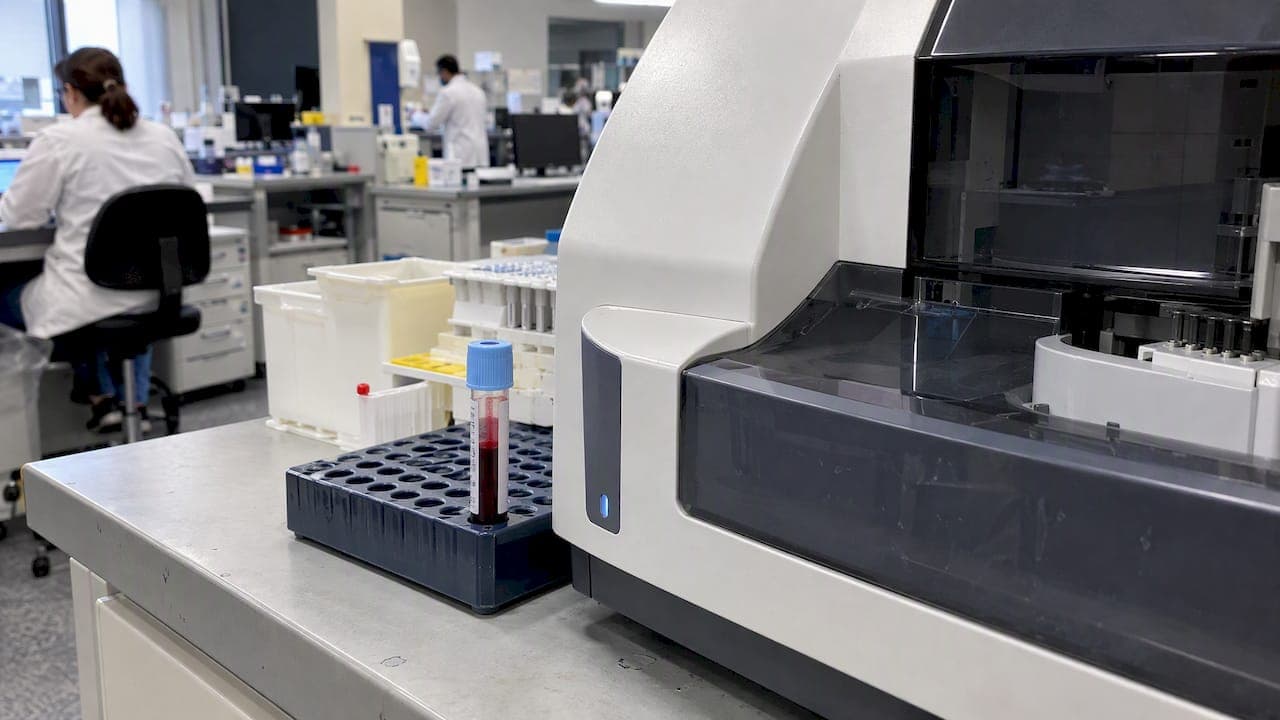
A D-dimer test is a blood test that looks for a protein fragment your body makes when a blood clot dissolves. Doctors use it mainly to help rule out a serious clot, such as deep vein thrombosis (DVT) or pulmonary embolism (PE). A normal result in a low-risk person is reassuring. An abnormal result does not mean you have a clot, only that more evaluation may be needed.
This guide explains what the number means, why reference ranges differ from lab to lab, what pushes D-dimer up for reasons that have nothing to do with clots, and how it differs from the high-sensitivity CRP (hs-CRP) test that people often search for alongside it.
TL;DR
- D-dimer is a fragment released when a clot breaks down. The test is best at ruling out clots, not confirming them.
- A negative result is most useful when your pre-test probability is low or moderate. A positive result usually leads to imaging such as an ultrasound or CT scan.
- There is no single normal range. Labs report in different units, so compare your number only with the reference range printed on your own report.
- hs-CRP is a different test. It measures low-grade inflammation and is used to refine cardiovascular risk, not to look for clots.
- Sudden shortness of breath, chest pain or a swollen, painful leg needs emergency care, not a lab appointment.
Table of Contents
- What a D-dimer test measures
- Why doctors order it: ruling out, not ruling in
- D-dimer normal range and why your report may look different
- High D-dimer causes beyond blood clots
- Symptoms that should not wait for a lab
- Perspective: how we think about D-dimer
- D-dimer vs. hs-CRP: two different questions
- How to prepare and what to expect
- Getting lab work done around Fresno
- FAQ
- Sources
What a D-dimer test measures
When your body forms a clot, it uses fibrin to build a mesh. Later, an enzyme called plasmin breaks that mesh down. D-dimer is one of the pieces left behind. According to the American Society of Hematology, it is a degradation product of crosslinked fibrin. D-dimer isn’t usually found in your blood unless your body is making and breaking down clots.
That is why the test works as a screen. If clotting and breakdown are not happening in a meaningful way, D-dimer stays low. If they are, it rises. The catch is that clotting and breakdown happen in many situations besides DVT and PE.
Conditions it helps evaluate
MedlinePlus lists several problems the test is used to check, including DVT, disseminated intravascular coagulation (DIC) and pulmonary embolism. In practice, the most common reason for the test is a suspected DVT in a leg or a suspected PE in the lungs.
Why doctors order it: ruling out, not ruling in
D-dimer is highly sensitive but not very specific. Sensitive means it rarely misses a clot. Not specific means it is often elevated when no clot exists.
MedlinePlus notes that a negative result has a high negative predictive value, typically 95 to 100 percent, for ruling out DVT or PE in low-risk patients. The test is meant for people whose clinical probability is low or moderate. If a clinician already thinks a clot is likely, a D-dimer is not the right first step, and imaging goes ahead directly.
The American Society of Hematology frames this as diagnostic stewardship. The goal is to avoid unnecessary and more invasive testing in people unlikely to have VTE. A negative D-dimer can spare someone a CT pulmonary angiogram and its radiation exposure.
What happens after a positive result
A positive D-dimer does not confirm a clot. The usual next step is imaging: duplex ultrasonography for a suspected DVT, or CT pulmonary angiography for a suspected PE. The CDC describes duplex ultrasound as the standard imaging test for DVT. Expect a two-step path rather than a yes-or-no answer from one blood draw.

D-dimer normal range and why your report may look different
People search for a single normal range, but one does not exist. This is the most common source of confusion.
The American Society of Hematology points out that laboratories report D-dimer in at least nine different unit types, such as mg/L, μg/mL and ng/mL. Some labs use fibrinogen equivalent units (FEU) and others use D-dimer units (DDU). Cut-offs also vary by assay manufacturer.
Many US labs report in FEU, with a cutoff around 500 ng/mL FEU. Treat that as a common example only. Your own report will list its own reference interval, and that is the one to use.
| What varies | Why it matters |
|---|---|
| Unit (ng/mL, mg/L, μg/mL) | The same blood can produce numbers that look 1,000 times apart |
| FEU vs. DDU | FEU values run higher than DDU values for the same sample |
| Assay manufacturer | Each method has its own validated cutoff |
| Your age | Levels naturally rise as people get older |
Researchers have even proposed a unit-free ratio: dividing your result by the upper limit of normal for that assay. A D-dimer ratio of 2.0 means twice the upper limit, whatever the unit. You may not see this on a report, but you can do the division yourself to understand how far above range a result sits.
Do not compare numbers across labs
If you had a D-dimer at one facility last year and another this year somewhere else, the two numbers may not be comparable. Ask your clinician whether the same method was used before drawing conclusions about a trend.
High D-dimer causes beyond blood clots
Because the test is not specific, many things raise it. MedlinePlus lists pregnancy, recent surgery or trauma, infection, inflammation, liver disease, heart disease, cancer and older age among them. Obesity, smoking and long periods of immobility, such as bed rest or long travel, are also associated with higher risk of clotting problems.
A few practical points follow from that:
- Age matters. Levels rise naturally over the years, so older adults often have a positive result without a clot.
- Pregnancy raises levels. A D-dimer in pregnancy needs a clinician’s interpretation.
- Recent surgery or illness can push the number up. Tell the person ordering the test about anything recent.
- Cancer can be a cause. It is one of several conditions linked to elevated levels, so a high number alone is not a cancer finding.
Very high values deserve attention too, but with caution. The ASH notes that D-dimer does not necessarily correlate with severity. It reflects system-wide activation of clotting and breakdown, not the size of a clot. Clinicians are advised against over-interpreting the magnitude without other clinical evidence.
Symptoms that should not wait for a lab
A D-dimer is a diagnostic tool, not a replacement for acting on warning signs. The CDC describes symptoms of DVT and PE that call for immediate medical attention.
- Possible DVT: unexplained swelling, warmth or tenderness in a leg or arm.
- Possible PE: sudden trouble breathing, chest pain that worsens with a deep breath, a rapid heartbeat or lightheadedness.
If you have these symptoms, call 911 or go to an emergency department. Do not book a routine blood draw and wait for results. In an emergency, the clinician will decide whether a D-dimer, imaging or both are appropriate.
Perspective: how we think about D-dimer
We see D-dimer as a good example of why a lab result needs context. The number itself is simple. What it means depends on who is being tested, why, and which method produced it.

As an independent pathology laboratory in Fresno, we work with physicians, patients with prescriptions and self-pay customers. Across all three groups, the most common problem is not the test but the interpretation. A patient sees a flagged value and assumes the worst, or sees a normal value and assumes there is nothing to follow up. Neither reading is safe on its own.
Our advice is consistent. Read the reference range printed on your own report, not one from a website. Bring recent surgery, travel, pregnancy or illness to the conversation with your clinician. And if the question is a possible clot, let your clinician decide whether a D-dimer is even the right test. Our board-certified pathologists and CAP-accredited quality standards exist to make the lab side of that conversation as reliable as it can be.
— EIV Diagnostics
D-dimer vs. hs-CRP: two different questions
Readers often search for both tests together, so it helps to separate them. They answer different questions.
| D-dimer | hs-CRP | |
|---|---|---|
| What it reflects | Clot formation and breakdown | Low-grade inflammation |
| Typical use | Ruling out DVT or PE | Refining cardiovascular risk |
| Used for acute emergencies | Yes, as part of an evaluation | No |
| Interpretation depends on | Assay, units, age, pregnancy, illness | Your baseline and other risk factors |
What hs-CRP is
CRP is a protein the liver makes when there is inflammation. The high-sensitivity version, hs-CRP, is designed to detect even small elevations. A review in a peer-reviewed journal describes it as a test that measures even low levels of inflammation and indicates the risk of heart disease and stroke. A standard CRP is used for higher levels of inflammation, for example during an infection, while hs-CRP is meant for the low range that matters in cardiovascular risk.
hs-CRP normal range and cardiovascular risk
The same review groups cardiovascular risk by hs-CRP level: under 1 mg/L is low, 1 to 2 mg/L is average, and above 2 mg/L is high. These are risk categories, not diagnoses. An infection, injury or flare of an inflammatory condition can raise hs-CRP temporarily, so clinicians often repeat the test when the result is high and you have been unwell. Ask your doctor how it fits with your cholesterol, blood pressure, family history and other factors.
How to prepare and what to expect
A D-dimer is a standard blood draw from a vein in your arm. Fasting is not generally required, but follow any instructions from the person ordering it. Tell them about:
- Any recent surgery, injury or hospital stay.
- Pregnancy, or recent delivery.
- Blood thinners or other medications you take.
- Recent long trips or periods of bed rest.
- Any known liver, heart or clotting conditions.
When you get your result, look for three things: the number, the unit and the reference range printed next to it. If a value is flagged, do not search for a cutoff online and compare. Ask the clinician who ordered it what they plan to do next.
Getting lab work done around Fresno
If your clinician has ordered blood work, getting to a draw site can be the hardest part, especially if you are recovering, have limited mobility or work long hours. Our mobile phlebotomy service brings the blood draw to your home or office in the Fresno area, starting at $65 per visit.
We also work with patients who hold a prescription and with people who want to order tests on a self-pay basis, with or without a doctor’s order. Our self-pay testing page explains how that works, and our clinical pathology team handles the lab side. Because test menus and orderable assays can change, contact us to confirm whether a specific test is available before you book. Self-pay testing is not a way to diagnose a possible clot. If you have symptoms, seek emergency care first.
Providers can see our full list of laboratory services, including molecular, digital and dermatopathology work.
FAQ
What does a positive D-dimer test mean?
It means clotting and breakdown activity is higher than the lab’s reference range. It does not confirm a clot. Pregnancy, infection, surgery, inflammation, cancer and older age can all raise it, so doctors usually follow up with imaging such as an ultrasound or CT scan.
Can a normal D-dimer rule out a blood clot?
In people with low or moderate pre-test probability, a negative result can safely help rule out DVT or PE. The negative predictive value is typically 95 to 100 percent in low-risk patients. If your symptoms are severe or your doctor suspects a clot strongly, imaging may still be done regardless of the result.
Is hs-CRP the same as CRP?
No. Both measure the same protein, but hs-CRP is built to detect very low levels. That makes it useful for estimating cardiovascular risk in people without an active infection. Standard CRP is used to track higher inflammation.
Can I get a D-dimer test without seeing a doctor first?
Some labs offer self-pay testing without a physician’s order, but availability varies by test. Even then, a D-dimer is hard to interpret without a clinician who knows your symptoms and history. If you have leg swelling or breathing trouble, go to urgent or emergency care instead.
Sources
- D-Dimer Test, MedlinePlus Medical Test
- D-dimer test, MedlinePlus Medical Encyclopedia
- COVID-19 and D-dimer, American Society of Hematology
- ASH VTE guidelines snapshot, diagnosis of VTE
- Testing and Diagnosis for Venous Thromboembolism, CDC
- Standardization of D-dimer reporting, PMC
- Age adjusted D-dimer, WikEM
- Role of hs-CRP in non-communicable diseases, PMC